 Whatcom County
 Siding in Bellingham: Built for Bay Air and a Long Wet Season
Bellingham sits where the Puget Sound lowlands meet the foothills of the North Cascades, and that geography hands local homes a specific, year-round workload. Homes closer to Bellingham Bay pick up salt-laden air off the water. Homes tucked under the tree canopy in neighborhoods around the city and out toward the county's rural edges deal with deep shade, slow-drying siding, and moss that never really goes dormant. And every house in Whatcom County, regardless of which side of town it's on, sits through months of driving rain carried in on Pacific storm systems. Siding here isn't cosmetic — it's the first line of defense against a climate that stays damp for most of the year.
We install James Hardie fiber cement siding exclusively. That's not a marketing angle; it's a standard we hold because we've seen what this climate does to lesser materials over a 10-, 15-, 20-year horizon, and we'd rather put something on your home once and have it hold up than revisit the same house in a decade for repairs.
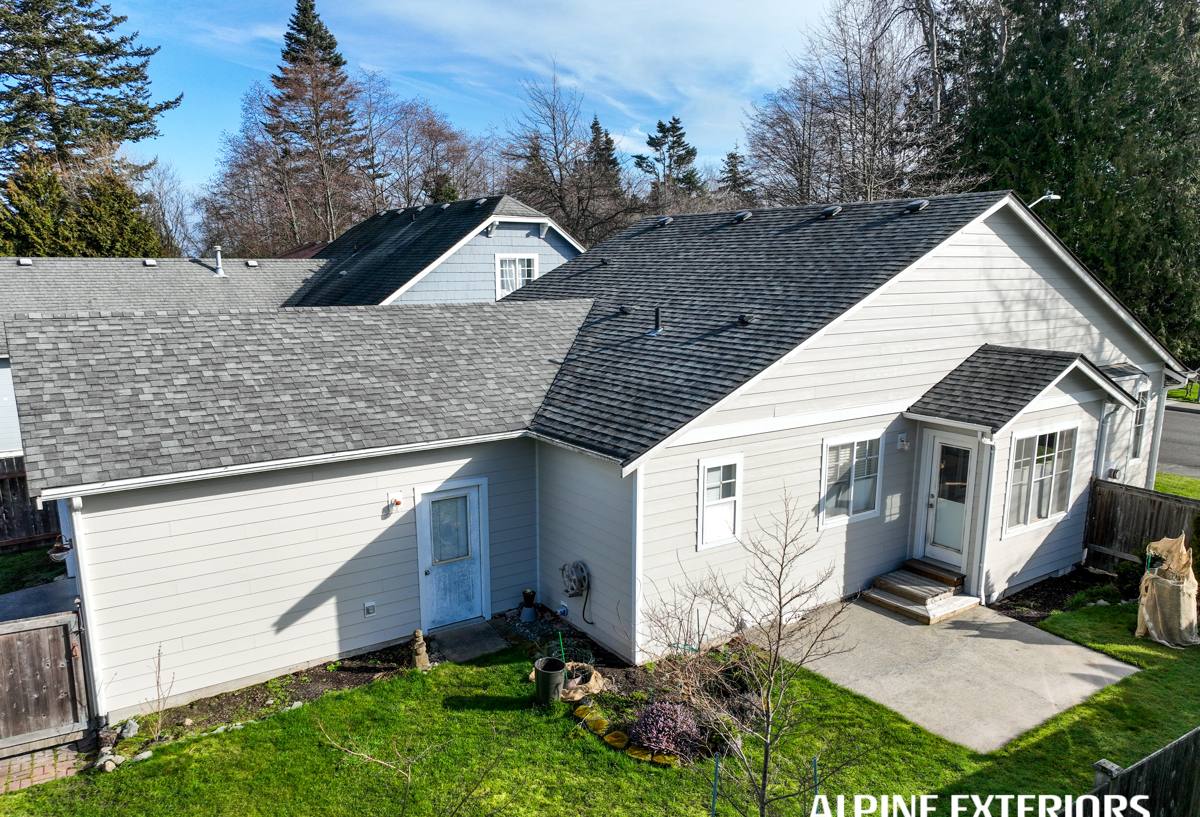
What Bellingham's Climate Actually Does to Siding
Salt Air and Moisture Off the Bay
Proximity to Bellingham Bay means airborne salt and moisture settle on exterior surfaces more consistently than they would further inland. Salt exposure accelerates corrosion on fasteners and trim, and it speeds up the breakdown of finishes that aren't engineered to resist it. Homes with a clear line to the water see this most, but the effect reaches well beyond the immediate waterfront.
Driving Rain and Wind-Driven Moisture
Storms rolling in off the Pacific don't just drop rain straight down — wind pushes it sideways into wall assemblies, especially on west- and south-facing elevations. Siding systems with weak seams, poor flashing details, or materials that absorb and hold water are the ones that fail first under this kind of sustained, angled exposure.
Moss, Shade, and Slow Drying
Whatcom County's tree cover and long, overcast stretches mean a lot of siding surfaces simply don't get much direct sun or airflow. Moss and algae take hold on surfaces that stay damp, and once established they hold moisture against the siding even longer, compounding the problem. Materials that are moisture-sensitive at their core — not just on the surface — are the ones that suffer real damage from this cycle, not just a cosmetic green tint.
Why We Only Install James Hardie
We get asked regularly why we don't offer vinyl, LP SmartSide, cedar, primed spruce, or fiber cement alternatives like Allura or Cemplank. The honest answer is that we made a call, based on years of installs and repairs across this region, that James Hardie fiber cement is the product that holds up best against exactly the conditions Bellingham throws at a house.
- Non-combustible core — fiber cement doesn't burn, which matters in a state that has seen more wildfire smoke and dry-season risk in recent years.
- Engineered for regional climate — Hardie's HZ10 product line is formulated for the specific moisture and temperature patterns of the Pacific Northwest, rather than a one-size-fits-all national spec.
- Factory-applied ColorPlus finish — baked-on color resists fading and chipping far better than field-applied paint, which matters when a house sits under wet, shaded conditions for months at a time.
- Dimensionally stable — fiber cement doesn't swell, warp, or cup the way wood-based products can when they take on repeated moisture cycles.
- Strong transferable warranty — backed by a manufacturer with decades of track record, which matters if you sell the home before the siding's functional life is up.
We're not going to tell you other products are junk — vinyl is inexpensive and easy to install, cedar has real aesthetic appeal, and LP SmartSide has improved over the years. But each of those comes with a trade-off that shows up specifically in a climate like ours: vinyl can warp and doesn't stand up structurally the way fiber cement does; wood-based products are inherently more moisture-sensitive at the core; and maintenance burdens on painted or stained products climb fast when a house barely dries out between storms. We'd rather install one product we trust completely than offer five and let homeowners gamble on which one survives here.
Our Siding Process for Bellingham Homes
Assessment
We start with a walk-around of the exterior, checking existing siding condition, trim and flashing details, and any moisture damage already in progress — particularly around windows, roof-to-wall intersections, and lower courses near grade, which are common trouble spots in wet climates.
Moisture Barrier and Flashing
Correct installation matters as much as the material itself. We pay close attention to weather-resistive barrier continuity, window and door flashing, and proper drainage planes so that any water that does get behind the cladding has somewhere to go instead of sitting against the wall sheathing.
Installation to Manufacturer Spec
James Hardie's warranty coverage depends on installation following their specifications — proper fastener spacing, clearances, and joint treatment. We install to that spec every time, not as an upsell but because it's the only way the product performs the way it's designed to.
Finish and Detail Work
Trim, corners, and transitions get the same attention as the field siding. These are the spots where moisture typically finds its way in, and they're often where a rushed installation shows up first.
Comparing Siding Options for a Bellingham Home
| Factor | James Hardie Fiber Cement | Vinyl | Wood / Engineered Wood |
|---|---|---|---|
| Moisture resistance | Engineered for wet climates, dimensionally stable | Doesn't absorb water but can warp and gap over time | Moisture-sensitive at the core; requires diligent maintenance |
| Salt air performance | Holds finish and structure well near the bay | Can fade and become brittle with UV and salt exposure | Finish breaks down faster; more frequent recoating needed |
| Moss/algae resistance | Surface treatable; core unaffected by surface growth | Surface growth possible; material itself unaffected | Sustained moss contact can degrade wood over time |
| Fire resistance | Non-combustible | Combustible | Combustible |
| Finish durability | Factory-baked ColorPlus, long fade resistance | Color molded in but can chalk/fade | Requires periodic painting or staining |
| Typical maintenance | Occasional wash; minimal repainting | Low, but repair options limited if damaged | Regular painting/staining and moisture monitoring |
Beyond Siding: Full Exterior Protection
Siding doesn't work in isolation — a house is a system. We also handle roofing, windows, and decks, because a failure in one area often shows up as damage in another. A roof leak at a wall intersection can rot siding from behind long before it's visible from the street. A failing window seal can push moisture into a wall cavity that otherwise has good siding on it. And decks, given constant exposure to Whatcom County's rain, need their own attention to drainage and material choice. When we look at a home, we look at the whole exterior envelope, not just the cladding.
Signs It's Time to Talk About Siding Replacement
- Visible warping, cupping, or gaps between siding boards
- Persistent moss or algae staining that returns quickly after cleaning
- Soft spots or spongy areas when pressed, especially near the bottom courses
- Peeling or bubbling paint that keeps recurring in the same spots
- Visible rot or discoloration around window and door trim
- Rising energy bills that may point to a compromised weather barrier
Why a Local Crew Matters
A crew that works Whatcom County regularly knows which elevations of a house take the worst of the driving rain, which neighborhoods see the heaviest moss growth, and how proximity to the bay changes what a siding system needs to handle. That's not knowledge you get from a national installation manual — it comes from doing this work, on these kinds of homes, in this specific climate, over and over. It also means we're accountable locally: if a warranty question or a detail needs a second look down the road, we're not a crew that came through once and moved on.
What to Expect From an Estimate
A siding estimate should be a real assessment, not a sales script. We look at your home's current siding condition, exposure (how much sun, shade, and wind-driven rain it actually gets), and any moisture issues already developing, then walk you through what James Hardie's product lines would look like on your specific house — including color options through the ColorPlus finish system and the trim details that make the biggest difference in a climate like ours.
If you're weighing a siding replacement, a repair, or just want an honest read on your home's current exterior condition, we're happy to take a look. Reach out for a free, no-pressure estimate — someone local will walk your property and give you a straight answer about what your Bellingham home actually needs.