 Whatcom County
 What Primed Wood Siding Actually Is
Primed wood siding is solid wood — usually cedar, pine, or spruce — that comes from the mill with a coat of primer already applied. The primer is meant to seal the wood and give the finish paint something stable to bond to before the boards go up. It's been a staple of Pacific Northwest construction for generations, and there's a reason: wood is a genuinely beautiful material, it's renewable, and a well-built cedar exterior has real curb appeal that some homeowners want specifically.
We get asked about it often enough in Whatcom County that we think it deserves an honest answer rather than a quick "we don't do that." So here's the full picture — what primed wood does well, where it struggles in this climate, and why our crews only install James Hardie fiber cement siding today.
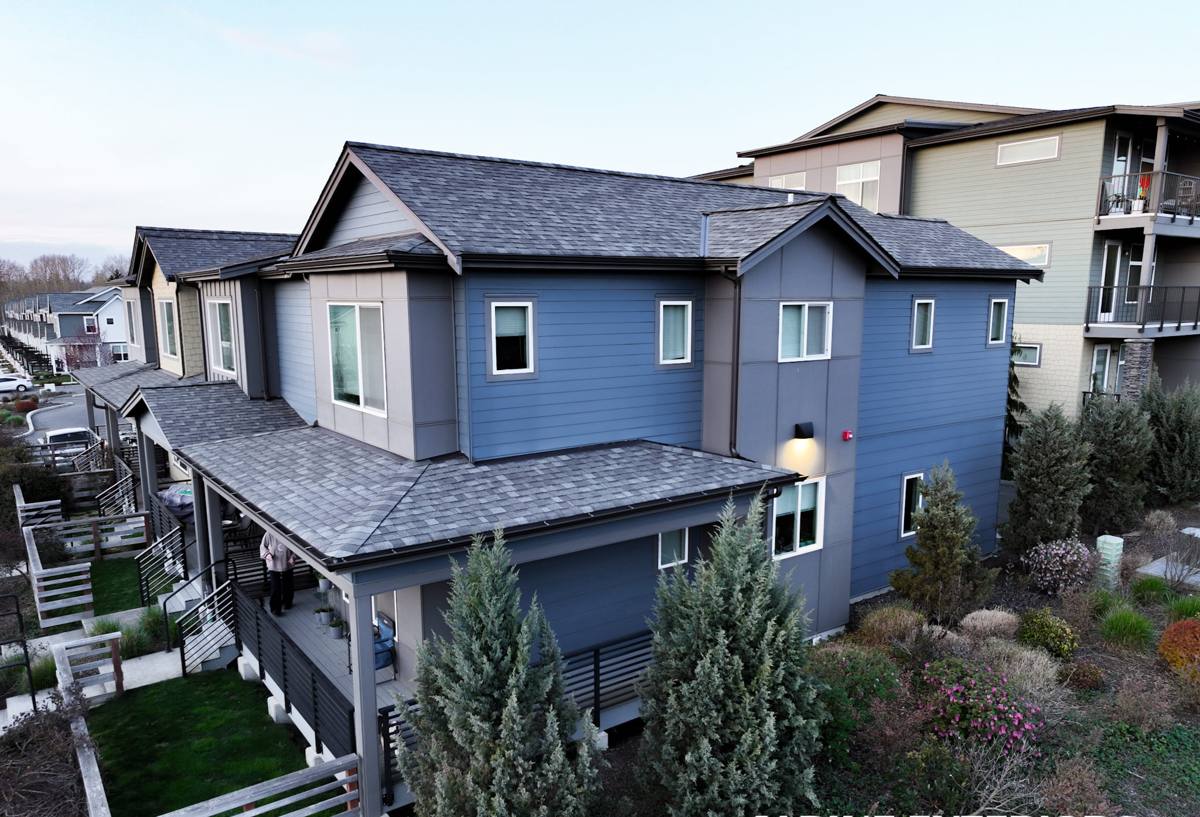
What Primed Wood Gets Right
Fair is fair. Primed wood siding has some real strengths:
- Natural grain and texture that some manufactured products still try to imitate
- Renewable material, and often locally sourced in the Pacific Northwest
- Easy to cut and shape on site with standard woodworking tools
- Long track record — there are century-old wood-sided homes still standing in this region
- Can be refinished in a new color relatively easily compared to some manufactured sidings
None of that is in dispute. The problem isn't what primed wood is — it's what it takes to keep it performing once it's on a house in a marine climate like ours, and what happens when that upkeep gets skipped, deferred, or done incorrectly.
Why Whatcom County's Climate Is Hard on Primed Wood
Whatcom County sits right up against the Salish Sea, with Bellingham Bay and the Strait of Georgia feeding salt-laden air inland on a regular basis. Add driving rain off the water, a long wet season that stretches from fall through spring, and a moss season that can run nearly year-round on north-facing and shaded walls, and you've got a climate that's about as tough on exterior wood as it gets in the continental U.S.
Primed wood siding depends entirely on an intact paint film to keep water out. The moment that film cracks, checks, or peels — and in this climate it will, on a predictable schedule — the wood underneath starts absorbing moisture. Salt air accelerates the breakdown of paint bonds. Driving rain finds every gap at butt joints, nail heads, and board edges. And moss doesn't just look bad; it holds moisture against the wood surface for weeks at a time, which is exactly the condition rot fungi need to get established.
None of this means primed wood siding is doomed on day one. It means it's a high-maintenance material in a climate that punishes any lapse in that maintenance, and most homeowners don't find that out until the first repaint cycle is already overdue.
The Maintenance Reality Homeowners Don't Always Hear Upfront
The repaint clock starts immediately
Primer is not a finish coat — it's a base layer with a limited service life on its own. Most manufacturers expect a full paint job within a defined window after installation, and after that, repainting on a recurring cycle for the life of the siding. In a wetter, saltier climate like ours, that cycle tends to run shorter than the general national guidance, not longer.
Caulking is not optional, and it fails first
Every seam, joint, and penetration on a wood-sided house depends on caulk to stay watertight. Caulk is the first thing to fail under UV exposure and constant wet-dry cycling, and it fails quietly — you often can't see a hairline caulk crack from the ground. By the time it's visible, water has usually already been getting behind the siding for a season or two.
Deferred maintenance compounds fast
Wood siding doesn't degrade at a steady, predictable rate. It's fine, fine, fine — and then a section that's held moisture for a while turns soft seemingly all at once. Once rot sets in, the fix generally isn't a patch; it's replacing the affected boards, which rarely match the surrounding siding's weathering exactly.
Moisture Behavior: Wood vs. Fiber Cement
| Factor | Primed Wood Siding | James Hardie Fiber Cement |
|---|---|---|
| Core material response to moisture | Absorbs water, can swell, rot, and support fungal growth | Cement-based core is not organic; won't rot or support rot |
| Finish coat | Site-applied or shop-primed; full paint job needed after install | Factory-applied ColorPlus finish, baked on, warrantied separately |
| Repaint cycle in this climate | Typically needed on a recurring multi-year cycle | ColorPlus finish is engineered for long intervals before repainting is needed |
| Combustibility | Combustible | Non-combustible fiber cement |
| Pest vulnerability | Vulnerable to carpenter ants and wood-boring insects | Not a food or nesting source for wood-destroying insects |
This isn't a knock on wood as a material in general — it's a straightforward comparison of how each product behaves once it's exposed, year after year, to a marine climate with salt air and sustained damp.
Installation Sensitivity: Where Small Mistakes Become Big Problems
Wood siding is far less forgiving of installation shortcuts than most homeowners assume. Back-priming (coating the hidden face of each board before installation, not just the visible face) is essential in a wet climate, but it's also the step most likely to get skipped because nobody sees it once the board is on the wall. Field-cut ends need to be sealed on site or they become a direct entry point for water into the end grain — the most absorbent part of any board. Fastener placement matters too; nails driven in the wrong spot can split boards or create points where water tracks inward instead of running off.
Every one of these is a real, fixable installation detail. But it means the long-term performance of a wood-sided home depends heavily on how carefully every single board was handled during installation — and on a large house, that's hundreds of individual judgment calls. We'd rather stand behind a product system where the manufacturer engineers out that level of variability than ask our crews (or the next homeowner) to catch every one of those details for the life of the siding.
What This Costs Over the Life of the Siding
The sticker price comparison between primed wood and fiber cement often favors wood at the point of installation. The number that matters more is the total cost across 20 or 30 years, once you factor in the recurring costs primed wood carries that Hardie's factory finish is designed to reduce:
- Full repaint labor and materials on a recurring cycle
- Recaulking of seams and joints as part of that same cycle
- Spot repair or board replacement for any sections that develop rot
- Moss and mildew treatment, particularly on shaded or north-facing walls
- Higher homeowners insurance consideration in some cases, given wood's combustibility
None of these costs are exotic or surprising — they're the normal cost of owning painted wood siding anywhere, and doubly so in a county that sits directly in the path of Pacific storm systems and salt-laden marine air.
Why We Standardized on James Hardie
We made a decision as a company to install one siding system — James Hardie fiber cement — rather than offer a menu of products with very different maintenance demands and asking homeowners to guess which one fits their situation. Hardie's HZ5 product line is engineered specifically for climates like Whatcom County's: wet, cool, and coastal. The fiber cement core doesn't rot, doesn't feed pests, and isn't a fuel source the way wood is. The ColorPlus factory finish is baked on under controlled conditions rather than applied on site or in the field, and it comes with its own dedicated finish warranty backing it, separate from the product warranty on the siding itself.
That combination — a stable, non-organic core plus a factory-controlled finish — is what lets us stand behind an installation with a strong transferable warranty and tell a homeowner honestly what to expect over the next few decades. We can't make that same promise with primed wood, not because the material is without merit, but because so much of its long-term performance depends on maintenance commitments and installation details that are genuinely hard to guarantee house to house, especially in a climate this demanding.
Questions to Ask Before Choosing Any Wood Siding Product
- What is the manufacturer's recommended repaint interval, and does that account for a marine climate?
- Is the product back-primed on all six sides before installation, not just the visible face?
- How will field-cut ends be sealed, and is that spelled out in the written scope of work?
- What does the manufacturer's warranty actually cover — and does it cover paint failure, or only material defects?
- Who is responsible for ongoing maintenance, and is there a written maintenance schedule?
- How does the product perform against moss and mildew on shaded, north-facing walls specifically?
If a contractor can't answer these clearly and specifically for your home's exposure, that's worth treating as a red flag regardless of which siding product is on the table.
Talk to Us About Your Home
We're not going to tell you wood siding has no place anywhere — it has a long history in this region for real reasons. What we can tell you is why our crews only install one product, and why that product is James Hardie. If you're weighing options for a Whatcom County home, we're happy to walk your specific exposure — sun, shade, wind direction, proximity to the water — and give you a straight answer about what will hold up. Reach out for a free, no-pressure estimate using the form below.