 Whatcom County
 One Product, No Exceptions
Homeowners sometimes ask why we don't carry a catalog of siding options the way a lot of contractors do. The honest answer is that we used to install more than one product, and we stopped. After years of tear-offs, warranty claims, and callbacks on other materials in Whatcom County's climate, we made a decision: James Hardie fiber cement is the only siding we put on a house. Not because it's the cheapest option or the easiest to install, but because it's the one product we've seen hold up, year after year, against what this corner of Washington throws at a house.
This page explains what James Hardie actually is, how it's engineered for a marine climate like ours, and why we think it's worth the investment over the alternatives.
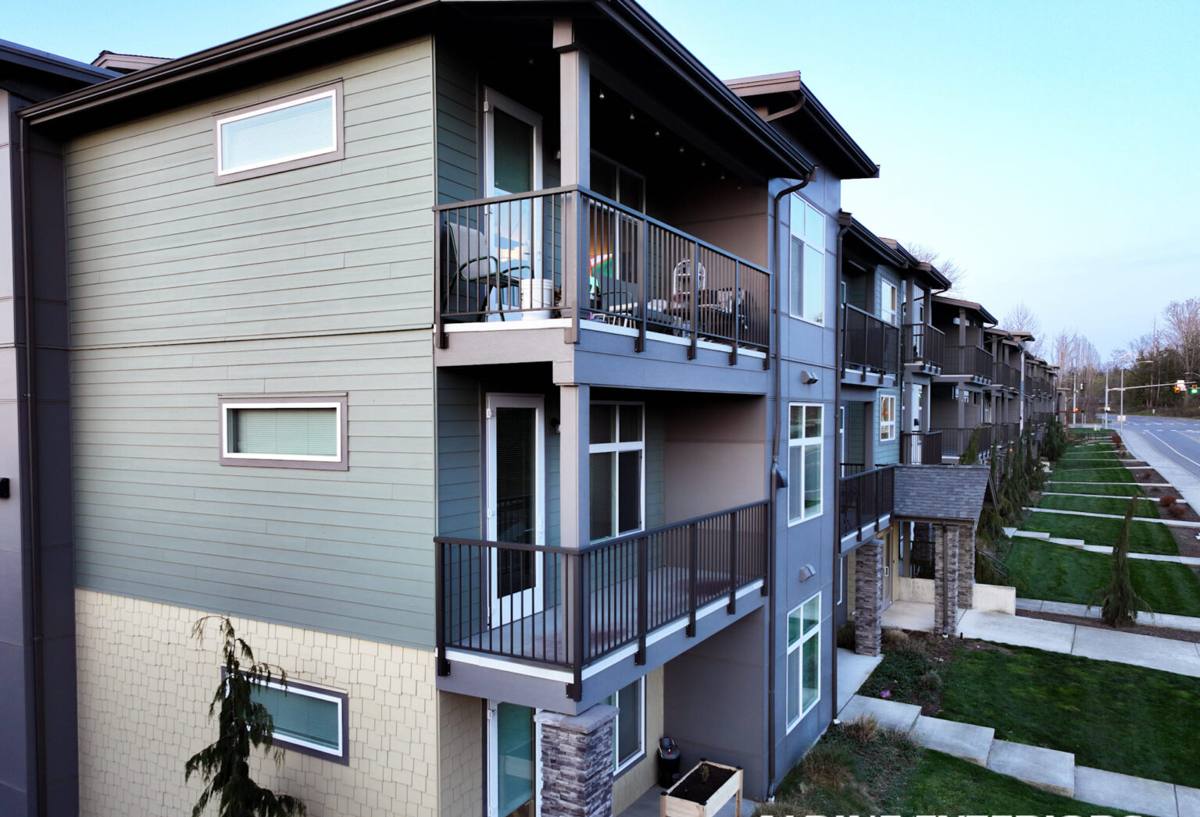
What Whatcom County Siding Is Up Against
Whatcom County sits right on the Salish Sea, with a long, wet shoulder season and a coastline that pushes salt-laden air inland on windy days. That combination is harder on exterior building materials than most homeowners realize.
Salt Air and Corrosion
Homes near Bellingham Bay, Birch Bay, or the Blaine waterfront take on airborne salt that accelerates corrosion of fasteners, trim, and any siding material with metal components or a coating that isn't built to resist it. Salt exposure also breaks down cheaper paint systems faster than inland weathering would.
Driving Rain
Our rain doesn't just fall straight down — winter storms off the water push rain sideways into wall assemblies, testing every seam, joint, and piece of flashing on a house. A siding product that isn't dimensionally stable, or that swells and shrinks with moisture, opens gaps that driving rain will find.
Moss and Sustained Dampness
Whatcom County's moss season runs long — shaded north walls and tree-covered lots stay damp for months at a stretch. Any siding material that absorbs moisture or provides organic material for spores to take hold on will grow moss and algae faster here than almost anywhere else in the country.
Why Fiber Cement Holds Up Where Other Materials Don't
James Hardie siding is fiber cement: a mix of Portland cement, sand, and cellulose fiber, cured into a rigid board. It doesn't swell with moisture, it doesn't rot, and it's non-combustible. Those three properties directly answer the three regional problems above — it resists the moisture cycling that drives moss and rot, it stays dimensionally stable so seams stay tight against driving rain, and it has no organic content for salt-air corrosion to work on the way it does with some metal and coated products.
Fiber cement isn't a new invention, but James Hardie is the manufacturer that has put the most engineering into matching the product to specific climate zones, which is the part that matters most for a house in Whatcom County.
Engineered for This Climate: The HZ5 System
James Hardie makes climate-specific versions of its siding, called HZ (Hardie Zone) products. Western Washington, including all of Whatcom County, falls into the HZ5 zone — engineered for regions with sustained damp, cool conditions and freeze-thaw cycling. HZ5 products are formulated to resist moisture absorption and cracking under exactly the conditions we get nine months out of the year: cool temperatures, high humidity, and long stretches of rain rather than short, hot downpours.
This matters because a fiber cement product engineered for a hot, dry climate zone doesn't perform the same way here. Installing the wrong zone product is one of the most common corners cut by contractors who don't specialize in this region — it's not obvious to a homeowner at installation, but it shows up years later in how the siding ages.
The ColorPlus Finish: Why the Paint Job Matters as Much as the Board
A siding board is only half the system. The other half is the finish, and this is where a lot of the long-term performance difference actually comes from. James Hardie's ColorPlus Technology is a factory-applied finish, baked on and cured under controlled conditions, rather than field-painted on a ladder in whatever weather the crew gets that week.
- Factory-cured finish adheres more evenly than a field-applied coat, with fewer thin spots or missed edges
- Color consistency across every board on the house, since it isn't mixed and applied on-site batch by batch
- Better fade and chip resistance than typical field-applied paint, which matters under UV exposure even in a cloudy climate
- Touch-up products matched to the factory finish, so repairs blend rather than standing out
Field-painted siding — whether that's primed fiber cement, primed spruce, or cedar — depends entirely on the quality of that one paint job and how well it's maintained afterward. In a climate with this much sustained moisture, a field finish is the first thing to fail, long before the board underneath.
The Product Lines We Install
James Hardie makes several distinct product lines, and matching the right one to the house matters as much as the brand decision itself.
| Product | What It's For | Where It Fits |
|---|---|---|
| HardiePlank Lap Siding | Traditional horizontal lap siding, the most common Hardie product | Standard on most homes; several plank profiles and textures available |
| HardieShingle | Staggered or straight-edge shingle panels | Craftsman and cottage-style homes, accent gables |
| HardiePanel | Vertical fiber cement panels | Modern facades, accent walls, board-and-batten looks |
| HardieTrim | Fiber cement trim boards | Corners, window and door surrounds, fascia — matched material, not wood |
| HardieSoffit | Vented and non-vented panels | Eaves and overhangs, resists the same moisture issues as the walls |
Using HardieTrim alongside the siding, rather than mixing in painted wood trim, matters more than it might seem — wood trim is often the first thing to fail on an otherwise sound fiber cement job, because it's still an organic material sitting in the same wet conditions.
Why We Won't Install the Alternatives
We get asked about LP SmartSide, vinyl, cedar, and primed spruce fairly often, usually because a homeowner has seen a lower quote for one of them. Each of those products has legitimate uses somewhere, but here's our honest read on why we don't put them on Whatcom County homes:
Wood-Based Composites (LP SmartSide, Cemplank, Allura)
These are engineered wood or alternate fiber cement products, and quality varies by manufacturer and installation crew. Wood-strand composites in particular are more sensitive to cut-edge sealing and moisture intrusion at seams — miss one detail during installation in a climate this wet, and it's a slow, hidden problem rather than an obvious one.
Vinyl Siding
Vinyl is inexpensive and low-maintenance in dry climates, but it expands and contracts significantly with temperature swings, which stresses seams over time, and it doesn't hold up as well against the impact and wind-driven rain events we get off the water. It also isn't a good match stylistically for a lot of Whatcom County's architecture.
Cedar and Primed Spruce
Real wood siding looks great and has a long tradition here, but it's an organic material in a climate built to rot organic materials. Maintenance is constant — recoating, caulking, watching for moss and woodpecker damage — and skipping a maintenance cycle even once can let rot get a foothold that's expensive to fix.
We're not saying these products are junk. We're saying that after weighing installation sensitivity, long-term maintenance, and how each one actually performs against salt air, driving rain, and moss over ten-plus years, Hardie is the one we're willing to put our name behind.
The Warranty Difference
James Hardie backs its siding with a manufacturer's limited warranty, and it's transferable to a new owner if the house sells — something worth mentioning to anyone planning to sell within the warranty period. The ColorPlus finish carries its own separate finish warranty, covering the factory coating specifically, which is a meaningful distinction from a field-applied paint job that has no warranty backing at all once the contractor's own workmanship warranty expires.
A warranty is only as good as the installation behind it, though — Hardie's warranty terms require installation according to their published specifications, which is one more reason installation quality isn't optional.
Installation Is Where Jobs Succeed or Fail
Fiber cement siding is not forgiving of shortcuts. Correct installation in a climate like ours means:
- Proper starter strips and clearance from grade, decks, and roof lines to keep siding out of standing water
- Correct fastener type and placement — over-driven or under-driven nails compromise the board's performance
- Rain screen or drainage plane detailing appropriate to the wall assembly, not just direct-to-sheathing installation
- Proper flashing and sealant at every penetration — windows, doors, hose bibs, light fixtures
- Manufacturer-specified gaps and caulking at butt joints and trim intersections
- Cut-edge sealing on every field cut before the board goes up
Every one of these details is invisible once the job is finished and the paint is on. A homeowner can't tell, looking at a finished wall, whether the crew followed spec or not — the difference shows up five, ten, or fifteen years later.
What This Costs, and Why
James Hardie siding costs more up front than vinyl and is generally comparable to or somewhat above wood-composite products, depending on the product line and trim package chosen. The way we'd frame it: you're paying for the board, the factory finish, and correct installation labor — and in exchange you're not paying for repainting cycles, caulking maintenance, or an early tear-off. Over the ownership life of a house in this climate, that trade-off has consistently favored fiber cement in what we've seen.
Every house is different — square footage, trim complexity, existing wall condition, and product line all move the number, so we'd rather walk your specific house than quote a range that doesn't mean much out of context.
If you're weighing a siding replacement and want a straight answer about what your house needs, we're happy to take a look. A free, no-pressure estimate gets you a real assessment of your walls and a clear explanation of what correct James Hardie installation would involve — no obligation either way. The form below will get that started.