 Whatcom County
 Siding in Cordata: A Neighborhood Built on Marine Climate
Cordata sits on the north end of Bellingham, close enough to Bellingham Bay that salt-laden air is a regular part of the weather cycle, and far enough inland to still catch the wind and rain that roll off the Salish Sea and Cascade foothills. That combination is tough on the outside of a house. Homes here deal with a longer wet season than most of the country, shaded lots that hold moisture, and enough tree cover in and around the neighborhood that moss and algae growth is less a possibility and more a certainty if the siding material and installation aren't up to it.
We install and repair siding, roofing, windows, and decks for homeowners throughout Whatcom County, and Cordata is one of the areas where we see the clearest evidence of what the wrong exterior material does over ten or fifteen years. This page is about what that climate does to a house, and how we approach a siding project so it actually holds up.
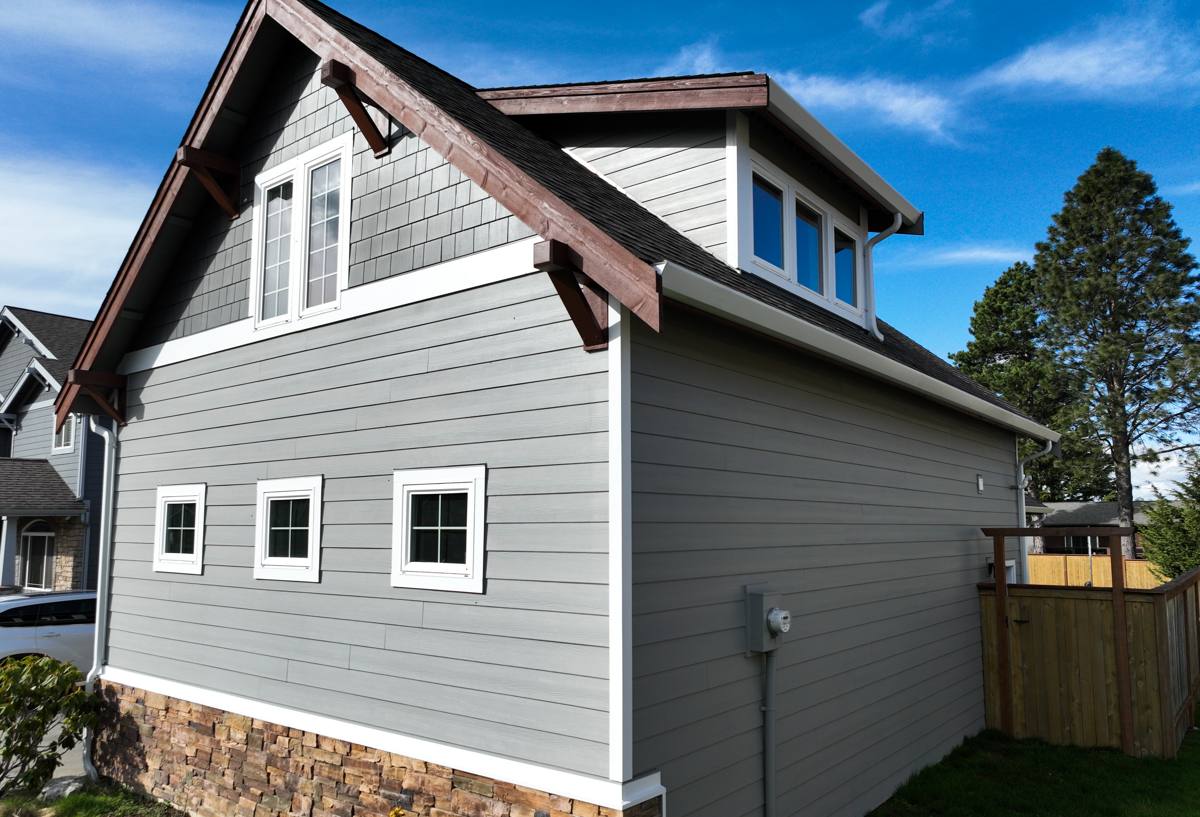
What the Local Climate Does to Exterior Materials
Salt Air
Proximity to Bellingham Bay means airborne salt is part of the environment, even a few miles inland. Salt accelerates corrosion on fasteners, flashing, and any metal trim, and it degrades paint and coatings faster than a drier inland climate would. Materials and finishes that aren't rated for a marine-influenced environment tend to chalk, fade, or corrode ahead of schedule.
Driving Rain
Whatcom County doesn't just get a lot of rain — it gets a lot of wind-driven rain, which pushes moisture sideways into laps, seams, and butt joints that a calmer climate would never stress. Any weak point in the water-management plane behind the siding — a bad seam, a missing flashing detail, caulk used where flashing should have been — becomes a slow leak instead of a minor imperfection.
Moss and Algae Season
Shade, moisture, and mild temperatures are exactly what moss and algae need, and Cordata has all three for a good part of the year. On porous or textured surfaces, growth takes hold in seams and low-sun areas and holds moisture against the substrate long after the rest of the exterior has dried out. Over years, that constant damp cycle is what actually breaks materials down — not one big storm, but thousands of days of the surface never fully drying.
Why We Only Install James Hardie Fiber Cement
We made a deliberate decision as a company to install one siding system: James Hardie fiber cement. We don't install vinyl, LP SmartSide, Cemplank, Allura, primed spruce, or cedar, even though all of those products have a place in the market and reasonable people choose them. Our reasoning comes down to how each of those materials performs specifically in a wet, salt-influenced, moss-prone climate like ours — not a blanket claim that they're bad products everywhere.
- Wood-based siding (cedar, primed spruce, engineered wood like LP SmartSide) relies on an intact factory coating and diligent long-term maintenance to keep moisture out. In a climate this wet, any gap in that maintenance schedule shows up as swelling, delamination, or rot faster than it would in a drier region.
- Vinyl siding is low-maintenance and inexpensive, but it's a thin, flexible material that can warp in temperature swings and doesn't offer the same fire resistance or dent resistance as fiber cement — and it's not something we can guarantee will hold a factory finish the way ColorPlus-coated Hardie does.
- Fiber cement products from other manufacturers exist, but James Hardie is the one we've found offers the strongest combination of climate-specific engineering, factory finish warranty, and consistent supply and support in this region.
James Hardie fiber cement is non-combustible, dimensionally stable in wet-dry cycles, and available with a factory-applied ColorPlus finish that's baked on rather than site-painted, which matters a great deal when the finish has to survive salt air and constant moisture cycling rather than a mild dry climate.
James Hardie Product Lines and Where They Fit
Hardie makes several siding profiles, and the right one for a given Cordata home depends on the style of the house, the exposure of each wall, and the homeowner's preference for a traditional lap look versus a shingle or panel look.
| Product | Look | Where it works well |
|---|---|---|
| HardiePlank lap siding | Traditional horizontal lap | Most home styles; the most common choice for full re-sides |
| HardieShingle | Staggered or straight-edge shingle | Craftsman and cottage-style homes, accent gables |
| HardiePanel | Vertical panel with battens | Modern builds, garages, accent walls |
| HardieTrim | Smooth or textured trim boards | Corners, window and door casing, fascia |
All of these are manufactured to Hardie's HZ5 climate specification, which is the version engineered for regions like ours with sustained moisture exposure, rather than the HZ10 formulation built for hot, dry climates. That distinction matters more than most homeowners realize — a siding product engineered for the wrong climate zone will underperform no matter how well it's installed.
What Correct Installation Looks Like Here
Fiber cement siding is only as good as the installation behind it, and in a climate that pushes rain sideways into every seam, the details behind the boards matter as much as the boards themselves. Before we button up a wall, we're checking for the same things every time:
- A properly lapped weather-resistive barrier (house wrap) with no gaps or reverse laps that could funnel water inward
- Correct flashing at every window, door, and roof-to-wall intersection — not caulk used as a substitute for flashing
- Manufacturer-specified fastener type and placement to avoid blow-outs and to keep warranty coverage intact
- Proper gapping and clearance at butt joints, inside corners, and ground contact points so the assembly can handle expansion and drainage
- Rainscreen or drainage gap detailing on walls with heavy exposure, so any moisture that does get behind the cladding has somewhere to go
- Factory-finished cut edges sealed per Hardie's specification, not left exposed to soak up moisture
Skipping any one of these doesn't usually cause an obvious problem in year one. It shows up in year five or ten, as a soft spot, a stain, or a section that's holding moss no matter how often it's cleaned.
Signs Your Current Siding Is Past Its Useful Life
Homeowners in Cordata usually call us for one of a handful of reasons, and most of them trace back to the climate factors above:
| Sign | What it usually means |
|---|---|
| Persistent moss or algae that returns quickly after cleaning | Surface is porous or holding moisture against the substrate |
| Soft or spongy boards, especially near the bottom courses | Moisture intrusion, often from missing flashing or ground contact |
| Peeling or chalky paint on wood-based siding | Coating failure from prolonged wet-dry cycling |
| Visible fastener corrosion or staining streaks below nail heads | Salt-accelerated corrosion on incompatible fasteners |
| Warping or bowing panels | Material not dimensionally stable in this moisture range |
Roofing, Windows, and Decks: Treating the Whole Exterior
Siding doesn't work in isolation. A leaking roof edge, a failed window flashing, or a deck ledger board that's trapping moisture against the house will undermine even a well-installed siding job. Because we also handle roofing, windows, and decks, we look at a Cordata home's exterior as one connected water-management system rather than a siding job with blinders on. That's especially relevant on older homes in the area, where roofing and window details installed decades ago may not meet current flashing standards, and on newer builds where a single missed detail during original construction can become the point where trouble starts.
Why a Local Crew Matters
A crew that works Whatcom County year-round knows the difference between a detail that's fine in a dry climate and one that will fail here within a few winters. We know how much drainage gap to leave on a shaded, moss-prone wall versus a sun-exposed one, which fastener specs actually hold up against salt air, and how the wet season here compares to a dry-climate installation manual written with a different region in mind. That local knowledge is part of what separates a siding job that looks good on install day from one that still looks good in ten years.
Maintenance and What to Expect Long-Term
James Hardie siding, installed correctly, is genuinely low-maintenance compared to wood, but "low-maintenance" doesn't mean "no maintenance," especially here. Periodic rinsing to keep moss and organic growth from taking hold, prompt caulk touch-ups where movement has opened a seam, and keeping gutters and downspouts clear so water isn't dumping directly onto a wall all go a long way. The ColorPlus factory finish is backed by its own warranty separate from the substrate warranty, and both are transferable, which matters if you sell the home before the coverage period ends.
If your Cordata home's siding is showing its age, or you're planning ahead of a sale or a full exterior update, we're happy to take a look and walk through what we're seeing — no pressure, no obligation. Reach out for a free estimate using the form below.