 Whatcom County
 Siding in Sunnyland: A Neighborhood That's Hard on Exteriors
Sunnyland is one of Bellingham's older, established neighborhoods, and like most of Whatcom County, it sits in a climate that never really gives exterior surfaces a break. There's no dry season to speak of — just a wetter half of the year and a slightly less wet half. Add in the proximity to Bellingham Bay, the tree cover that keeps yards shaded and damp, and the long stretch of gray months where surfaces rarely get a chance to fully dry out, and you have a recipe for siding that ages faster than it should if it wasn't built for the job in the first place.
We work on homes throughout Sunnyland and the surrounding Bellingham area, and the pattern we see is consistent: houses with the wrong siding material, or siding installed without the right details for this climate, start showing problems years before they should. Houses with the right system, installed correctly, hold their look and keep water out for decades. The difference isn't luck — it's material choice and installation quality.
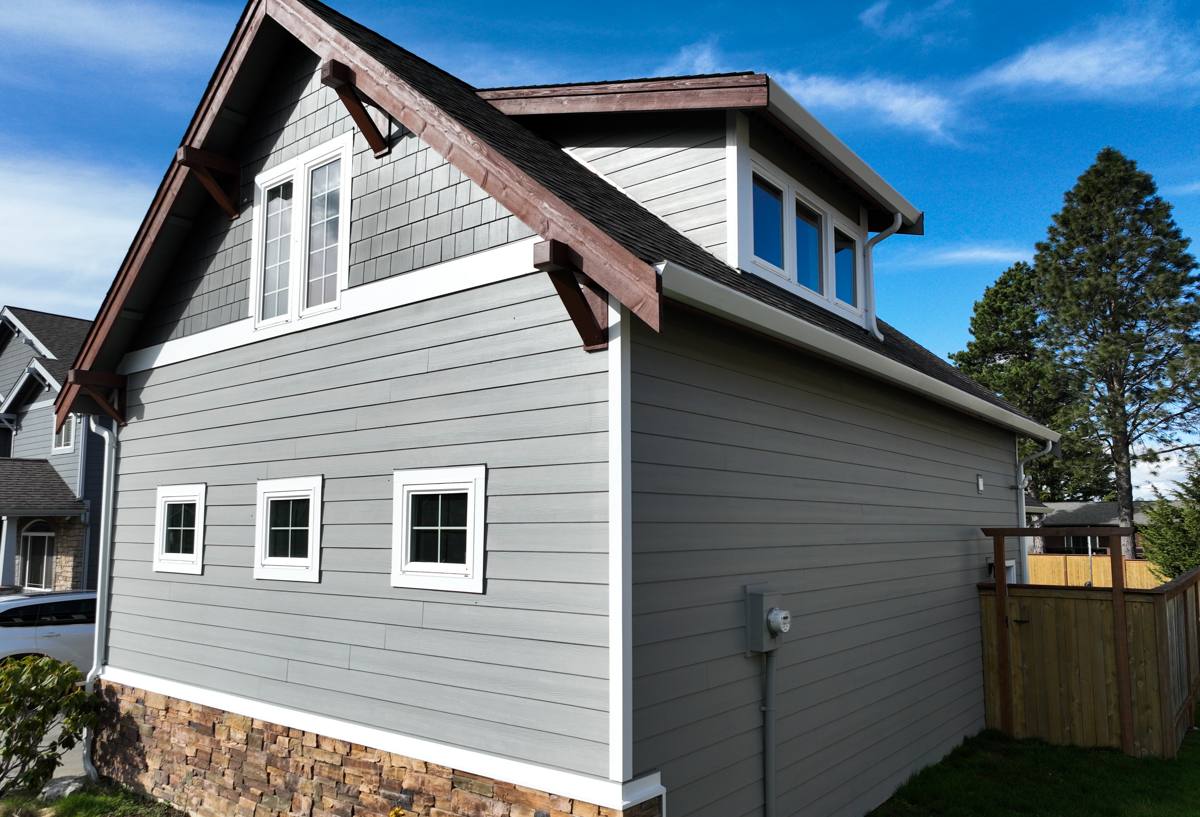
What Salt Air, Driving Rain, and Moss Season Actually Do to Siding
Homeowners in this part of Whatcom County deal with three climate stressors that, together, are tougher on a house than any one of them alone:
- Salt-influenced air off Bellingham Bay accelerates corrosion on fasteners, flashing, and any metal trim that isn't properly rated or protected, and it can speed up the breakdown of lower-grade paints and coatings.
- Driving, wind-pushed rain doesn't just wet the surface of a wall — it gets pushed sideways and upward under laps, around trim, and into any gap in the water-resistive barrier. A siding system that relies on caulk and hope instead of proper flashing and drainage detailing will eventually let water in.
- A long moss and algae season comes from the combination of shade, moisture, and mild temperatures that never really dry things out. North-facing walls, areas under overhangs, and anything near mature trees are especially prone to green and black staining, and porous or absorbent siding materials hold onto that moisture longer, which feeds the growth cycle.
None of this is unique to Sunnyland — it's the reality of exterior work anywhere in Whatcom County — but Sunnyland's tree canopy and closeness to the bay put it on the tougher end of that spectrum.
Why We Install James Hardie Fiber Cement — and Nothing Else
We made a decision as a company to install only James Hardie fiber cement siding. We don't install vinyl, LP SmartSide, Cemplank, Allura, primed spruce, or cedar. That's not a marketing angle — it's a standard we hold because of what we've seen happen to these other materials in exactly the climate conditions Sunnyland deals with every year.
Wood and wood-based products (cedar, primed spruce, LP SmartSide)
Real cedar and primed wood siding can look excellent when new, and some homeowners love the appearance enough to accept the tradeoffs. But wood-based siding is organic material in a climate that stays damp for months at a time. It requires more frequent repainting or resealing, it's more vulnerable to rot at cut ends and fastener penetrations, and moss and mildew take hold on it readily. Engineered wood products like LP SmartSide have improved moisture resistance over raw wood, but they're still wood-strand composites with treated surfaces — if that surface is compromised by a nick, a poor cut, or a failed caulk joint, the underlying material can absorb water and swell or deteriorate at the damaged spot.
Vinyl siding
Vinyl is inexpensive and low-maintenance in the sense that it doesn't need painting, but it's a thin plastic product that expands and contracts significantly with temperature swings, can crack in impacts, and tends to fade and chalk over time in UV exposure. It also isn't a great fit stylistically for a lot of the older, character-driven homes in a neighborhood like Sunnyland, and it doesn't offer the same fire-resistance profile as fiber cement.
Cemplank and Allura
These are other fiber cement manufacturers, and fiber cement as a category is the right general direction — non-combustible, dimensionally stable, resistant to moisture-driven rot. Where we draw the line is the factory finish, product engineering, and warranty backing. We standardized on James Hardie specifically because of its ColorPlus factory-applied finish, its HZ5 climate-engineered product line built for the Pacific Northwest's moisture profile, and a warranty structure we're comfortable standing behind.
The James Hardie System We Install
HZ5 — engineered for this climate zone
James Hardie makes different product formulations for different climate zones across the country, and the HZ5 line is engineered for regions like ours — places with high moisture exposure, freeze-thaw cycling, and extended damp periods. It's built to resist moisture damage and hold its dimensional stability through the kind of weather Whatcom County sees most of the year.
ColorPlus factory finish
Rather than field-painting siding after installation — which is where a lot of moisture and coating failures start, at inconsistent coverage or poor cure conditions — Hardie's ColorPlus finish is baked on at the factory under controlled conditions, with a finish designed to resist fading and hold color far longer than a typical field-applied paint job. That matters in a climate where a house rarely gets a long, dry stretch to properly cure fresh paint.
Non-combustible material
Fiber cement is made from cement, sand, and cellulose fiber — it doesn't burn. That's a meaningful difference from wood-based siding products, and increasingly a factor insurers and homeowners both care about.
Transferable warranty
James Hardie backs its siding with a strong limited warranty that's transferable to a new owner if you sell the home — a detail that matters for resale in a market where buyers are increasingly asking what siding is on a house before they make an offer.
Beyond Siding: Roofing, Windows, and Decks
Siding doesn't work in isolation — it's one piece of the building envelope, and the same climate stressors that wear down siding go after your roof, windows, and any exterior wood structures like a deck. We handle all four because they're connected:
- Roofing — the first line of defense against driving rain and the source of most water intrusion when flashing or underlayment fails.
- Windows — window flashing and the siding-to-window transition is one of the most common failure points on any house; getting it right requires coordinating both trades.
- Decks — exposed wood or composite decking in this climate deals with the same moss, moisture, and mildew issues as siding, just horizontally instead of vertically.
Having one crew that understands how these systems interact — instead of separate contractors who only think about their own scope — reduces the chances that a gap between trades turns into a leak.
Signs Your Sunnyland Home May Need Exterior Attention
A lot of siding and exterior problems in this area develop slowly, which means homeowners often don't notice until there's visible damage. Some things worth checking:
- Persistent green, black, or dark staining on north- or shade-facing walls, especially near trees
- Soft or spongy spots when you press on siding, particularly near the bottom of walls or around windows
- Visible cracking, warping, or separation at seams and corners
- Peeling or bubbling paint that keeps coming back in the same spots
- Gaps or deteriorating caulk around windows, doors, and trim
- Musty smells or moisture signs on interior walls that share a wall line with problem exterior areas
- Visible moss buildup on the roof, which usually means moss is affecting the siding too
Any one of these is worth a look. Several together usually mean it's time for a real assessment rather than a spot repair.
What Installation Involves — and Why Quality Control Matters
Fiber cement siding performs the way it's supposed to only when it's installed to manufacturer specification. That includes correct fastener placement and spacing, proper clearance from grade and roof lines, correctly lapped and sealed water-resistive barrier and flashing behind the siding, and factory-recommended gaps and caulking at joints and penetrations. Skipping or rushing any of these steps is how even a good product ends up with moisture problems.
| Installation Factor | Why It Matters in This Climate |
|---|---|
| Weather-resistive barrier & flashing detail | Prevents wind-driven rain from getting behind the siding at laps, corners, and penetrations |
| Proper clearance from grade, decks, and roofs | Reduces splash-back moisture and standing water contact at the bottom edge |
| Correct fastener type and spacing | Salt-influenced air accelerates corrosion on the wrong fastener grade |
| Factory-recommended joint gaps and sealant | Allows for expansion/contraction without cracking or trapping moisture |
| ColorPlus touch-up practices | Keeps the factory finish's UV and moisture resistance intact at cut edges |
Cost Factors for a Sunnyland Siding Project
Every home is different, and we don't give real numbers without seeing the house, but the main variables that drive cost on a siding project in this area are fairly consistent:
| Factor | Impact on Cost |
|---|---|
| Home size and wall complexity | More square footage and more corners, gables, and trim details mean more labor and material |
| Extent of existing damage | Rot repair or sheathing replacement found once old siding comes off adds to scope |
| Siding profile and trim selection | Lap width, shingle-style panels, and trim board details vary in material cost |
| Access and site conditions | Trees, tight lot lines, and multi-story sections affect labor time and equipment needs |
| Whether roofing, windows, or decking are bundled in | Combining trades can reduce redundant setup and staging costs |
Why a Local Crew Matters for a House Like This
A contractor who works throughout Whatcom County day in and day out knows what this climate does to a house, because we see the results year-round — not just on a sales call, but on repair calls for houses where the wrong material or a rushed install let water in. That familiarity shows up in the details: how flashing gets lapped, how much clearance gets left at grade, which areas of a Sunnyland-style lot are going to need extra moss and moisture consideration because of shade and tree cover. It also means we're accountable locally — the warranty and the relationship don't end when the crew leaves for the next state.
What to Expect After Installation
James Hardie siding with a factory ColorPlus finish is genuinely low-maintenance compared to painted wood siding, but "low-maintenance" doesn't mean "no maintenance" in a climate like this. Periodic rinsing to keep moss and grime from building up, prompt attention to any caulk or trim wear, and keeping vegetation trimmed back from walls all go a long way toward getting the full lifespan out of the system. We're happy to walk through what a reasonable maintenance routine looks like for your specific home and its exposure.
If you're noticing wear on your current siding, dealing with moss or moisture issues, or just planning ahead for a home in Sunnyland or elsewhere in Whatcom County, we're glad to come take a look. There's no pressure and no cost to get an honest assessment and a straightforward estimate — just fill out the form below and we'll get in touch.