 Whatcom County
 If you've priced out a siding job in Bellingham, Ferndale, or anywhere else in Whatcom County, you've probably heard two names come up: James Hardie and Cemplank. Both are fiber cement siding. Both look similar on a spec sheet. And if you ask five different contractors which one they install, you might get five different answers based on whatever gives them the best margin that month.
We're not going to pretend Cemplank is a bad product wrapped in a bad reputation. It isn't. It's a legitimate fiber cement siding manufactured by Saint-Gobain, and plenty of homes around the country wear it just fine. But we made a decision years ago to install only James Hardie, and homeowners deserve to know why — especially here, where salt air off Bellingham Bay, driving rain off the Strait, and a moss season that runs most of the year put more stress on a wall assembly than a lot of other parts of the country ever see.
What Cemplank Actually Is
Cemplank is fiber cement siding — a mix of Portland cement, sand, and cellulose fibers, pressed and cured into planks, panels, and trim. That's the same basic recipe James Hardie uses, and fiber cement as a category is a good one: it doesn't burn, it doesn't rot, and it holds paint far better than wood. If you're comparing fiber cement to vinyl or primed wood, fiber cement wins that argument every time, regardless of brand.
Cemplank is sold through building supply channels rather than a dedicated contractor network, and it's often priced a bit below Hardie for a similar plank profile. For a lot of markets, that combination — real fiber cement at a lower price point — is an easy sell. We get why contractors reach for it.
Where It Holds Up
- Non-combustible core, same as any fiber cement product
- Resists rot and insect damage better than wood or engineered wood siding
- Accepts paint and holds a finish longer than cedar or spruce
- Available in lap, panel, and some trim profiles
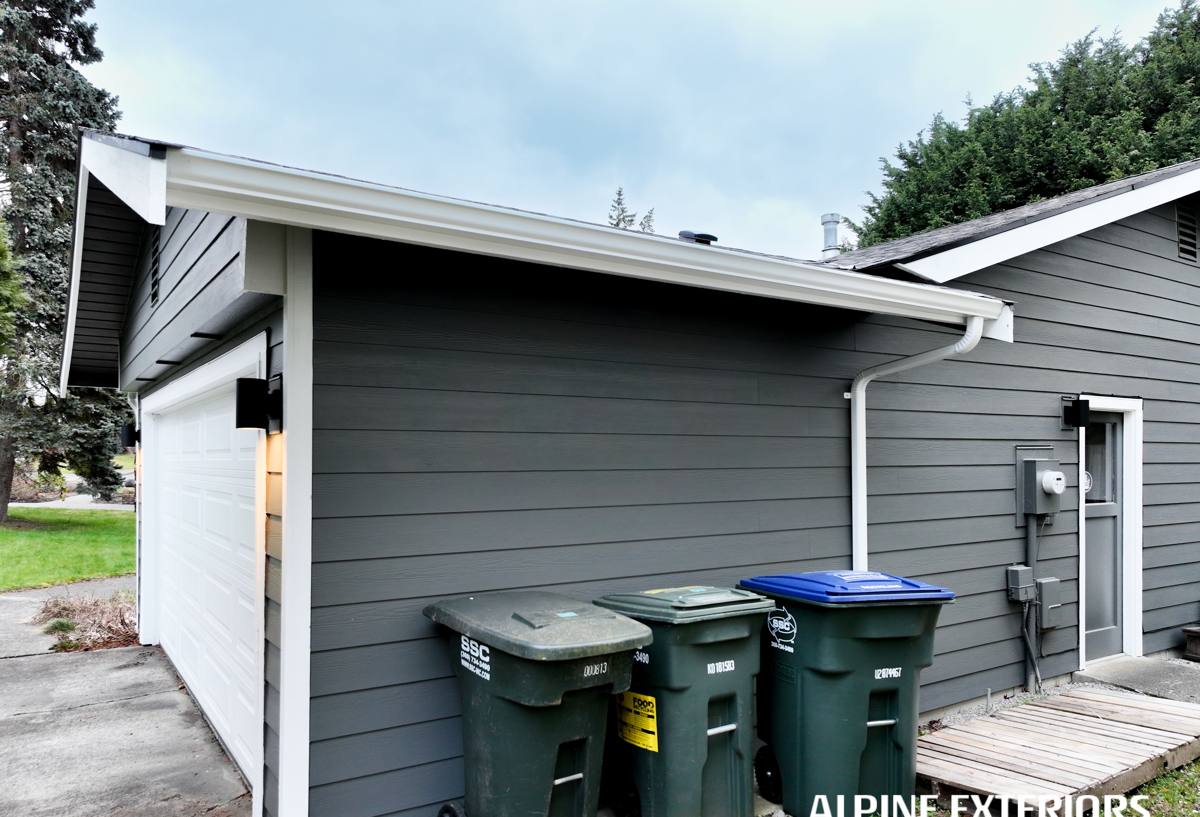
Where Our Standard Draws the Line
Our concerns with Cemplank aren't about whether it's "real" fiber cement — it is. They're about manufacturing consistency, finish system, regional engineering, and what happens when a warranty claim actually needs to get resolved on a house we installed.
Factory Finish vs. Field Paint
This is the biggest one. James Hardie's ColorPlus siding is finished at the factory with a baked-on, multi-coat finish that's engineered specifically for their substrate, with a matching caulk and touch-up system built around it. Cemplank is more commonly sold primed, meaning the finish coat gets applied on site or shortly after installation — by a painter, not a factory finish line calibrated to the plank.
In a dry climate, that gap matters less. In Whatcom County, where a new install can sit through weeks of drizzle before a paint crew gets a dry window, and where the finished wall then faces a long wet season every single year, a field-applied finish is a weaker link than a factory-cured one. Paint failure on siding almost never shows up as the plank failing — it shows up as the finish failing first, which then exposes the substrate underneath to the moisture cycle it wasn't designed to face bare.
Regional Engineering
James Hardie manufactures different formulations for different climate zones in the U.S. — a version engineered for freeze-thaw and moisture-heavy regions like the Pacific Northwest, and a different version for hot, dry climates. That's not a marketing detail; it changes how the board is formulated to handle moisture cycling. Cemplank does not offer that same climate-zoned product engineering. One board, one formulation, sold everywhere. For a county that gets driving rain off the Strait of Georgia most of the year and a moss season that barely lets up, we don't think a one-size-fits-all fiber cement board is the right call.
Warranty Structure
Both companies offer warranties, but they're not built the same way. Hardie's warranty on ColorPlus product includes the factory finish as part of the coverage, and Hardie has a long, established track record of standing behind claims through a broad, active installer network — which matters when you need someone local who's still around in fifteen years to help walk a claim through. Cemplank's warranty covers the substrate, but with a field-applied finish, the paint itself is typically a separate warranty from whoever applied it — which means a siding problem and a paint problem can turn into two different companies pointing at each other instead of one clear path to a fix.
Side-by-Side: What the Sheet Doesn't Tell You
| Factor | Cemplank | James Hardie |
|---|---|---|
| Core material | Fiber cement | Fiber cement |
| Finish | Typically primed, field-painted | Factory-baked ColorPlus finish |
| Climate-specific formulation | Single national formulation | HZ5 formulation engineered for PNW moisture/freeze-thaw |
| Warranty on finish | Separate from substrate warranty | Bundled into product warranty on ColorPlus |
| Local installer network depth | Limited, distributor-driven | Established, contractor-driven |
| Upfront material cost | Generally lower | Generally higher |
Why Whatcom County's Climate Tips the Scale
This isn't a page about fiber cement being bad in general — it's about what our specific climate does to the weak points in a siding system over time. Whatcom County sits right where marine air, near-constant winter rain, and shaded, moisture-holding lots all overlap. That combination does three things to exterior siding that drier regions don't have to worry about as much:
- Salt air acceleration: Homes closer to Bellingham Bay and the water see faster wear on any finish that isn't fully cured and bonded to the substrate before installation.
- Extended wet exposure: Long stretches of driving rain mean field-applied paint has fewer good drying windows, and any gap in coverage becomes a moisture entry point.
- Moss and organic growth: A finish that's holding up structurally but wearing thin gives moss and algae more surface to grab onto, which then holds moisture against the board even longer.
None of that makes Cemplank fail overnight. It's a slow-motion problem — the kind that shows up as chalking, hairline finish cracking, and uneven fading five to ten years in, right around the time a homeowner assumed they were done thinking about their siding for a couple decades.
Installation Sensitivity Matters Too
Fiber cement in general is less forgiving than vinyl or wood when it comes to installation details — proper clearances, fastener patterns, caulking at joints, and flashing behind the plank all have to be done right regardless of brand. Hardie publishes detailed, climate-specific installation guidelines and backs a network of contractors trained to those specs. That consistency is part of why we standardized on one product: it lets us install to one exacting spec, every time, rather than juggling different manufacturer guidelines depending on what's cheapest that month.
A Practical Checklist If You're Comparing Bids
If you're getting quotes and one contractor is proposing Cemplank while another proposes Hardie, here's what's worth asking before you decide based on price alone:
- Is the siding factory-finished, or will it be field-primed and painted after installation?
- What does the warranty actually cover — substrate only, or substrate and finish together?
- Is the product formulated for this climate zone, or is it the same board sold nationwide?
- How many local installers are certified or experienced with this specific product, in case you need warranty support years from now?
- What's the total cost difference once you factor in a professional paint job, versus a factory finish that's already done?
Why We Standardized on James Hardie
We install exteriors we're willing to stand behind for the long haul, on homes that face real Pacific Northwest weather every year, not a showroom. James Hardie's HZ5 formulation is engineered for exactly the moisture and freeze-thaw conditions we see here, the ColorPlus factory finish removes the weakest link in the whole system — the field-applied paint job — and the warranty and installer network give homeowners an actual path to resolution if something does go wrong down the line. Cemplank isn't a scam or a shortcut product. It's just not built around our specific climate the way Hardie's regional formulations are, and after weighing that trade-off, we decided we'd rather install one product exceptionally well than offer two and quietly hope the cheaper one holds up.
If you're weighing siding options for a home anywhere in Whatcom County, we're happy to walk through what we install, why, and what it actually costs — no pressure, no hard sell. Reach out for a free estimate and we'll give you a straight answer.