 Whatcom County
 Exterior Work in South Hill: What the Climate Actually Does to a House
South Hill sits inside a stretch of Whatcom County weather that's harder on exteriors than most homeowners realize until something starts failing. It isn't one dramatic event that wears out siding, roofing, windows, and decks here — it's the accumulation of three things happening at once, year after year: salt-laden air moving in off the water, long stretches of driving rain, and a moss season that can run from fall through spring. Any one of those is manageable. All three, working on the same wall assembly for a decade or two, is what actually causes the problems we get called out for.
Salt air is corrosive to fasteners and finishes in ways that inland Washington homes never have to deal with. Driving rain — rain that comes in sideways, not straight down — finds every gap, seam, and weak caulk joint on a wall, which is a different failure mode than simple exposure to moisture. And moss doesn't just grow on roofs; it holds water against siding, trim, and decking longer than the material was ever designed to tolerate. Homes in South Hill that were built or sided with products meant for a milder, drier climate tend to show their age faster than the same product would somewhere else.
Why We Standardized on James Hardie Fiber Cement
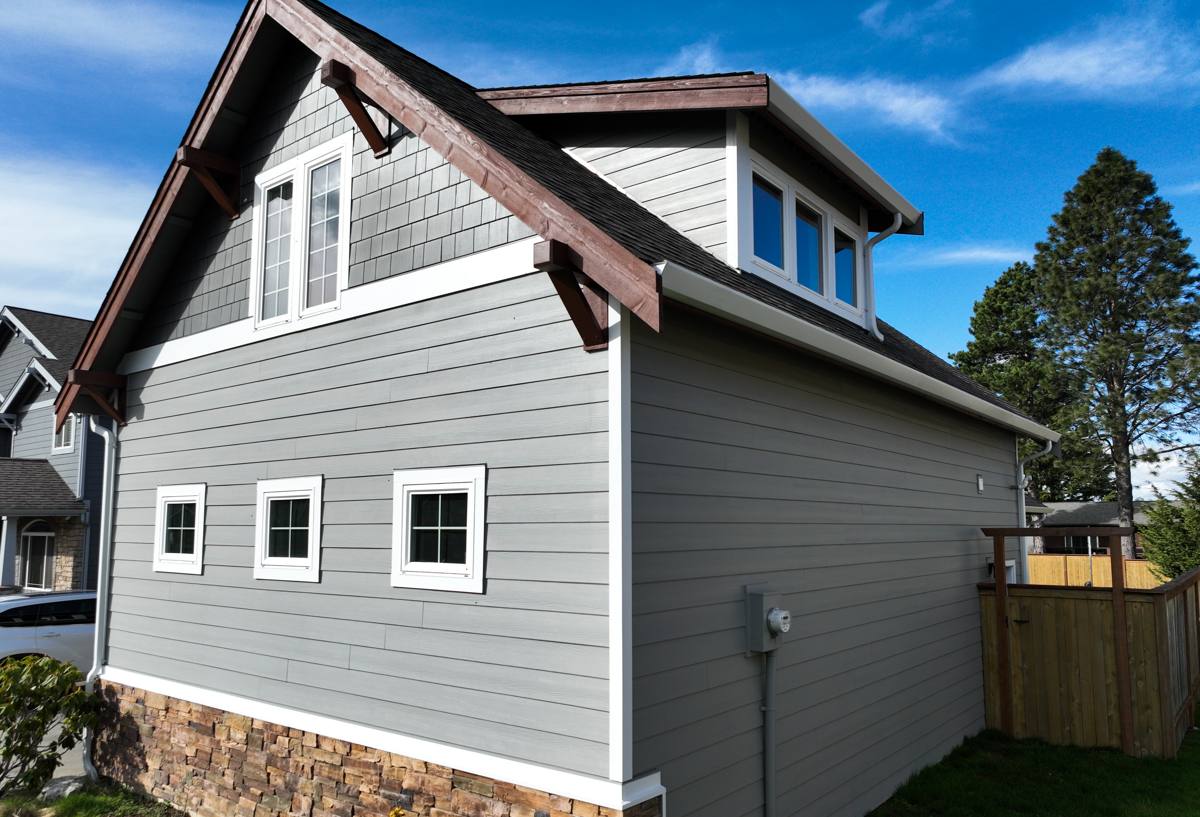
We install James Hardie fiber cement siding exclusively. Not because it's the only decent product on the market, but because after years of doing exterior work in this specific climate, it's the one system that consistently holds up to salt air, sustained rain exposure, and moss without the maintenance burden or moisture risk we've seen with other options. We don't install vinyl, LP SmartSide, Cemplank, Allura, primed spruce, or cedar — each of those has real strengths, but each also has a trade-off that becomes a bigger deal in a place like Whatcom County than it would somewhere drier.
Hardie's fiber cement is non-combustible, factory-finished with its ColorPlus coating (so the color cures under controlled conditions rather than curing on your wall in variable weather), and engineered in HZ product lines specifically for climate zones like ours — meaning wetter, cooler, moss-prone regions. It carries a strong transferable warranty when installed to manufacturer spec, which matters more here than in a low-moisture climate because installation errors show up faster when the wall is under constant moisture pressure.
What "Climate-Engineered" Actually Means
James Hardie's HZ10 product is formulated for regions with more moisture, more temperature swings, and more freeze-thaw cycling than the HZ5 line built for hot, dry climates. Whatcom County — and South Hill specifically — falls into that wetter category. The practical difference shows up in how the material handles sustained damp conditions without swelling, delaminating, or hosting mold growth the way some wood-based and wood-adjacent products can if a seam ever opens up.
Siding, Roofing, Windows, and Decks — One Crew, One Standard
We do more than siding. Roofing, windows, and decks all face the same three climate stressors, and treating them as separate problems handled by separate specialists is part of how small issues turn into big ones. A roof leak that isn't caught early feeds moisture down into the wall assembly behind the siding. A window that isn't flashed correctly lets driving rain in at the one place in the wall where it's hardest to reroute. A deck built without attention to drainage becomes a place where moss and standing water sit against ledger boards and framing all winter.
Having one crew handle the full exterior means the flashing details at a window tie into the siding plan correctly, the roof drainage doesn't dump water onto a deck that can't shed it, and nobody's pointing fingers at "the other contractor" when something at a transition point fails. It's a more coordinated approach, and in a climate this unforgiving of gaps, coordination is what actually prevents callbacks.
Roofing Considerations for South Hill
Moss is the dominant issue on roofs in this area. It's not cosmetic — moss holds moisture against roofing material, lifts shingles at the edges, and shortens the service life of a roof that would otherwise last much longer. Roof work here should always include attention to moss-resistant strategy and proper ventilation, not just the shingle swap itself.
Windows and Driving Rain
Window failures in this region are rarely about the window unit itself — they're about flashing and installation. Driving rain tests every window installation on a house multiple times a year, and a flashing detail that would be fine in a calmer climate can fail here within a few seasons. This is one of the areas where installation quality matters more than which brand of window you choose.
Decks: Drainage First
A deck in South Hill needs to be built or restored with drainage and moss exposure in mind from the start — proper spacing between boards, ledger flashing that actually sheds water away from the house, and materials chosen for how they'll perform wet, not just how they'll look dry.
Why a Local Crew Matters Here
A contractor who works across Whatcom County regularly — not one who occasionally travels in for a job — knows which details actually matter in this climate versus which ones are just generic best practice from a manual written for a different region. That's not a marketing point, it's a practical one: the flashing sequence that works fine in a dry climate can be the exact detail that fails here within a few winters if it's not adapted for sustained rain and moss exposure. Local experience means fewer surprises and fewer callbacks.
Comparing Common Siding Choices for This Climate
| Material | Moisture Behavior | Maintenance Burden | Our Position |
|---|---|---|---|
| James Hardie Fiber Cement | Non-combustible, engineered for wet/cool climates (HZ10) | Low — factory-cured ColorPlus finish | What we install |
| Vinyl | Doesn't rot, but seams and edges can allow moisture intrusion behind the panel | Low upfront, but can warp or fade over time | Not installed |
| LP SmartSide (engineered wood) | Wood-based core is more moisture-sensitive if seams or cuts aren't sealed correctly | Moderate — relies on maintained sealant and paint | Not installed |
| Cedar | Natural material, moisture-sensitive without diligent upkeep | High — regular refinishing needed in wet climates | Not installed |
| Primed Spruce | Softwood, needs consistent paint maintenance to resist moisture | High | Not installed |
What Goes Into a Correct Hardie Installation
The product only performs to spec if the installation matches it. In a climate with this much sustained moisture exposure, the installation details below are not optional extras — they're what separates siding that lasts decades from siding that develops problems in five years.
- Proper water-resistive barrier and rain screen gap behind the siding, not just the siding itself
- Correct fastener type and placement per Hardie's climate-specific installation guide
- Flashing integrated at every window, door, and roofline transition — not caulk used as a substitute
- Appropriate clearance between siding and grade, decks, and roof lines to avoid standing moisture contact
- Factory-cut and factory-primed edges maintained wherever possible to preserve the warranty
- Ventilation strategy that accounts for the home's overall moisture load, not just the wall in isolation
Signs Your South Hill Home May Need an Exterior Assessment
Some signals are worth a look before they become bigger repairs:
- Visible moss buildup on siding, trim, roofing, or deck boards
- Soft spots, bubbling, or discoloration near window trim or wall seams
- Paint or finish that's failing faster than expected, especially on sun-exposed or wind-exposed walls
- Water staining on interior walls or ceilings near exterior corners
- Deck boards that stay damp long after rain has stopped elsewhere
What to Expect Working With Us
We start with an honest look at what's actually happening on your home — not a sales pitch for the most expensive option available. If your siding, roofing, windows, or deck are still sound, we'll tell you that. If Hardie fiber cement is the right long-term answer for a home exposed to this much salt air and rain, we'll explain why in plain terms, walk through the product lines and colors that fit the house, and give you a clear scope before any work starts.
If you're in South Hill and dealing with an aging exterior, moss creep, or a home that just isn't holding up the way it should against this climate, we're happy to take a look. Reach out for a free, no-pressure estimate using the form below.