 Whatcom County
 Happy Valley Homes Face a Specific Kind of Weather
Happy Valley sits close enough to Bellingham Bay to catch salt-laden air off the water, and close enough to the surrounding hills and tree cover to stay shaded and damp for long stretches of the year. That combination is tougher on a home's exterior than either factor alone. Salt air accelerates corrosion on fasteners and trim. Shade and moisture slow drying time after every storm. Put those two things together with a Pacific Northwest wet season that can run from October through May, and you have an exterior environment that punishes anything not built for it.
We've worked on enough homes around Whatcom County to know that "it rains a lot here" undersells the real issue. It's not just rain volume — it's how long surfaces stay wet, how much wind-driven rain gets pushed sideways into wall assemblies, and how much organic growth (moss, algae, lichen) gets a foothold when a house sits in partial shade near mature trees, which describes a lot of properties in and around Happy Valley.
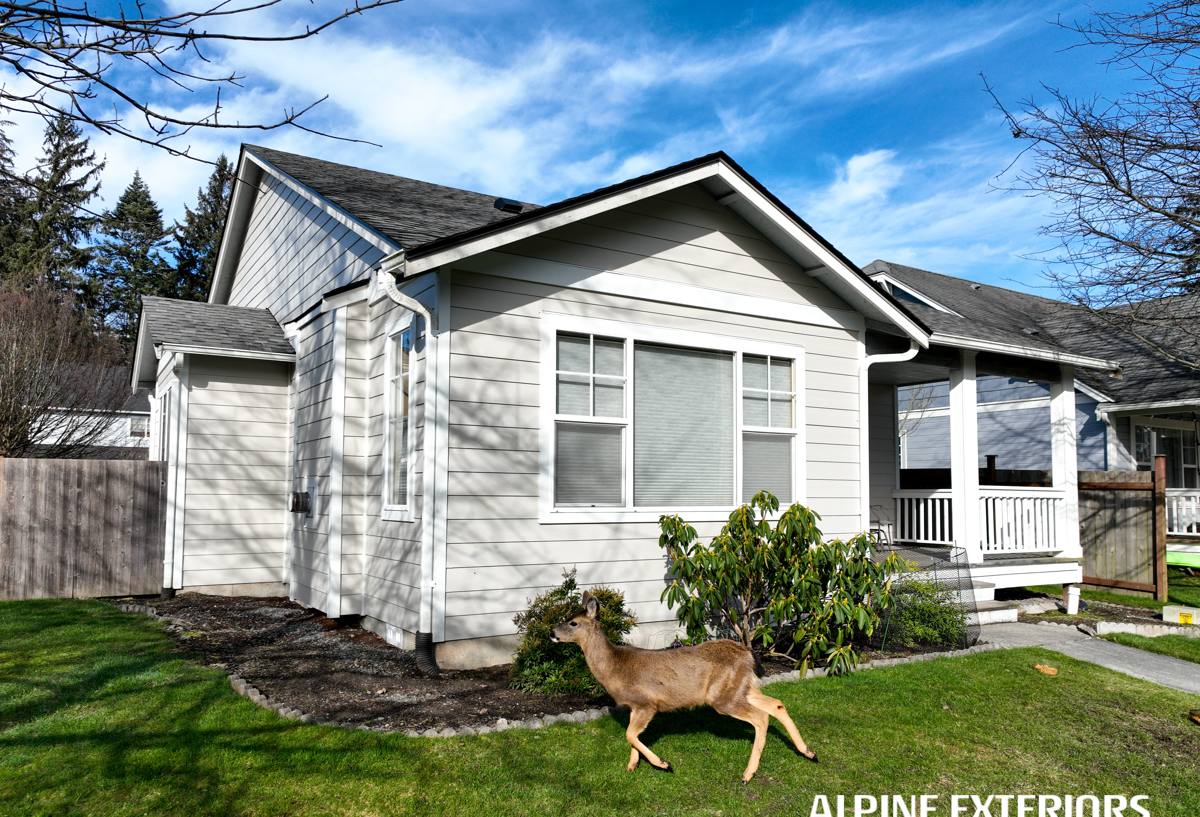
What We See on Siding Inspections in This Area
Moss and Algae Growth
North-facing walls and anything shaded by fir or cedar trees tend to stay damp longest. On wood-based siding products, that moisture sits in the surface and feeds moss and algae growth, which in turn holds even more moisture against the material. Over a few seasons, that cycle degrades paint film, softens substrate, and opens the door to rot at seams and butt joints.
Salt Air Corrosion
Homes with any bay exposure or onshore wind exposure see faster degradation of exposed metal — nail heads, flashing, hose bibs, light fixtures — than homes further inland. Siding materials and fasteners that aren't rated for coastal-adjacent conditions can show rust staining and pitting years before a comparable inland install.
Driving Rain and Wind-Driven Moisture
Whatcom County storms often come with real wind behind them, not just straight-down rain. That pushes water sideways into laps, seams, and butt joints — the exact places where lesser siding systems and shortcut installs fail first. A siding system's water-shedding detail work matters more here than in drier climates, because it gets tested constantly.
Why We Only Install James Hardie Fiber Cement
We made a decision as a company to stop installing several products that are common elsewhere in the region — vinyl, LP SmartSide, primed wood species like spruce, and cedar — because we were tired of watching homeowners pay for the same repairs and repaints every few years in exactly this kind of climate. James Hardie fiber cement is what we install on every siding job now, full stop.
It's not that those other products don't work anywhere. It's that in a marine climate with salt exposure, long wet seasons, and heavy shade, their weak points get exposed fast:
- Vinyl expands and contracts with temperature swings and can crack in cold snaps; it also doesn't stop moisture from getting behind it if house wrap and flashing details aren't perfect.
- Wood-based products (including engineered wood like LP SmartSide) rely on an intact factory coating and careful field-sealing of every cut edge — miss one spot and moisture gets in, especially under moss and shade.
- Cedar and primed spruce look great on day one but need ongoing maintenance — refinishing, caulking, and moisture monitoring — that most homeowners don't sign up for and don't keep up with.
James Hardie fiber cement is cement, sand, and cellulose fiber — it doesn't rot, it doesn't feed moss the way wood does, and it's non-combustible. The factory-applied ColorPlus finish is baked on and warranted separately from the substrate, so you're not relying on field-applied paint to hold up against years of coastal rain. Hardie also engineers specific product lines (HZ5, HZ10) for different climate zones, which matters in a county where you can go from bay-adjacent to foothill conditions in a few miles.
How We Handle Siding Installation for This Area
Moisture Management First
Before any siding goes up, we look at house wrap condition, flashing at windows and doors, and drainage plane continuity. In a climate that stays wet as long as this one does, the siding is only as good as what's behind it. A rainscreen gap where the wall assembly calls for one gives water a path to drain and dry instead of sitting against the back of the siding.
Fastener and Flashing Choices
Given the salt air exposure some Happy Valley properties see, we pay attention to fastener material and flashing details around penetrations and butt joints — the spots where lesser installs fail first when wind-driven rain is a regular occurrence rather than an occasional event.
Correct Hardie Installation Practices
Fiber cement performs the way it's supposed to only when it's installed to spec — proper clearance from grade and roof lines, correct fastener placement, factory-primed cut edges sealed in the field, and gaps and joints handled per manufacturer detail. We follow Hardie's installation requirements because that's what keeps the product warranty valid and the wall assembly dry over the long run.
Comparing What Happens Over Time
| Factor | Vinyl / Wood-Based Products | James Hardie Fiber Cement |
|---|---|---|
| Moisture / rot resistance in shaded, wet conditions | Vulnerable, especially at cut edges and seams | Cement-based, does not rot |
| Moss / algae susceptibility | Higher on porous or organic surfaces | Lower; smooth factory finish sheds growth more easily |
| Finish durability against coastal air | Field-applied paint fades and chalks faster | Factory ColorPlus finish is separately warranted |
| Fire resistance | Vinyl melts/deforms; wood is combustible | Non-combustible material |
| Ongoing maintenance | Repainting, caulking, and monitoring on a cycle | Occasional cleaning and caulk checks; no repainting cycle |
Roofing, Windows, and Decks in the Same Conditions
Siding rarely fails in isolation. If a roof is shedding water improperly, or flashing at a window is compromised, water finds its way behind even well-installed siding. We handle roofing, windows, and decks alongside siding work because in a climate like Whatcom County's, these systems all have to work together to keep a house dry. A deck that traps moisture against a wall, or a window that isn't flashed correctly, undermines even the best siding job above or beside it.
When we're on a property for a siding estimate, we'll flag anything we see with the roof, windows, or deck that's contributing to moisture problems — not to upsell, but because ignoring it means the new siding inherits the same issues.
What a Siding Project Looks Like
Assessment
We walk the exterior, check for existing moisture damage, moss buildup, and areas of heavier exposure (shaded north walls, bay-facing elevations, ground contact points), and look at the current wall assembly before recommending a scope.
Prep and Moisture Barrier
Removal of existing siding where needed, repair of any damaged sheathing, and installation or correction of house wrap and flashing.
Installation
Hardie panel, plank, or shingle siding installed to manufacturer spec, with attention to fastener schedule, joint treatment, and clearances.
Finish Details
Trim, caulking at appropriate joints (not as a substitute for proper flashing), and a final walk-through.
A Practical Checklist Before You Choose a Contractor
- Ask what siding product they install and why — a contractor who installs everything usually isn't specializing in the details any one product needs.
- Ask about their moisture management approach, not just the siding brand.
- Ask how they handle fastener and flashing choices given coastal/salt air exposure.
- Confirm they carry current licensing and insurance for exterior work in Washington.
- Ask whether they'll flag roof, window, or deck issues that could undermine new siding.
- Get a written scope that specifies the product line (not just "fiber cement" or "James Hardie" generically).
Why a Local Crew Matters Here
A crew that works Whatcom County regularly knows which elevations of a house take the worst of the wind-driven rain, how shaded lots behave differently than open ones, and what salt air does to fasteners and trim over a few winters. That local knowledge shapes real decisions on the job — where to pay extra attention to flashing, which fastener spec to use, how to sequence work around the wet season. It's the difference between a generic install and one built for the conditions the house will actually face.
If you're weighing a siding project in Happy Valley — or want an honest read on whether your current siding is holding up the way it should — we're glad to come take a look. Reach out for a free, no-pressure estimate using the form below.