 Whatcom County
 Siding Built for Everson's Climate
Everson sits in the Nooksack River valley in the northern part of Whatcom County, close enough to the Cascades foothills and the Canadian border that its weather carries the full character of Northwest Washington: long wet winters, a short dry summer window for exterior work, and a damp, shaded microclimate wherever trees or river-bottom fog hold moisture against a house. Homes here don't fail because owners neglect them. They fail because the exterior product on the wall was never engineered for this many wet-dry cycles, this much shade, and this many months of standing moisture in the yard and against the foundation.
Across Whatcom County generally, driving rain off the Strait and the Sound, salt-laden air near the water, and a moss season that can run eight months or longer all put steady mechanical and biological stress on siding. Everson is far enough inland that salt exposure is lighter than it is on the water, but the driving rain and moss pressure are just as real here, arguably worse in the low, tree-shaded stretches along the river where air doesn't move and surfaces stay damp for days after a storm passes. That combination — sustained moisture plus biological growth plus freeze-thaw swings in the colder months — is exactly the profile that separates siding products that hold up from siding products that don't.
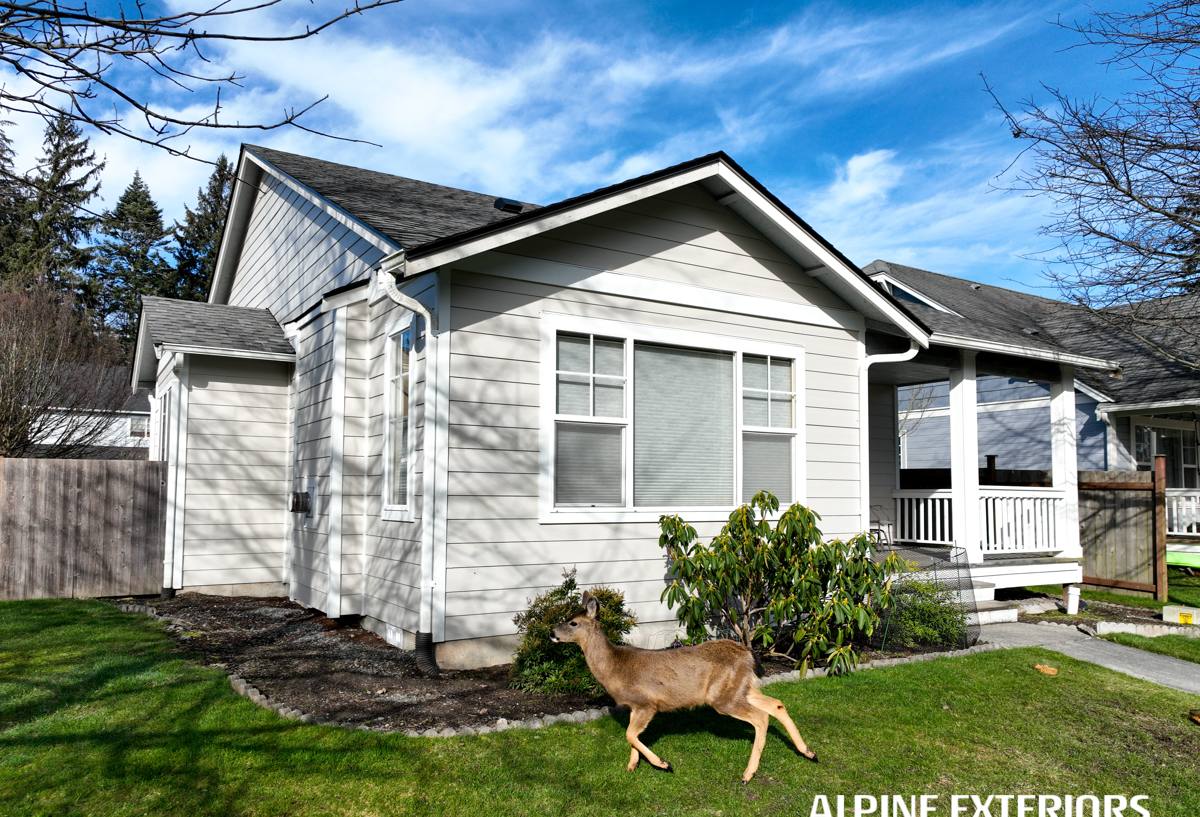
What We See on Everson Homes
A few patterns show up over and over on service calls in and around Everson:
- Moss and algae staining on north-facing and shaded walls, especially under trees or close to fence lines where airflow is limited
- Swelling, delamination, or soft spots on wood-based siding products where paint film has failed and moisture got behind the surface
- Caulk and trim joints that have opened up from repeated wet-dry and freeze-thaw cycling, giving water a path behind the siding
- Fading and chalking on painted siding that was never designed to hold color under this many UV and moisture cycles per year
- Rot at the bottom courses of siding near grade, planters, sprinkler zones, or areas that stay wet longer after rain
None of this is unusual for the region. It's a predictable result of ordinary siding materials meeting an extraordinary number of wet-dry cycles every year. The fix isn't more frequent painting or caulking — it's starting with a product that doesn't depend on a perfect paint film to keep water out in the first place.
Why This Matters More on River-Adjacent and Low-Lying Lots
Lower-lying properties near the Nooksack River corridor tend to hold ground moisture and humidity longer after storms than homes on higher, better-drained ground elsewhere in the county. That extra dwell time is what accelerates moss growth and wood decay. It doesn't mean those homes need a different siding system — it means the margin for error with a moisture-sensitive product is smaller, and the value of a genuinely water-resistant, non-combustible material is higher.
Why We Install Only James Hardie Fiber Cement
We are not a multi-brand siding company that offers whatever a customer asks for. We install James Hardie fiber cement siding, exclusively, on every home we side. That's a deliberate standard, not a sales limitation, and it comes down to how the material performs over decades in exactly the conditions Everson sees every year.
Fiber cement is made from cement, sand, and cellulose fibers, engineered to be dimensionally stable in wet climates. It doesn't swell, cup, or absorb water the way wood-based products can, and it won't support the kind of moisture-driven rot that shows up on shaded, damp walls after a few Northwest winters. It's also non-combustible, which carries real weight given wildfire smoke seasons have become a more regular part of Pacific Northwest summers, even here away from the coast.
We get asked fairly often why we don't offer vinyl, LP SmartSide, Cemplank, Allura, primed spruce, or cedar. Each of those has a place in the market and reasonable arguments in its favor. Our answer is simple: we've chosen to build our business, our warranty promises, and our crew's training around one system we trust completely rather than install several products at varying confidence levels. That focus lets us install Hardie correctly, every time, instead of spreading expertise thin across products with very different installation requirements.
How James Hardie Compares to What It Replaces
| Factor | Wood-based siding (cedar, primed spruce, LP SmartSide) | Vinyl siding | James Hardie fiber cement |
|---|---|---|---|
| Moisture behavior | Absorbs water; prone to swelling, cupping, rot if paint film fails | Doesn't absorb water, but can trap moisture behind panels | Dimensionally stable; engineered for wet climates |
| Fire performance | Combustible | Melts/deforms under heat | Non-combustible |
| Moss/algae resistance | Prone to biological growth on shaded, damp faces | Resistant to rot, but seams and buckling can trap grime | Resistant surface; ColorPlus finish sheds staining better over time |
| Finish longevity | Repaint typically every 5-8 years in this climate | Color molded in, can fade and chalk | Factory ColorPlus finish backed by its own separate warranty |
| Typical lifespan when properly installed | 15-25 years before major refinishing or replacement | 20-30 years, but seams and warping common sooner | 30+ years is common with correct install and basic maintenance |
The James Hardie Product Lines We Work With
James Hardie makes climate-engineered product lines, and for Whatcom County we work within their HZ5 designation, built specifically for cold, wet Northern climates rather than a generic national product. Depending on the look a homeowner wants, that can mean:
- HardiePlank lap siding — the most common choice, available in multiple textures and reveal widths for a traditional look
- HardiePanel vertical siding — often used for board-and-batten style or modern accent sections
- HardieShingle siding — for a shingle look without the maintenance burden of real wood shakes
- HardieTrim boards — matched trim for a consistent, factory-finished system rather than mismatched wood trim that ages differently than the field siding
All of it comes with the ColorPlus factory finish option, which bakes color onto the board under controlled conditions rather than relying on job-site painting, plus a substantial transferable limited warranty on the substrate and a separate finish warranty on the color coat.
How a Siding Project Runs, Start to Finish
Assessment
We start with a walk-around of the home, checking existing siding condition, trim and flashing details, areas of moisture intrusion or rot, and anything specific to the lot — shade patterns, drainage, proximity to the river or low ground, sprinkler overspray, that kind of thing.
Tear-off and Sheathing Check
Old siding comes off and we inspect the sheathing underneath. This step matters more than people expect — hidden rot behind failed siding is common, and it needs to be addressed before new siding goes on, not covered up.
Weather Barrier and Flashing
Correct water management behind the siding — housewrap, flashing at windows, doors, and penetrations, proper drainage planes — is what actually keeps water out of a wall system. Fiber cement is a durable material, but it's still only as good as the installation behind it.
Installation to Manufacturer Spec
James Hardie publishes specific fastening patterns, clearances, and caulking requirements, and following them precisely is what keeps the material's warranty valid and keeps it performing for decades. This is where a lot of installation problems on other jobs originate — not from the product, but from shortcuts during install.
Final Walkthrough
We review the finished work with the homeowner, cover basic maintenance expectations, and make sure trim, caulking, and paint lines are clean.
Roofing, Windows, and Decks — The Rest of the Exterior Envelope
Siding doesn't work in isolation. Roof flashing, window flashing, and deck ledger connections all interact with the same wall system, and a weak point in any one of them can undermine even a well-installed siding job. We handle roofing, window replacement, and deck construction alongside siding so the whole exterior envelope is coordinated by one crew that understands how water moves around a Northwest home, rather than being split across separate contractors who never talk to each other about flashing details.
Choosing a Local Contractor in Whatcom County
A siding job is only as good as the crew installing it. A few things worth asking any contractor you're considering, whether it's us or someone else:
- Are they factory-trained or certified on the specific product they're installing?
- Will they show you the manufacturer's installation instructions and follow them, including fastener spacing and clearances?
- Do they carry proper liability insurance and workers' comp, and can they provide proof?
- Is their bid detailed — tear-off, sheathing repair allowance, house wrap, flashing, trim, paint or ColorPlus finish — or just a lump sum with no breakdown?
- Do they have a physical presence and reputation in Whatcom County, or are they a traveling crew working the region for one season?
A local crew that works this climate year-round understands things a national or out-of-area contractor won't — how much shade a lot near the river gets in January, how fast moss returns on a north wall, what flashing details actually hold up through a wet Whatcom County winter.
Maintenance After Installation
James Hardie siding is low-maintenance, not no-maintenance. A simple annual routine keeps it performing at its best:
- Rinse the exterior once or twice a year to keep moss, pollen, and grime from building up, especially on shaded faces
- Check caulking at trim joints, windows, and doors annually and touch up as needed
- Keep gutters clear so overflow doesn't run down the siding face repeatedly
- Trim back vegetation and branches that hold moisture against the wall or block airflow
- Watch drainage around the foundation, particularly on lower or river-adjacent lots where standing water lingers longer
If your Everson home's siding is showing moss buildup, paint failure, soft spots, or you're simply planning ahead for a replacement, we're happy to walk the property and give you a straightforward, no-pressure assessment. Use the form below to request a free estimate.