 Whatcom County
 Silver Beach: A Lakeside Neighborhood With Its Own Exposure Problems
Silver Beach sits along the shoreline of Lake Whatcom, tucked into a landscape of mature evergreens, steep wooded lots, and homes that were often built to take advantage of water views. That setting is a big part of what makes the neighborhood desirable, but it also creates a specific set of exterior challenges. Tree cover holds moisture against siding and roofing long after a storm has passed. Lake proximity keeps humidity elevated for more of the year than homeowners a few miles inland typically deal with. And the tree canopy that gives Silver Beach its character also means constant leaf litter, needle debris, and shaded siding that never fully dries between rain events.
None of that is unique to any one street in the neighborhood — it's the nature of building on a wooded lake shoreline in Whatcom County. But it does mean the exterior products used on a Silver Beach home need to be chosen with that exposure in mind, not just picked off a builder's standard spec sheet.
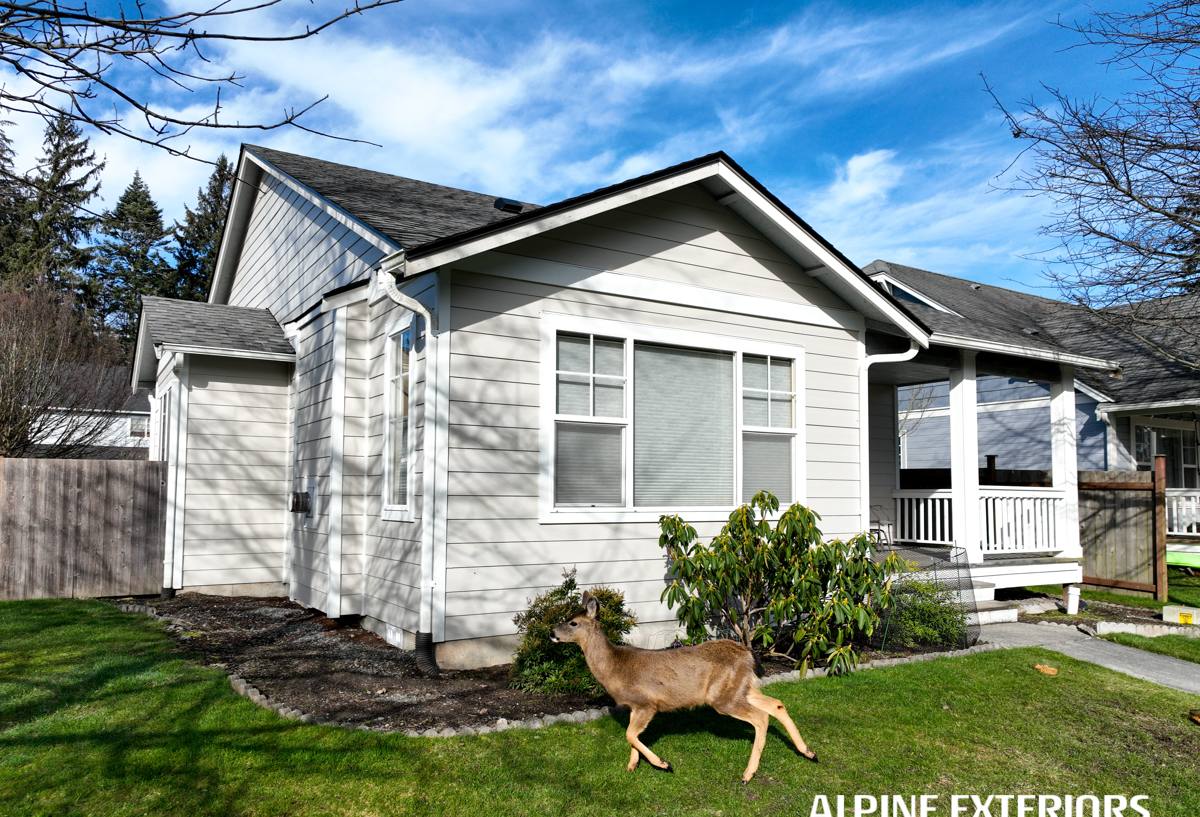
What Whatcom County's Climate Actually Does to a House Over Time
Whatcom County's weather pattern is defined by long stretches of low-intensity rain, a marine-influenced air mass that keeps humidity high even on dry days, and a moss season that can run the better part of the year on shaded or north-facing surfaces. None of these are dramatic weather events — there's no hurricane season to plan around — but the cumulative, year-after-year exposure is exactly what wears down the wrong exterior materials.
Driving rain works its way into seams, laps, and fastener penetrations that aren't detailed correctly. Sustained moisture feeds moss and algae growth on siding and roofing, which then holds even more water against the surface. Marine air carries salt and moisture that accelerates corrosion of fasteners and hardware that aren't rated for it. On a lake-adjacent, tree-shaded property like the ones common in Silver Beach, all three of these factors are working at once, most of the year, whether or not the sun is out.
This is why we tell homeowners in this area that the siding decision matters more here than it might in a drier climate. A product that performs fine in Eastern Washington or the Southwest can fail early in a Whatcom County lake environment — not because it's a bad product everywhere, but because it wasn't engineered for this kind of sustained moisture load.
Signs Whatcom County Homes Show First
- Moss and algae streaking on siding, especially on north- and east-facing walls and anywhere shaded by trees
- Soft or swollen siding edges near the ground, under decks, or where gutters have overflowed
- Paint that's peeling or bubbling rather than fading evenly, which usually points to moisture trapped underneath
- Rust staining around fasteners or trim hardware
- Gaps opening at butt joints and corner boards as boards swell and shrink with the seasons
Why This Company Installs Only James Hardie Fiber Cement Siding
We made a deliberate decision years ago to install one siding system: James Hardie fiber cement. We don't offer vinyl, LP SmartSide, Cemplank, Allura, primed spruce, or cedar as alternatives, and that's not because those products don't have a place in the market — it's because, after years of installing and repairing exterior products across this region, we concluded that fiber cement from Hardie gives homeowners here the best combination of moisture resistance, fire safety, and long-term finish stability, and we'd rather stand fully behind one system than offer several and hedge our recommendation.
Fiber cement is made from cement, sand, and cellulose fibers, which makes it dimensionally stable in a way that wood-based and wood-derived products aren't. It doesn't absorb water the way engineered wood siding can, it won't rot the way untreated cedar can if a finish is neglected, and it's non-combustible, which matters increasingly to insurers and to homeowners thinking about wildfire smoke and ember exposure even on the wet side of the state. James Hardie also builds region-specific product lines — its HZ5 formulation is engineered for climates like ours, with freeze-thaw cycling, high humidity, and heavy rainfall factored into the product's design rather than treated as an afterthought.
What We're Not Saying
We're not telling homeowners that vinyl, LP SmartSide, or cedar are junk products with no legitimate use. Vinyl is inexpensive and low-maintenance in the right application. LP SmartSide has improved significantly with engineered wood treatments. Cedar, properly finished and maintained, can look beautiful for decades. Our position is narrower than "these products are bad" — it's that we've chosen to specialize in one system we trust completely for this climate, rather than installing several products with different maintenance requirements, moisture tolerances, and warranty structures. That specialization is what lets our crews install Hardie correctly, every time, instead of splitting expertise across five different materials.
Comparing Common Siding Options for a Whatcom County Home
| Material | Moisture Behavior | Maintenance | Typical Lifespan | Fire Rating |
|---|---|---|---|---|
| James Hardie Fiber Cement | Engineered for wet climates; won't rot or swell | Low — factory finish, occasional wash | 30-50+ years | Non-combustible |
| Vinyl | Doesn't absorb water, but can trap moisture behind it | Low, but color fades and can't be repainted well | 20-30 years | Combustible, can warp near heat |
| LP SmartSide | Engineered wood — treated, but still wood-based | Moderate — seams and cuts need ongoing sealing | 20-30 years with proper upkeep | Combustible |
| Cedar | Natural wood — absorbs and releases moisture | High — refinishing every few years | 20-40 years with diligent maintenance | Combustible |
These figures are general ranges, not guarantees — actual performance depends heavily on installation quality, sun and shade exposure, and how consistently a homeowner keeps up with maintenance. A well-maintained cedar home can outlast a neglected fiber cement one. But the table reflects why, in a shaded, humid, lake-adjacent environment like Silver Beach, we favor the material with the least dependence on ongoing homeowner upkeep to perform well.
ColorPlus Finish: Why the Factory Coating Matters Here
One of the specific reasons we standardized on James Hardie is the ColorPlus finishing process. Instead of field-painting siding after installation — which is common with cedar and some engineered wood products — Hardie's ColorPlus boards are finished in a controlled factory environment with a baked-on coating that's engineered to hold color and resist moisture intrusion far better than a job-site paint job. In a climate where siding rarely gets a long, uninterrupted dry stretch to cure a fresh coat of paint properly, that factory-controlled finish is a real practical advantage, not just a marketing point.
ColorPlus finishes also come with their own warranty coverage against fading and peeling, layered on top of the product warranty on the siding itself. For a homeowner near Lake Whatcom dealing with tree shade, algae growth, and repeated wet-dry cycling, that combination reduces the odds of needing a repaint within the first decade — something that's a real risk with field-applied finishes on wood-based siding in this climate.
Roofing, Windows, and Decks: Treating the Whole Exterior as One System
Siding doesn't work in isolation. Water that gets past a bad roof valley or a poorly flashed window will find its way behind even the best siding installation. Because we handle siding, roofing, windows, and decks, we look at a Silver Beach property as one connected building envelope rather than a series of separate trades.
That matters most at the transitions: where roofing meets siding at a wall intersection, where window flashing ties into the water-resistive barrier behind the siding, and where a deck ledger board attaches to the house. These are the spots where most real-world moisture problems actually start, and they're easy to get wrong if the crew doing the siding isn't thinking about how it interacts with the roofing and window details around it.
Where the Envelope Typically Gets Compromised
- Roof-to-wall step flashing that's missing, undersized, or improperly lapped
- Window and door flashing that doesn't integrate with the housewrap or weather barrier
- Deck ledger connections that trap water against the rim joist and siding
- Gutters and downspouts that dump water directly against a wall instead of away from the foundation
- Siding installed too close to grade, decks, or roof lines, leaving no drainage gap
How a Hardie Installation Works, Step by Step
Correct installation is arguably more important to long-term performance than the product itself — fiber cement installed against manufacturer specification can still develop problems, while an inferior product installed meticulously can outperform expectations. Here's the general sequence we follow on a Whatcom County home:
- Tear-off and inspection. Old siding comes off and the sheathing underneath gets inspected for rot or water damage, which is common to find on lake-adjacent homes with aging siding.
- Weather barrier and flashing. A code-compliant water-resistive barrier goes on, with flashing integrated at every window, door, and penetration before any siding is hung.
- Rainscreen gap where appropriate. A drainage gap behind the siding lets any moisture that does get through drain and dry out instead of sitting against the wall.
- Hardie board installation. Boards are cut, fastened, and gapped according to James Hardie's published installation guide — fastener spacing, clearances from grade and roofing, and caulking at joints all follow spec, not shortcuts.
- Trim, corners, and detailing. Corner boards, trim, and any transitions to roofing or decks get finished so water sheds away from the structure at every joint.
- Final inspection. We walk the finished exterior looking specifically at the details that fail first — laps, corners, and penetrations — before calling the job done.
What to Look for When Hiring a Siding Contractor in Whatcom County
Silver Beach homeowners have plenty of contractor options, and the quality gap between them is real. A siding job that looks fine on installation day can start showing problems within a year or two if flashing, gapping, or fastener placement was rushed. A few things worth checking before you hire anyone:
- Ask whether the crew is factory-certified or specifically trained on the product they're installing, not just generally experienced with "siding"
- Get the manufacturer warranty terms in writing, and ask what voids it — improper fastening or gapping often does
- Ask how the contractor handles flashing at windows, doors, and roof-to-wall transitions specifically
- Confirm licensing and insurance, and ask for proof rather than taking it on faith
- Ask what happens to old siding and debris — a legitimate contractor has a clear disposal plan
- Be wary of bids that are dramatically lower than others; on a wet-climate installation, corners cut on flashing and barriers don't show up until years later
Cost Factors for a Silver Beach Siding Project
Every home is different, and we don't quote broad numbers without seeing the property, but a few factors consistently move the price on jobs in this area:
| Factor | Why It Matters |
|---|---|
| Extent of existing water damage | Rotted sheathing found during tear-off has to be replaced before new siding goes on |
| Home size and wall complexity | Multiple stories, dormers, and cut-up wall lines take more labor and material than a simple rectangle |
| Access and site conditions | Steep, wooded, or lake-adjacent lots common in Silver Beach can complicate staging and equipment access |
| Siding profile and trim detail | Lap width, shingle-style panels, and custom trim add labor beyond a basic install |
| Scope beyond siding | Bundling roofing, window, or deck work into the same project can improve efficiency versus separate jobs |
Why a Local Crew Matters for This Neighborhood
A contractor who works regularly in Whatcom County knows what a Silver Beach lot with mature tree cover and lake proximity is going to throw at a siding job before the first board goes up — where moss tends to establish first, how much shade a north wall is really getting through the year, and how local permitting and inspection processes work. That local knowledge doesn't replace correct installation practice, but it does mean fewer surprises during the project and a better match between the product spec and the actual conditions on your lot.
If you're weighing a siding, roofing, window, or deck project on a Silver Beach home, we're happy to take a look and talk through what we're seeing and why we'd recommend the approach we do. There's no pressure and no cost to get an estimate — just a straight assessment of your home's exterior and what it would take to get it performing well for the long haul. Use the form below to request a free estimate.