 Whatcom County
 Siding Built for Sehome's Bellingham Bay Climate
Sehome sits close enough to Bellingham Bay that salt-laden air is a fact of life for the homes here, not an occasional nuisance. Add in the long stretch of wet months that define a Whatcom County winter and spring, plus the mature tree canopy that shades so many Sehome lots, and you get a specific set of conditions that exterior materials either handle well or don't. We've worked on homes throughout this neighborhood and the surrounding Bellingham area long enough to know which failures show up here first, and it's almost always the same three: moisture intrusion at poorly flashed penetrations, moss and algae staining on shaded north- and west-facing walls, and paint or coating breakdown from repeated wet-dry cycling.
None of that is exotic. It's just what happens when a marine climate meets a building envelope over enough years. The point of a good siding system isn't to be clever — it's to shed water reliably, resist the organic growth this climate encourages, and hold its finish without constant homeowner upkeep.
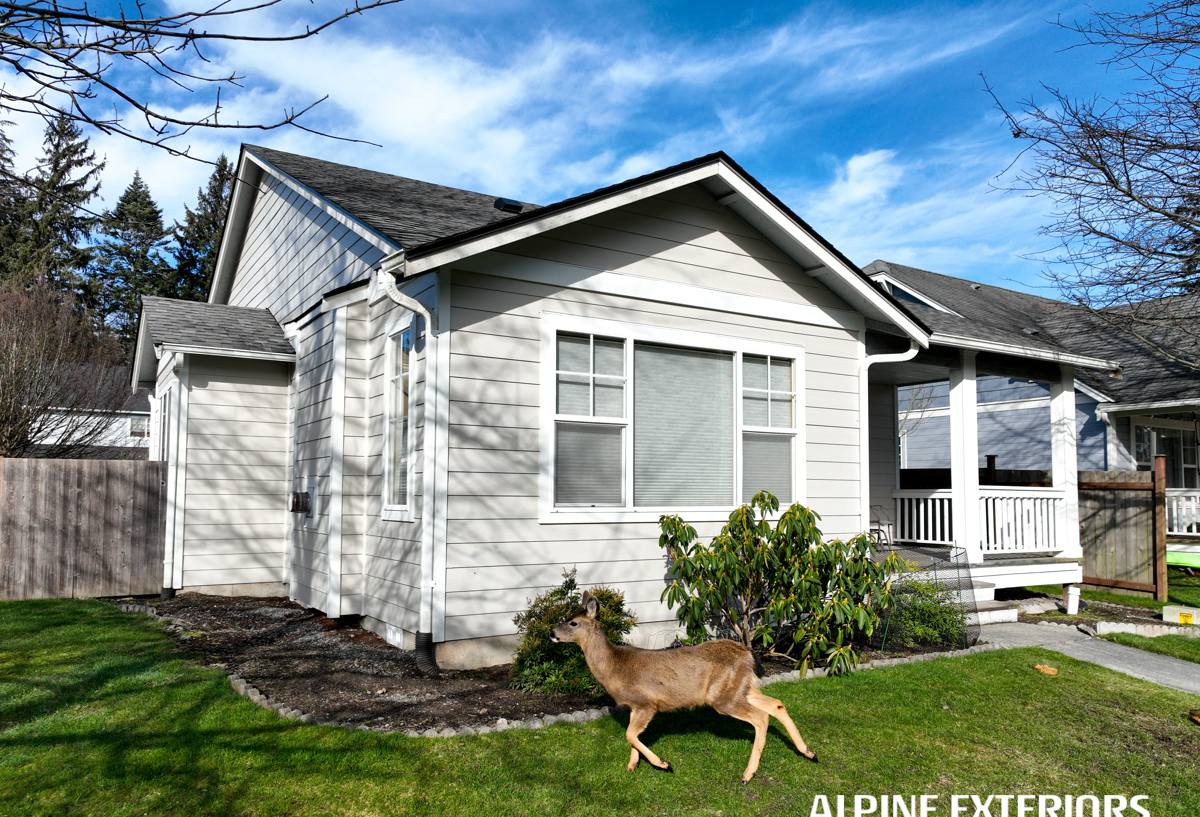
What Sehome Homes Are Up Against
Salt Air and Corrosion
Proximity to Bellingham Bay means airborne salt settles on exterior surfaces, accelerates corrosion on fasteners and trim hardware, and can degrade certain coatings faster than the manufacturer's lab testing might suggest for a drier climate. This is one of the reasons fastener selection and flashing details matter as much as the siding material itself.
Driving Rain
Whatcom County doesn't just get a lot of rain — a good portion of it comes in sideways during winter storms off the Strait. Wind-driven rain finds every gap in a wall assembly that vertical rain would never reach: unsealed butt joints, short kick-out flashing, siding installed too tight to trim. A siding product's water-resistance rating on paper matters less than whether it was installed with proper clearances, house wrap integration, and flashing at every transition.
Moss and Algae Season
Sehome's tree cover is part of what makes the neighborhood attractive, but shade plus moisture plus mild year-round temperatures is exactly the recipe moss and algae need. Wood-based sidings absorb moisture and give organic growth something to root into. Cement-based sidings don't offer that same foothold, which is a meaningful difference over a 10- or 20-year horizon, not just a cosmetic one.
Temperature Swings and Material Movement
Whatcom County doesn't see extreme heat, but daily and seasonal humidity swings still cause wood and wood-composite products to expand and contract. Over enough cycles, that movement telegraphs through paint film as cracking, and it opens hairline gaps at joints where water can start working its way in.
Why We Install Only James Hardie Fiber Cement
We made a deliberate decision years ago to stop installing vinyl, LP SmartSide, and other wood-composite sidings, and to standardize on James Hardie fiber cement across every job we take on. That wasn't a marketing decision — it came from watching how different products actually perform once they've been through several Whatcom County winters.
Fiber cement is non-combustible, which matters increasingly to insurers and to homeowners paying attention to wildfire-adjacent building codes even here in a wet climate. It doesn't swell, rot, or feed moss the way wood-based products can. Hardie's ColorPlus finish is baked on at the factory under controlled conditions, which gives it more consistent adhesion and UV resistance than field-applied paint typically achieves — a real advantage when a home sits under tree shade for half the year and gets hit with damp salt air the other half.
We're not going to tell you vinyl or LP SmartSide are junk — they're not, and they work fine in a lot of climates and budgets. But vinyl expands and contracts more than fiber cement, can warp near heat sources, and doesn't hold paint if a homeowner ever wants to change the color. LP SmartSide is a wood-strand product with an engineered coating, and while it's come a long way, it's still an engineered wood product asking to hold up in one of the wetter corners of the country. Fiber cement doesn't ask that question. Given what we see in Bellingham-area attics, crawlspaces, and wall cavities during tear-offs, we decided we'd rather install one product exceptionally well than several products adequately.
James Hardie Product Lines We Use
- HardiePlank lap siding — the most common choice for Sehome's mix of craftsman, mid-century, and newer builds; available in several exposure widths and textures.
- HardieShingle — for homes where a shingle-style accent or full elevation fits the architecture.
- HardiePanel — vertical panel applications, often used for modern facades or accent gables.
- HardieTrim — matched trim boards so the whole exterior system, not just the field siding, resists the same moisture and organic growth issues.
Hardie also engineers its products by climate zone (its HZ5 line is formulated for regions like ours with significant moisture exposure), which is another reason we don't see a need to offer alternatives.
How a Sehome Siding Project Typically Works
1. Assessment and Estimate
We start with a walk-around of the home, checking existing siding condition, trim and flashing details, and any signs of moisture intrusion already present — soft spots, staining, or gaps at windows and rooflines. This is also when we talk through product selection, coverage, and realistic scheduling given the season.
2. Tear-Off and Sheathing Check
Old siding comes off and we inspect the sheathing underneath. This step matters more in a climate like this one — if water has been getting behind the old siding for years, we want to know before we close the wall back up, not after.
3. Water-Resistive Barrier and Flashing
Correct house wrap installation, window and door flashing, and kick-out flashing at roof-wall intersections are what actually keep driving rain out. This is the step that separates a siding job that lasts from one that develops problems in five years.
4. Hardie Installation to Manufacturer Spec
Proper fastener spacing, clearances from grade and roofline, caulking at the right joints (and not others), and factory-finish touch-up done correctly — installation quality is what determines whether a fiber cement product delivers on its warranty in practice.
5. Final Walkthrough
We walk the finished exterior with the homeowner, checking every elevation and trim detail before we call the job done.
Roofing, Windows, and Decks Alongside Siding
Siding doesn't work in isolation — a roof that's shedding granules or flashing poorly, windows with failed seals, or a deck ledger that's trapping moisture against the house all undermine even a well-installed siding system. Because we handle roofing, windows, and decks as well as siding, we can look at a Sehome home's exterior as one connected system rather than a series of separate contractor visits, and flag issues in one trade that would otherwise show up as a "siding problem" later.
Cost Factors for a Sehome Siding Project
| Factor | Why It Affects Cost |
|---|---|
| Home size and elevation count | More square footage and more complex rooflines mean more material, more cuts, and more flashing detail work. |
| Existing siding removal | Tear-off of old wood, vinyl, or damaged siding adds labor and disposal costs versus a bare-sheathing new build. |
| Sheathing repair | If moisture has damaged the wall sheathing, that repair happens before new siding goes on — better to find and fix it now than later. |
| Product line and texture | HardiePlank, HardieShingle, and HardiePanel carry different material costs, as do smooth versus textured finishes. |
| Trim and accent work | Detailed trim packages, accent gables, or mixed materials add labor time. |
| Access and site conditions | Sloped lots, mature landscaping, or tight setbacks common in older Sehome lots can affect scaffolding and staging. |
What to Ask Before Hiring an Exterior Contractor in Whatcom County
- Are you a certified installer for the siding product you're proposing, and can you explain the manufacturer's clearance and fastening requirements?
- Will you inspect and, if needed, repair sheathing before installing new siding — not just cover it up?
- What's your approach to flashing at windows, doors, and roof-wall intersections?
- Is your bid itemized enough to show tear-off, materials, trim, and labor separately?
- Do you carry current licensing and insurance for work in Washington State, and can you provide proof?
- What does the manufacturer's warranty actually cover, and what voids it?
A Local Crew Matters More Than It Sounds Like
A lot of exterior problems in this region trace back to a crew that installed a product correctly for a drier climate but not for ours — wrong flashing sequence, under-caulked joints in the wrong spots, or clearances that made sense somewhere without our rain load. Being based in Whatcom County means we're dealing with these same conditions on our own homes, not just on job sites. That shapes how we sequence a tear-off around weather windows, where we pay extra attention on a shaded, moss-prone elevation, and why we don't cut corners on flashing details that don't show up in a walkthrough but absolutely show up in a wall cavity five years later.
If you're weighing a siding, roofing, window, or deck project for your Sehome home, we're happy to take a look and give you a straightforward, no-pressure estimate — no exaggerated claims, just an honest read on your home's condition and what it would take to get it right.