 Whatcom County
 Why Cordata Homes Wear Out Their Siding Faster Than the Brochure Says
Cordata sits far enough inland to escape the worst of Bellingham Bay's direct salt spray, but it's not immune to it — westerly weather still carries moisture and airborne salts across the flats, and combined with the neighborhood's mix of mature tree cover and newer development, homes here deal with a specific combination: driving rain that hits siding sideways during winter storms, long stretches of damp shade that never fully dry out, and a moss season that can run from October through April. Siding that's rated for a generic "Pacific Northwest" climate doesn't always account for how long a wall actually stays wet in a spot like this. That's the real question for any Cordata homeowner sizing up a re-side: not just what a product costs installed, but how it behaves after the fortieth wet week in a row.
Whatcom County's building stock includes a lot of homes from the 1970s through 2000s with original wood or early composite siding that's now past its service life. When that siding fails, it usually doesn't fail all at once — it shows up as soft spots near the ground, paint that won't hold past a year or two, and moss creeping up from the north side of the house. Fiber cement, installed correctly, is built to break that cycle.
What Fiber Cement Actually Solves Here
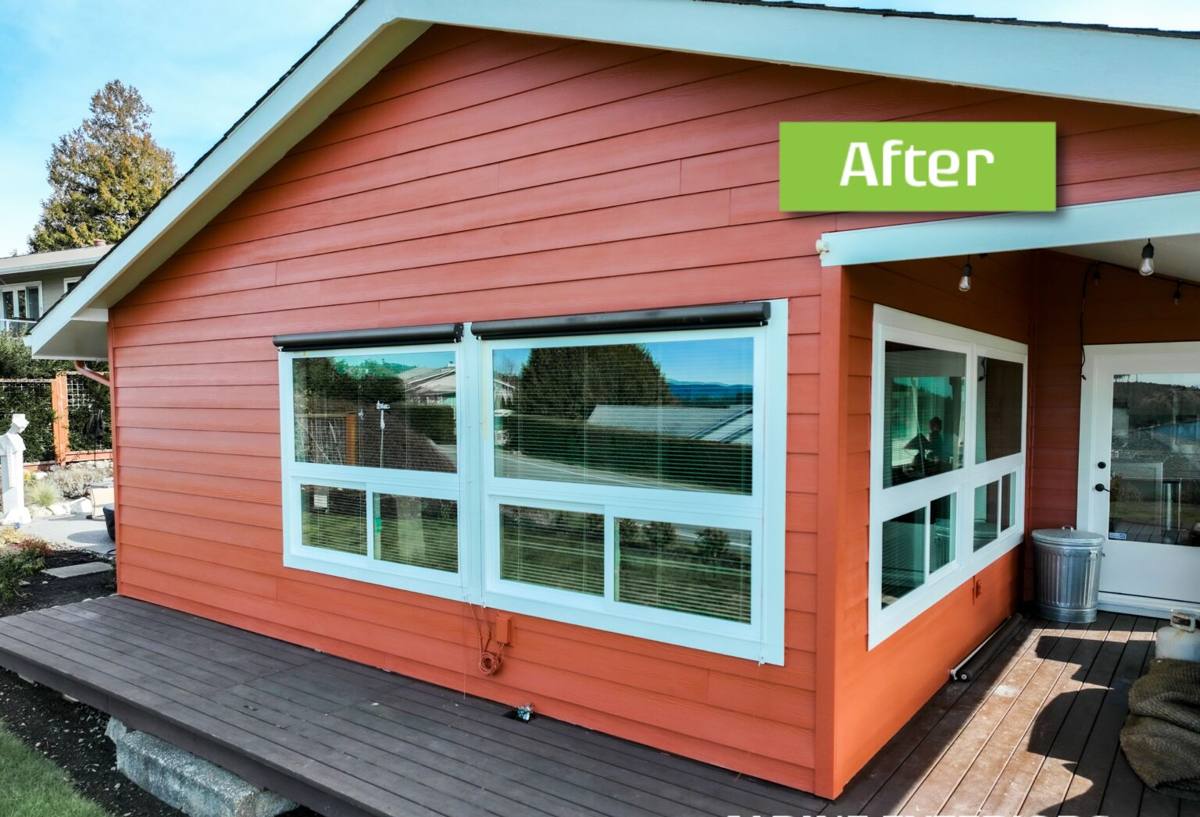
Fiber cement siding is a mix of cement, sand, and cellulose fibers, pressed and cured into planks or panels. It doesn't rot, it isn't attractive to insects, and it holds paint or factory finish far longer than wood because it doesn't expand and contract with moisture the way wood does. In a climate where a wall can stay damp for days after a rain event, that dimensional stability matters more than most homeowners realize — it's a big part of why paint fails early on wood and lap siding but holds up on fiber cement.
Moss and Algae Resistance
Moss doesn't grow on the fiber cement itself so much as it grows on grime, pollen, and organic buildup that sits on any siding surface long enough — and Cordata's shaded lots and long wet season give it plenty of time to do that. The difference with a factory-finished fiber cement product is that the finish is baked on under controlled conditions, so it resists staining and holds its color instead of giving mildew and algae something porous to grip onto. It still needs an occasional rinse, but it doesn't feed the growth the way bare wood or a thin field-applied coat can.
Rain Screen Behavior
The bigger factor in long-term performance isn't the plank itself — it's what's behind it. Fiber cement performs best in this climate when it's installed over a drainage gap (a rain screen), so wind-driven rain that gets behind the cladding has somewhere to go instead of sitting against the weather barrier. Skipping this detail is one of the most common corners cut on re-sides in wetter parts of Whatcom County, and it's the kind of mistake that doesn't show up for a few years — until it does.
What a Correct Installation Involves
- Full tear-off of failing siding and inspection of the sheathing underneath for hidden rot before anything new goes up
- A code-compliant weather-resistive barrier, installed shingle-style so water sheds outward and down
- A drainage gap (furring strips or a purpose-built rain screen product) so water that gets behind the siding can drain and the wall can dry
- Correct fastener type, spacing, and placement per the manufacturer's installation instructions — not "close enough"
- Proper clearance at grade, decks, and patios so siding isn't sitting in standing water or buried soil contact
- Factory-mitered or properly caulked and back-primed field cuts at corners, trim, and penetrations
- Flashing at every window, door, and roof-to-wall intersection — not just caulk covering a gap
Every one of those steps is invisible once the job is done. That's exactly why it matters who does the work — a wall that looks finished on day one can still be set up to fail behind the surface if the drainage plane and flashing details were skipped.
Why We Only Install James Hardie
We install James Hardie fiber cement exclusively. We don't install vinyl, LP SmartSide, or other fiber cement brands, and that's a deliberate standard, not a sales pitch. Hardie engineers specific product lines for different climate zones — their HZ5 formulation is built for regions with freeze-thaw cycles and sustained moisture exposure, which describes a normal Whatcom County winter. The ColorPlus factory finish is baked on with a process that holds color and resists fading and moisture intrusion better than field-applied paint, which matters directly for the moss-and-algae problem described above. Hardie also backs its siding with a long transferable limited warranty and a separate finish warranty on ColorPlus products, and the company has a multi-decade track record in wet coastal climates specifically. When we stand behind an installation, we want the product underneath it to have that same track record — not a newer or thinner alternative that hasn't been proven under the same conditions for as long.
Comparing the Realistic Options for a Cordata Re-Side
| Factor | James Hardie Fiber Cement | Vinyl | Wood / Untreated Composite |
|---|---|---|---|
| Moisture behavior | Dimensionally stable, won't rot or swell | Doesn't rot but can warp/buckle with heat and impact | Absorbs moisture, prone to rot in shaded/wet areas |
| Moss/algae resistance | Factory finish resists staining buildup | Can stain and chalk over time | Porous surface holds moisture and organic growth |
| Finish longevity | ColorPlus finish rated for decades, factory-controlled | Color molded in but can fade; can't easily repaint some types | Field paint typically needs redoing every 3-7 years here |
| Fire resistance | Non-combustible | Combustible, can melt/deform near heat | Combustible |
| Warranty | Long transferable limited warranty | Varies widely by manufacturer | Typically none beyond installer's workmanship |
Vinyl and lower-cost composites can make sense on a tight budget or a short-hold property. For a home you plan to keep and maintain in this climate, the ongoing cost of repainting, patching, or dealing with early moisture damage tends to close the gap with fiber cement faster than people expect.
What Drives the Cost of a Fiber Cement Re-Side
| Cost Factor | Why It Matters in Cordata |
|---|---|
| Existing wall condition | Hidden sheathing rot from long-term moisture adds tear-off and repair time |
| House size and complexity | Dormers, multiple gables, and cut-up wall lines add labor and waste |
| Siding profile chosen | Lap width, panel style, and trim detail affect material and labor |
| Drainage plane detail | Adding a proper rain screen system is worth the added cost for long-term performance |
| Access and lot conditions | Mature trees, slopes, and tight lots common in Cordata can affect staging and scaffolding |
We won't quote a job without walking the property, but these are the factors that actually move the number — not just square footage.
Our Process for a Cordata Project
- On-site inspection of existing siding, trim, and any visible moisture or rot signs
- Sheathing assessment once old siding comes off, with any hidden damage addressed before new siding goes up
- Installation of a code-compliant weather barrier and drainage gap suited to the home's exposure
- James Hardie plank or panel installation to manufacturer spec, including correct fastening and clearances
- Flashing and sealing at all windows, doors, and penetrations
- Final walkthrough covering finish, trim lines, and care instructions specific to the product installed
Why Local Experience in Whatcom County Matters
Building code requirements, typical wall assemblies, and the specific weather stresses in this county aren't the same as what a crew coming from a drier climate or a different region is used to. A contractor who works Whatcom County regularly knows which details — flashing at deck ledgers, clearance at grade on sloped lots, drainage planning for shaded north walls — actually get tested by this weather every year. That's not something you can substitute with a lower bid from a crew that mostly works somewhere else.
Signs Your Cordata Home May Need a Siding Assessment
- Paint that's peeling, bubbling, or needing repainting more often than every 5-7 years
- Soft or spongy siding near the ground, under windows, or around deck ledgers
- Moss or dark staining that keeps returning within months of cleaning
- Visible gaps, warping, or separation at seams and corners
- Rising energy bills that may point to a compromised weather barrier
If you're seeing any of those signs, or you're just planning ahead for a re-side, we're happy to take a look and give you a straightforward, no-pressure estimate — no obligation, just an honest read on what your home actually needs.