 Whatcom County
 Siding in Nooksack: A Small Town With a Big Moisture Problem
Nooksack sits in the Nooksack River valley in northeast Whatcom County, close enough to the foothills of the North Cascades that weather patterns here don't behave exactly like they do out on Bellingham Bay or the coastal edges of the county. But the underlying problem is the same one every siding contractor in this part of Washington deals with: it stays wet for a long time, and whatever is on the outside of a house has to survive that without falling apart.
Whatcom County's climate is defined by long stretches of low-intensity rain, heavy overcast, and short winter days that don't give exterior surfaces much chance to dry out between storms. In a river valley setting like Nooksack, you also get morning fog and higher humidity settling in low areas, especially in fall and winter. That combination — driving rain, persistent dampness, and a moss season that can run half the year on shaded or north-facing walls — is exactly the environment that separates siding products that hold up from siding products that don't.
We're not going to pretend every house in Nooksack faces identical exposure. A home on an open lot catches more wind-driven rain on its west and south walls. A home tucked under fir trees deals with more shade, more moss, and slower drying. What doesn't change is the baseline: this is a wet, marine-influenced climate, and the siding material matters more here than it does in a dry climate where mistakes get forgiven by the weather.
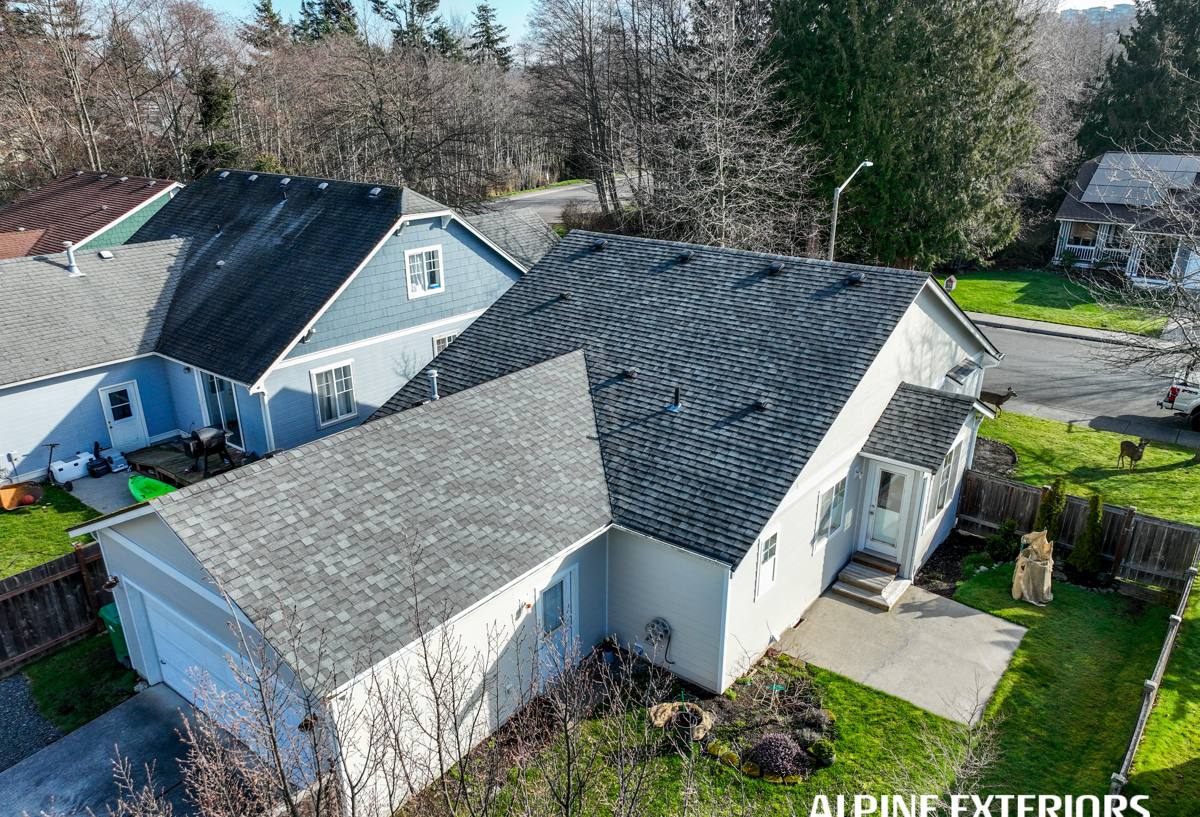
Why We Only Install James Hardie Fiber Cement
We install James Hardie fiber cement siding exclusively. We don't install LP SmartSide, vinyl, cedar, primed spruce, Cemplank, or Allura. That's not a marketing position — it's an operational one, built from watching how different siding materials actually perform after a decade or two of Whatcom County weather, not just how they look on install day.
Fiber cement is a mix of Portland cement, sand, and cellulose fiber, cured into a dense, stable board. It doesn't absorb water the way wood-based products do, it isn't fuel for fire the way wood or wood-composite sidings are, and it holds paint and factory finish dramatically longer than raw wood substrates. James Hardie has been making this specific product category for decades and backs it with engineering data and regional-specific product lines, which matters when you're deciding what goes on a house that has to survive thirty or more Whatcom County winters.
What This Means for a Nooksack Homeowner
In practice, choosing Hardie means the siding on your home resists the two things that do the most damage in this climate: sustained moisture and biological growth (moss, algae, mildew). It also means you're not repainting every five to seven years the way you would with raw wood siding, and you're not dealing with the seam and expansion issues that show up on vinyl after years of temperature cycling.
Why We Don't Install LP SmartSide, Vinyl, or Wood Siding
Every siding product on the market has a rational case behind it. We're not going to tell you LP SmartSide or cedar are bad products in some absolute sense — we're going to tell you why we, specifically, stopped installing them and standardized on one material instead.
LP SmartSide
LP SmartSide is an engineered wood product — strand board with a resin-treated surface. It's lighter and easier to handle than fiber cement, and it holds up reasonably well when installation details (flashing, caulking, ground clearance, cut-edge sealing) are followed exactly. The problem is that it's still wood-based, and wood-based products are dependent on the integrity of that treated surface staying intact. Any breach — a missed caulk joint, a cut edge left unsealed, prolonged contact with standing water — gives moisture a path into the substrate, and once that happens, swelling and deterioration follow. In a climate as consistently wet as Whatcom County's, we'd rather not build a warranty promise on "as long as every seal holds forever."
Vinyl Siding
Vinyl is inexpensive and low-maintenance in mild climates, but it's a thin plastic product that expands and contracts significantly with temperature swings, can crack in cold snaps, and fades under UV exposure over time. It also doesn't offer the fire resistance or the premium factory-finish appearance that fiber cement does, and it's not a product we can stand behind as a long-term investment on a Whatcom County home.
Cedar, Primed Spruce, Cemplank, and Allura
Cedar and primed spruce are real wood, and real wood needs real maintenance — recoating, caulking, and vigilant moisture management — to survive a climate where it rarely gets a chance to fully dry out. Cemplank and Allura are both fiber cement products, similar in concept to Hardie, but we've standardized on one manufacturer, one set of engineering specs, and one warranty structure so our crews install to a single, well-understood system every time rather than switching materials and methods project to project.
James Hardie Product Lines and Why HZ Ratings Matter
James Hardie engineers its siding by climate zone, and the Pacific Northwest — including all of Whatcom County — falls into their HZ5 wet/mixed climate category. That's not a marketing label; it's a manufacturing specification that determines the moisture-resistance formulation of the board itself. Installing a product engineered for a dry climate in a place like Nooksack is exactly the kind of mismatch that shows up as problems ten years down the road.
| Hardie Product Line | Typical Use | What It Offers |
|---|---|---|
| HardiePlank Lap Siding | Most common — full house exteriors | Classic horizontal lap look, wide color and texture range |
| HardieShingle | Accent areas, gables, dormers | Staggered or straight-edge shingle profile for architectural detail |
| HardiePanel | Modern/vertical board-and-batten looks | Clean vertical lines, often paired with trim for a contemporary look |
| HardieTrim | Corners, window and door trim, fascia | Matches the siding system for a consistent, integrated finish |
Most Hardie products are also available in ColorPlus Technology — a factory-applied, baked-on finish that's more UV- and weather-resistant than field-applied paint, and that comes with its own finish warranty separate from the substrate warranty. For a Nooksack home, that factory finish is one less maintenance item to worry about through the wet months.
Full Exterior Envelope: Siding, Roofing, Windows, and Decks
Siding doesn't work in isolation. Water that gets past a roof edge, a window flashing detail, or a deck ledger connection ends up in the wall assembly regardless of how good the siding itself is. Because we handle roofing, windows, and decks in addition to siding, we look at a Nooksack home's exterior as one connected system rather than a series of unrelated trades.
Roofing
Roof condition directly affects siding longevity — poor flashing at rooflines, undersized gutters, or aging roofing material send water exactly where it shouldn't go: down the wall. When we're on-site for a siding project, we're also evaluating whether roof-to-wall transitions are contributing to the moisture problem.
Windows
Window flashing is one of the most common sources of hidden water intrusion in older Whatcom County homes. Replacing siding is a natural point to also correct window flashing details that may have been done incorrectly — or not at all — in the original construction.
Decks
Deck ledger boards attach directly to the house structure, and a poorly flashed ledger connection is a well-documented source of rot in Pacific Northwest homes. If your deck project touches the exterior wall, it's worth coordinating with your siding plan rather than treating them as separate jobs.
Why a Local Whatcom County Crew Matters
Fiber cement siding is only as good as its installation. Hardie publishes specific fastening patterns, minimum clearances from grade and roofing, joint treatment requirements, and caulking specs — and skipping or guessing at any of those details is how a well-made product ends up with the same failures people associate with cheaper materials.
A crew that works regularly in Whatcom County — Nooksack, Everson, Lynden, Sumas, and the surrounding areas — has seen how local conditions actually play out on real houses: which wall orientations take the worst weather, where moss establishes first, how ground clearance requirements need to be handled on properties with less-than-ideal drainage. That's the kind of judgment that doesn't come from a spec sheet alone, and it's why we don't treat installation as an afterthought to the material choice.
Installation Checklist We Follow on Every Job
- Confirm and correct minimum clearance between siding and grade, decking, and roofing surfaces
- Install proper weather-resistive barrier and flashing at all penetrations before siding goes up
- Follow manufacturer-specified fastener type, spacing, and embedment
- Pre-treat and seal all field-cut edges per Hardie installation guidelines
- Use correct joint treatment and caulking at butt joints, corners, and trim transitions
- Verify window and door flashing integration with the new siding plane
- Final inspection walk-through with the homeowner before job close-out
What Drives the Cost of a Siding Project
Every Whatcom County home is different, and we don't publish blanket pricing because square footage alone doesn't determine cost. These are the factors that actually move the number:
| Factor | Why It Matters |
|---|---|
| Existing siding removal | Tear-off and disposal of old material adds labor and hauling cost |
| Substrate and sheathing condition | Rot or moisture damage found underneath must be repaired before new siding goes on |
| House complexity | Dormers, multiple gables, and cut-up wall lines take more labor than a simple rectangular footprint |
| Product line and profile | Lap siding, shingle accents, and panel/trim combinations vary in material and labor cost |
| Finish choice | Factory ColorPlus finish versus field painting affects both cost and long-term maintenance |
| Trim and flashing scope | Full trim replacement and corrected flashing details add scope but reduce future risk |
The only way to get an accurate number is a walk-around of the actual house, which is what a real estimate is for.
Signs Your Current Siding Is Losing the Fight
Homeowners in Nooksack often wait until damage is visible before calling anyone, but several early signs are worth acting on sooner:
- Persistent moss or algae staining that returns quickly after cleaning
- Soft or spongy spots when you press on wood-based siding
- Paint that's peeling, bubbling, or failing faster than expected
- Visible warping, cupping, or gaps at seams and corners
- Rising energy bills that may point to a compromised wall assembly
- Water stains on interior walls near exterior corners or window heads
Any one of these on its own isn't necessarily an emergency, but they're all worth a professional look before the next wet season sets in.
Getting an Estimate
If you're weighing a siding, roofing, window, or deck project on a Nooksack home, we're happy to walk the property, look at what's actually happening with your current exterior, and give you a straightforward assessment — including whether Hardie fiber cement is the right call for your situation and what it would take to get there. Reach out for a free, no-pressure estimate using the form below.