 Whatcom County
 Why So Many Birchwood Decks Need Full Replacement, Not Patching
By the time most homeowners in Birchwood call about a deck, the deck has usually been giving them small warnings for a while — a soft board here, a wobbly railing post there, a stain that never seems to hold. In this part of Whatcom County, those small warnings tend to add up faster than they would somewhere drier and more sheltered. Salt-tinged air drifting in off the water works on exposed fasteners and hardware year-round, driving rain gets pushed sideways and underneath railings and boards during the wetter months, and shaded or north-facing decks stay damp long enough for moss and algae to take hold and never fully let go. None of that means a deck is a bad investment here. It means a deck built or maintained without those conditions in mind tends to fail earlier than its age would suggest.
Replacement and repair are not the same job, and treating a replacement-level problem as a repair usually just delays a bigger expense while masking a safety issue underneath. This page covers how to tell the difference, what a correct full deck replacement actually involves for a Birchwood property, and how we run that job from first estimate to final walkthrough.
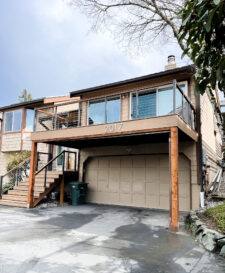
Repair or Replace? How to Tell
A lot of decks get patched for years past the point where patching still makes sense, usually because the visible damage looks isolated even when the underlying structure isn't. The questions below are the ones we actually walk through on site before recommending either path.
- Is the ledger board — where the deck bolts to the house — showing separation, staining, or soft wood behind the flashing?
- Do more than a few joists or the ledger itself show rot, not just the decking boards on top?
- Are post bases sitting in standing water, buried soil, or failed concrete footings?
- Does the whole structure flex, bounce, or sway when several people are standing on it?
- Is the deck old enough that it predates current guardrail and baluster spacing requirements?
- Has moss or algae regrowth become a monthly problem rather than a seasonal one, even after cleaning?
One or two "yes" answers on cosmetic items can often be handled with targeted repair. Multiple "yes" answers on the structural questions — ledger, framing, or footings — is usually where repair stops being the honest recommendation, because you'd be paying to rebuild the same problem into a deck that still isn't sound underneath.
What a Correct Deck Replacement Actually Involves
Structural Framing and the Ledger Connection
The ledger board is where the deck ties into the house, and it's also the single most common point of failure on older decks in this climate, because it sits directly against a wall that's already managing its own water. A correct replacement bolts the ledger to the house's rim joist with structural lag screws or through-bolts, not nails, and installs flashing that laps correctly with the house's existing water-resistive barrier so water is directed out and away rather than behind the siding. Joists get sized and spaced to the actual span and load, not guessed at, and hardware — joist hangers, post bases, structural screws — gets specified for the moisture and salt exposure this area sees rather than whatever was standard decades ago.
Footings and Post Bases
Undersized or shallow footings are common on older Birchwood decks, especially ones built before current frost depth and bearing requirements were consistently enforced. A full replacement is the point where footings get corrected — poured to proper depth and size for the soil and load, with post bases that hold the post above grade and off standing water rather than embedded in soil or sitting flush with a wet slab. This is also usually the cheapest point in a deck's life to fix a footing problem, since the framing is already open.
Drainage and Board Spacing
Framing gets a slight slope away from the house, and decking boards get gapped consistently so water sheds through rather than pooling on the surface. That gap also matters for how quickly a board dries out between rain events — a board that stays damp for days at a time is a board that grows moss and softens faster than one that dries within a few hours of the rain stopping.
Choosing Decking Material for This Climate
Material choice matters more here than it would in a drier climate, because the gap between a well-suited product and a poorly-suited one shows up within a season or two, not years. The honest trade-offs come down to upkeep, moisture behavior, and upfront cost.
| Material | Salt Air & Moisture Behavior | Moss Resistance | Upkeep Required | Relative Upfront Cost |
|---|---|---|---|---|
| Pressure-treated wood | Absorbs moisture; hardware corrosion risk increases over time | Low — porous surface, needs regular cleaning | Annual sealing or staining | Lowest |
| Cedar | Naturally rot-resistant but still absorbs moisture without upkeep | Moderate — still needs regular cleaning | Sealing/staining every 1–2 years | Moderate |
| Capped composite | Strong — cap layer resists moisture absorption and staining | Good on most product lines | Occasional washing | Higher |
| Cellular PVC | Excellent — no wood fiber to absorb moisture at all | Strong, smooth non-porous surface | Occasional washing | Highest |
We don't push one material as automatically "correct" for every Birchwood home. Wood costs less upfront and can be replaced in sections if it's damaged, but it demands real annual upkeep to hold up here — miss a season or two of sealing and moss and graying show up fast. Composite and PVC cost more initially and can't be spot-repaired as easily since boards don't fade or weather the same way after patching, but they hand back that upfront cost in far less annual maintenance. The right call usually comes down to whether you'd rather spend time on upkeep or spend more once and mostly leave it alone.
Our Deck Replacement Process
1. On-Site Estimate
We walk the existing deck with you, check the ledger, framing, and footings from underneath where possible, and talk through what you actually use the deck for — entertaining, grilling, just getting from the door to the yard — since that shapes size and layout decisions as much as the climate does. You get a written scope, not a verbal ballpark.
2. Permitting
Most structural deck replacements in Whatcom County require a permit, and we handle that application and the required inspections rather than leaving it on you to navigate. Skipping this step is a common shortcut that creates real problems later, particularly when selling the home or filing an insurance claim after storm damage.
3. Demolition
Old decking, railing, and — where the framing doesn't meet current standards — the ledger, joists, and footings come out. We haul debris off site as part of the job rather than leaving it for you to deal with.
4. Framing and Footings
New footings, posts, ledger, and joists go in to current code and to the loads the deck will actually see, with hardware and flashing specified for this area's moisture and salt exposure rather than whatever's cheapest.
5. Decking, Railing, and Finish
Decking goes down with correct gapping and fastening for the material chosen, railing and any stairs get installed to current guardrail height and baluster spacing requirements, and we do a final walkthrough with you before calling the job done.
Permits and Code in Whatcom County
Deck replacement that involves new framing, footings, or a change in size or height above grade almost always needs a permit in Whatcom County, whether the property sits inside city limits or in the unincorporated county. Requirements around guardrail height, baluster spacing, and stair geometry get enforced at inspection, and they're not optional details — they're there because deck failures and fall injuries are a real, well-documented category of home accidents. We pull permits as part of the job and coordinate inspections directly, but if you're getting a second opinion from another contractor, it's worth asking directly whether permitting is included in their quote or treated as an extra.
Keeping a New Deck Ahead of Moss Season
A correctly built deck still needs some seasonal attention in this climate — the goal of a good replacement is reducing that burden, not eliminating it entirely.
- Clear leaves and debris off the decking regularly through fall so they don't trap moisture against the boards
- Rinse the surface with plain water or a deck-safe cleaner before moss gets a foothold, rather than after it's established
- Keep gutters and downspouts clear so roof runoff isn't sheeting across the deck surface
- Trim back overhanging branches and shrubs where possible so boards get a chance to dry between rain events
- If you chose wood, keep sealing or staining on schedule — this is the single biggest factor in how long wood decking actually lasts here
- Check railing connections and visible fasteners once a year for movement, rust staining, or looseness
Why a Crew That Already Works Birchwood Matters
A deck replacement done by a crew that already works this part of Whatcom County isn't guessing at how much flashing detail is enough or which footing depth actually holds up here — they've seen what fails and what doesn't over enough jobs to know the difference before it becomes a callback. That familiarity also shows up in smaller ways: knowing how the local permitting process actually runs, sequencing work around the wetter months instead of getting caught mid-project by a stretch of driving rain, and specifying hardware and fasteners rated for salt-air exposure as a default rather than an upsell. None of that is complicated, but it's the difference between a deck that needs attention again in a few years and one that doesn't.
If your Birchwood deck is showing its age — soft spots, a wobbly rail, a ledger that doesn't look right, or just years of patching that haven't solved the underlying problem — we're happy to take a look and give you a straight answer on whether it's a repair or a replacement. Reach out for a free, no-pressure estimate using the form below.