 Whatcom County
 Why Everson Decks Take More Punishment Than People Expect
Everson sits inland from the coast, but that doesn't spare it from Whatcom County's marine-influenced weather pattern. Homes here deal with long stretches of driving rain from fall through spring, humid air that never fully dries out a deck surface, and a moss season that can run half the year on anything shaded or north-facing. Add in the salt-laden air that moves through the broader Whatcom County region off Bellingham Bay and the Strait of Georgia, and you've got a combination that's rough on fasteners, finishes, and untreated wood alike.
A deck that looks fine when it's installed in July can start showing problems by the second or third winter if it wasn't built with this climate in mind. That's not a knock on any one material — it's just what happens when moisture sits against wood fiber, metal hardware, or poorly drained framing for months at a time. Composite decking, installed correctly, is one of the more reliable answers to that problem for Everson homeowners who are tired of re-staining, sanding, and chasing rot every couple of years.
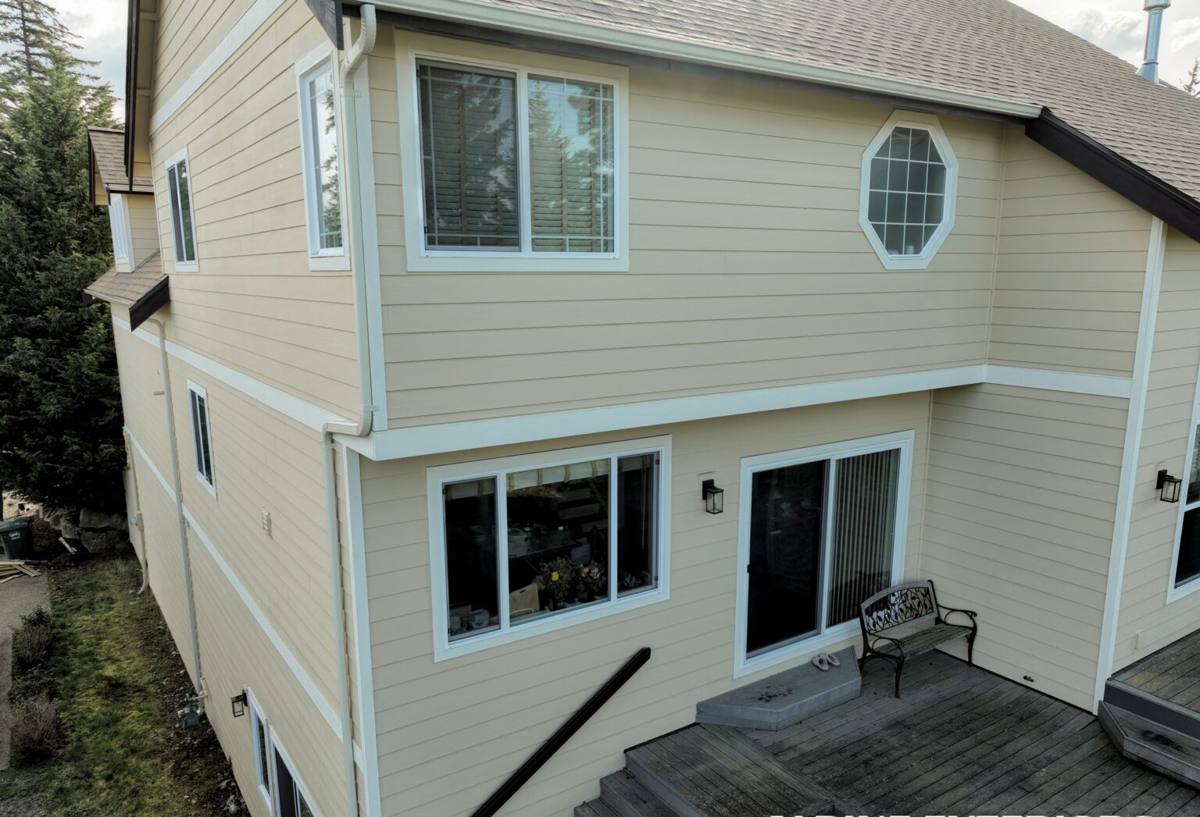
What Composite Decking Actually Solves Here
Moisture and Rot Resistance
Composite decking boards are made from a blend of wood fiber and plastic (usually polyethylene or polypropylene), which means the board itself doesn't absorb water the way solid lumber does. That matters a lot in a climate where boards can stay damp for days after a storm. Wood decking left wet that long is exactly how you get soft spots, splinters, and eventually rot at the joints and fastener holes. Composite doesn't eliminate moisture exposure, but it removes the wood-rot pathway that causes most structural deck failures in this area.
Moss and Algae Growth
Moss doesn't care what your decking is made of — it'll grow on any surface that stays damp and shaded long enough, composite included. The difference is how the surface handles it. Quality composite boards have a cap layer (a shell bonded over the core material) that resists staining and makes moss and algae easier to rinse off before they get a foothold. Bare or aging wood decking, by contrast, has open grain that moss can root into, which is why older wood decks in shaded Everson yards often look green within a season or two of being cleaned.
Composite vs. Wood vs. PVC: An Honest Comparison
There's no single "best" decking material for every house — it depends on your budget, how much upkeep you're willing to do, and how exposed the deck is to rain and shade. Here's how the three most common options actually compare for a home in this climate.
| Material | Upfront Cost | Ongoing Maintenance | How It Handles Our Wet Season |
|---|---|---|---|
| Pressure-treated wood | Lowest | Annual cleaning, periodic staining/sealing | Needs consistent upkeep to resist rot and moss; skipped maintenance shows fast |
| Composite | Mid to upper | Occasional wash-down, no staining or sealing | Resists moisture absorption and rot; surface can still need cleaning for moss and pollen |
| PVC (cellular vinyl) | Highest | Lowest of the three | Fully moisture-proof core, but can feel and look less like natural wood, and is less forgiving of installation errors |
We install composite for most Everson homeowners because it hits the balance point: far less maintenance than wood, without the higher price and more particular installation requirements of full PVC systems. That's our standard recommendation, not a rule — if a homeowner has a specific reason to want wood or PVC, we'll build it right either way.
What a Correct Composite Deck Installation Involves
Substructure and Drainage First
The composite boards get the attention, but the framing underneath is what actually determines whether the deck lasts. In a climate with this much rainfall, joist spacing, proper flashing where the deck meets the house, and a ledger board that's sealed and flashed correctly are non-negotiable. Composite manufacturers publish minimum joist spacing requirements specifically because their boards flex differently than wood — building to lumber-deck standards on a composite deck is a common corner-cutting mistake that leads to bounce and long-term sagging.
Fasteners and Board Layout
Hidden fastener systems (clips that sit in a groove along the board edge, rather than screws driven through the face) give a cleaner look and reduce the number of penetration points where water could otherwise sit. Board gapping also has to account for our climate — composite expands and contracts with temperature and moisture more than people expect, and gaps that are too tight will buckle over a wet winter, while gaps that are too loose collect debris and moss.
Railings, Stairs, and Code
Guardrail height, baluster spacing, and stair geometry are governed by Whatcom County's adopted building code, and permit requirements typically kick in based on deck height and attachment to the house. We handle that as part of the job rather than leaving it for the homeowner to sort out after the fact.
Where We See Decks Go Wrong in This Area
Most of the composite deck problems we get called out to inspect trace back to a handful of avoidable issues:
- Ledger boards attached to the house without proper flashing, letting water track behind siding
- Joist spacing built to wood-deck spec instead of the tighter spacing composite boards require
- Boards installed with no gap adjustment for seasonal expansion, leading to buckling
- Poor under-deck drainage, so water pools against posts and footings instead of running off
- Fasteners or hardware that aren't corrosion-rated for a marine-influenced climate, rusting and staining the deck within a couple of seasons
None of these are composite decking's fault — they're installation shortcuts that show up faster here than they would in a drier climate. It's the main reason we push back on "quick and cheap" builds even when a homeowner is trying to save money; the labor to do the framing and flashing right doesn't cost much more, and it's the part that actually determines whether the deck holds up.
Our Process, Start to Finish
- On-site assessment — we look at the existing structure (if there is one), drainage, sun/shade exposure, and how the deck connects to the house.
- Material and layout discussion — we walk through composite board options, color, and layout based on the homeowner's budget and how the space will be used.
- Permitting — where the project requires a Whatcom County permit, we handle the application and inspections as part of the job.
- Demolition and framing — old decking is removed and the substructure is built or reinforced to composite manufacturer spec, with flashing and drainage addressed before a single deck board goes down.
- Decking, railing, and finish work — boards, hidden fasteners, railings, stairs, and any lighting or fascia trim are installed.
- Final walkthrough — we go over care basics and answer questions before we consider the job done.
Living With Composite Decking Here: Realistic Maintenance
Composite decking is marketed as "low maintenance," which is true relative to wood, but it isn't "no maintenance" in a climate that grows moss on rooftops. Here's what actually keeps a composite deck looking good through an Everson winter:
- Sweep off leaves and debris regularly in fall — trapped organic matter under leaves is what feeds moss and mildew growth
- Rinse the deck with a hose and mild soap a couple of times a year, more often in shaded areas
- Avoid pressure washing at close range or high PSI, which can damage the board's cap layer
- Keep gutters and downspouts near the deck clear so runoff isn't dumping directly onto the surface or framing
- Check under-deck ventilation isn't blocked by stored items, since airflow underneath helps everything dry out between storms
What Affects the Cost
We won't quote a number without seeing the site, but these are the factors that move the price up or down on most composite deck projects in this area:
| Cost Factor | Why It Matters |
|---|---|
| Deck size and shape | More square footage and cut angles mean more material and labor |
| Existing structure condition | Reusing sound framing costs less than a full tear-out and rebuild |
| Height and grade | Elevated decks need more substructure, railing, and often stairs |
| Composite product tier | Board lines vary in cap technology, color options, and warranty length |
| Site access | Tight lots or difficult material access can add labor time |
| Permitting requirements | Height, attachment, and location can trigger inspections that add time to the schedule |
Why It Matters to Hire a Crew That Already Works This Area
Building a deck in Everson isn't fundamentally different from building one anywhere else, but knowing this stretch of Whatcom County's rain patterns, drainage behavior, and permit process saves real time and rework. A crew that already works locally isn't guessing at joist spacing for a wetter-than-average climate, isn't surprised by how fast moss establishes on a shaded north wall, and already has a working relationship with the county's permitting process instead of learning it project by project. That local familiarity shows up in fewer callbacks and a deck that's actually built for the conditions it has to survive, not just for the day it's finished.
If you're weighing composite decking for your Everson home, we're happy to take a look at your site, talk through honest options, and put together a straightforward estimate — no pressure, no sales script. Use the form below to get started.