 Whatcom County
 Why Everson Roofs Wear Out Differently Than Roofs Inland
Everson sits in a part of Whatcom County where the weather doesn't do a homeowner any favors. The combination of salt-laden air moving in off the Sound, long stretches of driving rain through fall and winter, and a moss season that can run most of the year puts a different kind of stress on a roof than you'd see in a drier climate. It's not one big event that wears a roof out here — it's the slow accumulation of moisture, organic growth, and corrosion that most homeowners don't notice until it shows up as a stain on a ceiling or a soft spot underfoot in the attic.
A roof replacement in this area isn't just about swapping old shingles for new ones. It's about building a roof system that's designed to shed water fast, resist moss colonization, and hold up to salt exposure over the long haul. That's a different set of priorities than a roofer used to arid climates would bring to the job, and it's worth understanding before you sign a contract.
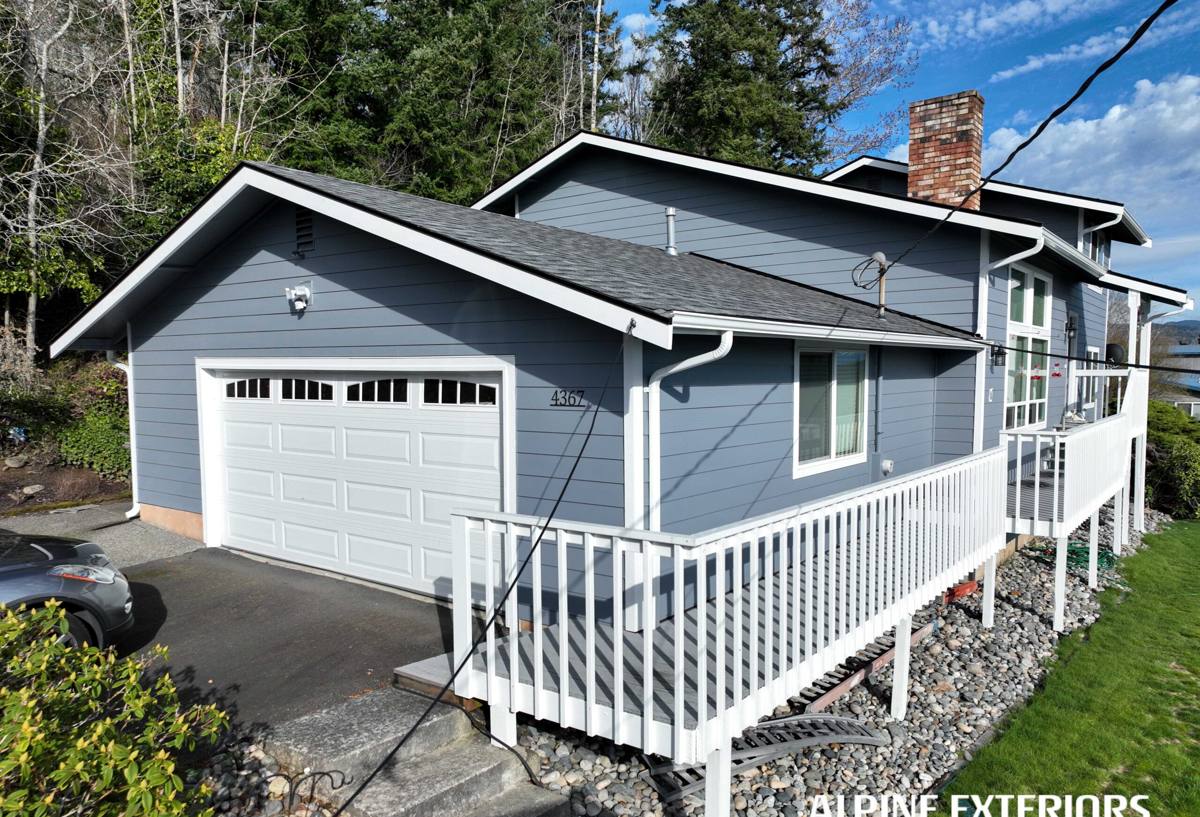
What Whatcom County Climate Does to a Roof Over Time
Moss and Organic Growth
Moss doesn't just sit on top of a roof looking bad — it actively works against the shingles underneath. Moss holds moisture against the roofing material long after a storm has passed, and its root structures work into shingle granules and seams over years of growth. On a roof with poor airflow or shaded sections, moss can establish itself within a couple of seasons and start lifting shingle edges, which is exactly where wind-driven rain finds its way in.
Driving Rain and Wind-Driven Moisture
Straight-down rain is easy for almost any roof to handle. The problem in this region is rain that comes in at an angle, pushed by wind off open fields and low terrain. That kind of weather tests every lap, seam, and fastener on a roof, not just the flat field area. Flashing details around chimneys, vents, and valleys take the brunt of it, and it's usually flashing failure — not shingle failure — that causes the leaks homeowners actually deal with.
Salt Air and Metal Corrosion
Even at a distance from open water, salt-carrying air moves inland with weather systems and settles on exposed metal components — nails, flashing, vent caps, and gutter hardware. Over years, that accelerates corrosion in lower-grade fasteners and flashing, which is why material selection matters more here than it would in a landlocked climate with the same rainfall.
Signs an Everson Roof Needs Replacing, Not Patching
Not every roof problem calls for a full replacement, but there's a point where patching stops making financial sense. Here's what typically tips a roof from "repair" to "replace" territory in this climate:
- Granule loss heavy enough that you can see bare shingle mat in multiple areas, not just one isolated spot
- Moss or algae growth that comes back within a season of cleaning, even after treatment
- Soft or spongy decking felt underfoot in the attic, which signals moisture has already reached the wood
- Shingles that are curling, cupping, or losing their seal along multiple courses
- Recurring leaks around the same penetration despite repeated flashing repairs
- A roof at or past the manufacturer's expected service life for this climate, even if it looks intact from the ground
A roof that's twelve or fifteen years old and showing two or three of these signs at once is usually cheaper to replace now than to keep patching for another few years while the decking underneath continues to take on moisture damage.
What a Correct Roof Replacement Involves Here
Tear-Off and Deck Inspection
A full tear-off to the decking is the only way to know what's actually happening underneath the shingles. In this climate, we routinely find soft or delaminated decking around valleys, chimneys, and eave edges — areas where water has been finding its way in slowly for years without an obvious interior leak. Replacing damaged decking before the new roof goes down isn't an upsell; it's the difference between a roof that lasts and one that fails early from the inside out.
Underlayment Built for Wet Climates
We use synthetic or self-adhered underlayment products suited to sustained wet weather rather than the minimum builder-grade felt. In valleys and along eaves, ice-and-water shield style membrane gives an extra layer of protection in the spots most likely to see standing water or wind-driven rain intrusion.
Flashing Done Right
Flashing is where most roof leaks actually originate, not the field shingles. That means new step flashing at walls and chimneys, correctly lapped valley flashing, and properly sealed penetrations for vents and pipes — done to shed water downhill at every layer, not caulked as an afterthought.
Ventilation That Fights Moss and Moisture
Balanced intake and exhaust ventilation keeps the underside of the roof deck dry and reduces the temperature and moisture conditions moss thrives in. A roof replacement is the right time to correct ventilation problems, since the deck is already exposed and any needed vent modifications are far easier to do now than after the new roofing is installed.
Material Selection for Moss and Salt Exposure
We steer homeowners toward algae-resistant shingle lines and corrosion-resistant flashing and fastener grades for this specific climate. It's a matter of matching the product to the environment — a fastener or flashing spec that's fine in a dry inland climate isn't necessarily the right long-term choice this close to the coast, and we'll walk through those trade-offs honestly rather than defaulting to the cheapest option on the shelf.
Comparing Roofing Approaches for This Climate
| Factor | Standard Approach | Climate-Matched Approach for Everson |
|---|---|---|
| Underlayment | Basic felt paper | Synthetic underlayment plus membrane at valleys and eaves |
| Shingle type | Standard architectural shingle | Algae-resistant shingle line to slow moss regrowth |
| Fasteners and flashing | Standard-grade galvanized | Corrosion-resistant grade suited to salt-air exposure |
| Ventilation | Left as-is unless failing | Evaluated and corrected during tear-off |
| Valley detail | Closed-cut shingle valley | Metal or membrane-reinforced valley for heavy rain volume |
None of this is about upselling every homeowner into the most expensive option available. It's about making sure the roof you get matches the weather it actually has to survive, and being upfront about which upgrades genuinely earn their cost in this climate versus which ones don't.
What Roof Replacement Typically Costs and What Drives the Range
Every roof is different, and giving a number without seeing the roof wouldn't be honest. In general terms, cost is driven by roof size, pitch, the number of penetrations and valleys, decking condition once it's exposed, and the material tier chosen. Steeper roofs and roofs with complex valley or dormer layouts take more labor and material than a simple rectangular roof of the same square footage. Decking replacement, if needed, is priced by the sheet once the old roofing is off and the wood is visible — we'll show you what we find before any of that work happens, not after the fact.
The most reliable way to get an accurate number is a walk of the roof and an honest look at its current condition, which is what a free estimate is for.
Our Roof Replacement Process
- On-site inspection and roof assessment, including attic access where possible
- Written estimate that breaks out material tier, labor, and any decking allowance
- Scheduling around Whatcom County's weather windows to minimize the deck's exposure time
- Full tear-off, deck inspection, and repair of any damaged sheathing
- Underlayment, flashing, ventilation correction, and new roofing installation
- Final walkthrough and cleanup, including magnetic nail sweep of the property
We plan installation dates around the weather rather than around convenience, because a roof deck left exposed during a wet stretch causes more problems than it solves. That means we're realistic with homeowners about scheduling rather than promising a date we can't guarantee.
Why a Crew That Already Works in Everson Matters
A roofing crew that works Whatcom County regularly already knows which shingle lines hold up to this specific combination of moss pressure, rain volume, and salt exposure, because they've gone back and looked at roofs they installed five and ten years earlier. That kind of feedback loop doesn't exist for a crew that installs a handful of roofs in a region and moves on. Local experience also means knowing which flashing and ventilation mistakes show up repeatedly on older Whatcom County homes, so they can be corrected during replacement instead of repeating down the line.
There's also a practical side to it: a local crew is available for warranty follow-up and can respond quickly if a question comes up after the job is done, rather than being a phone number for a company based somewhere else entirely.
Get a Straightforward Estimate
If your Everson home's roof is showing its age, or you just want an honest read on how much life it has left, we're glad to take a look. The estimate is free, there's no pressure attached to it, and you'll get a clear explanation of what we find and what it would take to fix it right. Use the form below to get started.