 Whatcom County
 Fairhaven's Climate Is Harder on a Roof Than Most Homeowners Realize
Fairhaven sits right up against Bellingham Bay, and that location shapes what a roof has to put up with year after year. Salt-laden air off the water accelerates corrosion on exposed metal — nail heads, flashing, vent stacks, and gutter hardware all take more of a beating here than they would further inland. Add in wind-driven rain that comes off the water sideways during fall and winter storms, and you've got conditions that will find every weak seam, every under-lapped shingle, and every gap in flashing within a season or two.
Then there's moss. Whatcom County's moss season isn't a two-month nuisance — it's close to year-round, thanks to the shade, humidity, and mild temperatures that let moss and algae establish themselves on north-facing slopes and anywhere tree cover keeps a roof from drying out between rains. Left alone, moss lifts shingle edges, holds moisture against the roof deck, and shortens the life of even a well-installed roof.
None of this means asphalt shingle roofing is a poor choice for Fairhaven — it's still one of the most practical, cost-effective options available. It means the installation details matter more here than they would in a drier, calmer climate, and cutting corners shows up faster.
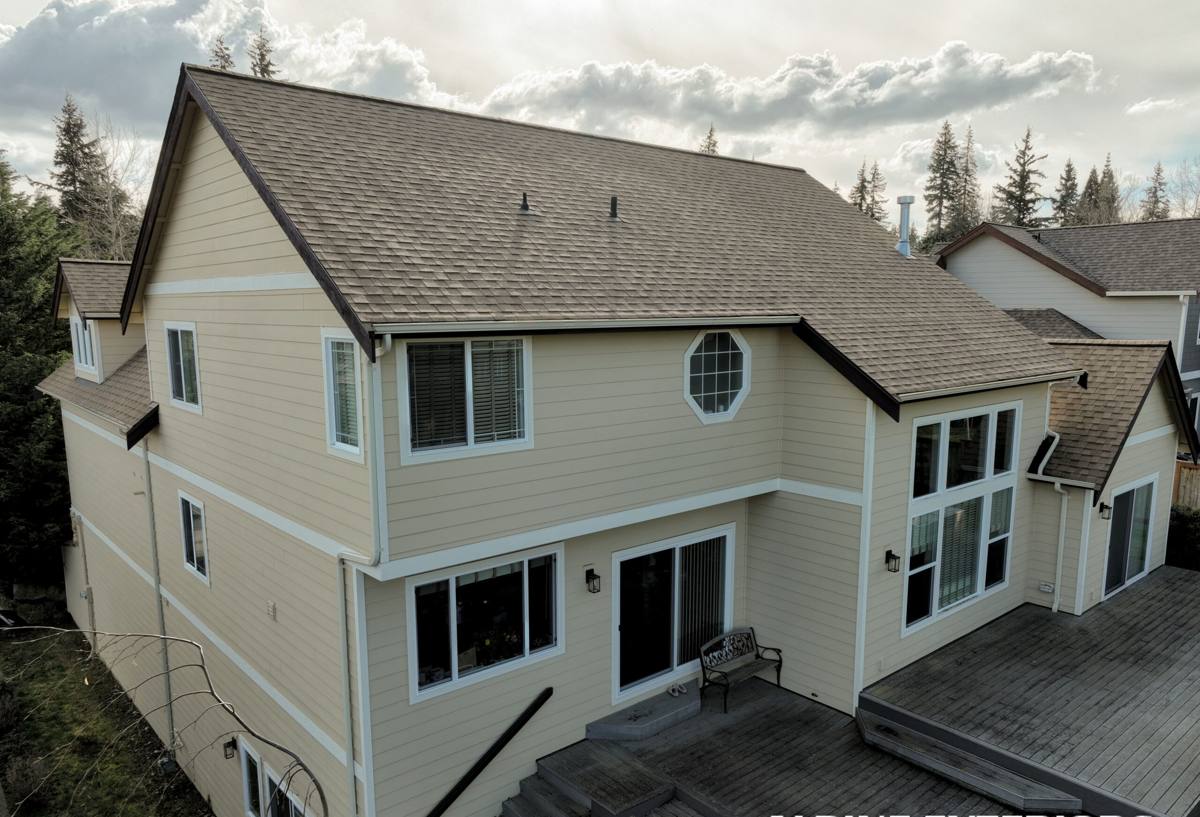
Signs Your Fairhaven Roof Needs Attention
Because the damage here tends to start at the edges and details rather than the shingle field itself, a lot of early warning signs get missed from the ground. Here's what we tell homeowners to watch for:
- Moss or dark streaking concentrated on shaded or north-facing slopes
- Granules collecting in gutters or at downspout outlets
- Shingle edges that look lifted, curled, or cupped
- Rust staining around vent pipes, flashing, or exposed fasteners
- Soft spots or slight sagging when walked on (a sign of deck moisture)
- Daylight visible through the roof deck from inside the attic
- Water stains on interior ceilings, especially near chimneys or valleys
- Shingles missing or torn loose after a windstorm off the bay
Any one of these on its own might just mean a repair. Several at once, or a roof pushing past 15-20 years, usually means it's time for a real inspection and an honest conversation about repair versus replacement.
What a Correctly Installed Asphalt Shingle Roof Actually Includes
A shingle roof is only as good as the layers underneath it. In a climate like this one, the underlayment, flashing, and ventilation do as much work as the shingles themselves.
Underlayment and Ice-and-Water Protection
A synthetic underlayment goes down over the full deck as the first line of defense against wind-driven rain that gets under the shingle tabs. At eaves, valleys, and around penetrations — the spots most exposed to standing water and wind-blown rain — a self-adhering ice-and-water membrane adds a second, sealed layer. This isn't optional upgrade territory in a marine climate; it's standard practice for a roof that's meant to hold up.
Flashing That Matches the Site
Flashing around chimneys, skylights, sidewalls, and roof-to-wall transitions is where most leaks actually start, not in the open shingle field. Salt air corrodes cheap or thin flashing faster than homeowners expect, so we use materials sized and detailed for the specific transition, not a one-size-fits-all strip. Step flashing at sidewalls, counter-flashing at chimneys, and properly lapped valley metal all matter more here than in a drier region.
Ventilation That Keeps Moisture Moving
A roof deck that can't breathe traps moisture, and trapped moisture is what feeds moss, rots decking, and shortens shingle life from underneath. Balanced intake at the eaves and exhaust at the ridge keeps air moving through the attic space, which helps the roof dry out between the frequent rain events that are just part of living near Bellingham Bay.
Choosing Shingles for a Marine, Moss-Prone Climate
Not every asphalt shingle product is a good match for this environment. The table below covers the main practical differences homeowners should weigh, independent of brand.
| Factor | 3-Tab Shingles | Architectural (Laminate) Shingles |
|---|---|---|
| Typical wind rating | Lower — more vulnerable to wind-driven storms off the water | Higher — better suited to exposed, waterfront-adjacent lots |
| Algae/moss-resistant granule option | Sometimes available | Widely available, worth specifying here |
| Expected lifespan in this climate | Shorter end of the range | Longer end of the range with proper ventilation |
| Upfront cost | Lower | Moderate to higher |
| Appearance | Flat, uniform | Dimensional, heavier shadow line |
We don't push a specific brand — plenty of manufacturers make a solid product. What we do insist on is a shingle rated for the wind exposure of the specific site and, wherever the budget allows, algae-resistant granules on shaded or north-facing slopes. That one spec change measurably slows how fast moss and dark streaking come back after a cleaning.
How We Approach a Fairhaven Roofing Job
Inspection and an Honest Estimate
We start on the roof, not just from the ground — checking the deck, flashing, ventilation, and the extent of any moss or moisture damage. You get a straight answer on whether you're looking at a repair, a partial re-roof, or a full replacement, along with what's driving that recommendation.
Tear-Off and Deck Prep
Old shingles and underlayment come off down to the deck. This is the point where hidden problems — soft plywood, old leaks, undersized ventilation — actually get found and fixed, rather than covered up under a new layer of shingles.
Installation Day
Underlayment, ice-and-water membrane, flashing, and shingles go on in that order, with extra attention at valleys, chimneys, and any wall transitions — the spots most likely to leak first in this climate. Fasteners are placed and driven to manufacturer spec, since underdriven or overdriven nails are a common, avoidable cause of early failure.
Cleanup and Final Walkthrough
The site gets cleared of debris and swept for stray nails, and we walk the finished roof with you so you know what was done and why, plus what to watch for going forward.
What Affects the Cost of an Asphalt Shingle Roof in Fairhaven
Every roof is priced on its own specifics, but these are the factors that move the number most:
| Cost Factor | Why It Matters |
|---|---|
| Roof pitch and access | Steeper roofs and tight lots near the water take longer and require more safety setup |
| Number of existing layers | Tearing off multiple old layers costs more than a single-layer tear-off |
| Deck condition | Rotted or soft plywood found during tear-off needs replacement before shingles go down |
| Shingle tier chosen | 3-tab vs. architectural, and whether algae-resistant granules are specified |
| Roof complexity | Valleys, chimneys, skylights, and dormers all add flashing labor |
| Ventilation upgrades | Adding or correcting intake/exhaust venting adds cost but pays off in roof life |
Broad ranges vary widely by roof size and condition, so we'd rather walk your actual roof and give you real numbers than quote a generic price that doesn't mean much either way.
Maintenance That Actually Extends Roof Life Here
A shingle roof in Whatcom County benefits from a little more upkeep than the same roof would need in a drier climate. A few habits go a long way:
- Keep gutters and downspouts clear so water isn't backing up under the shingle edge
- Have moss treated (not pressure-washed, which can strip granules) before it builds up thick enough to lift shingles
- Trim back overhanging branches to cut down on shade and debris that keep the roof damp
- Check attic ventilation isn't blocked by insulation or storage
- Have the roof looked at after major windstorms off the bay, even if nothing looks obviously wrong
None of this replaces a proper inspection every few years, but it's the difference between a roof that reaches its full expected lifespan and one that needs early repairs because moisture and moss got a head start.
Why Hiring a Crew That Already Works Fairhaven Matters
Fairhaven isn't like every neighborhood in Whatcom County. Its proximity to Bellingham Bay means more salt exposure and more wind-driven rain than roofs sit through just a few miles inland, and its mix of older and newer homes means deck conditions and roof framing vary more than a cookie-cutter subdivision. A crew that regularly works this specific area already knows which slopes tend to hold moss, which flashing details fail first in this exposure, and how to work efficiently on the tighter lots and access constraints common near the water.
That local familiarity also means fewer surprises during the permitting process with the City of Bellingham and a better sense of realistic timelines around the wetter months, when scheduling a tear-off around the weather actually matters. It's the difference between a roof installed to a generic standard and one installed for the conditions it will actually face.
If your Fairhaven home is due for a roof inspection, a repair, or a full asphalt shingle replacement, we're happy to take a look and give you a straight, no-pressure estimate. Use the form below to get started.