 Whatcom County
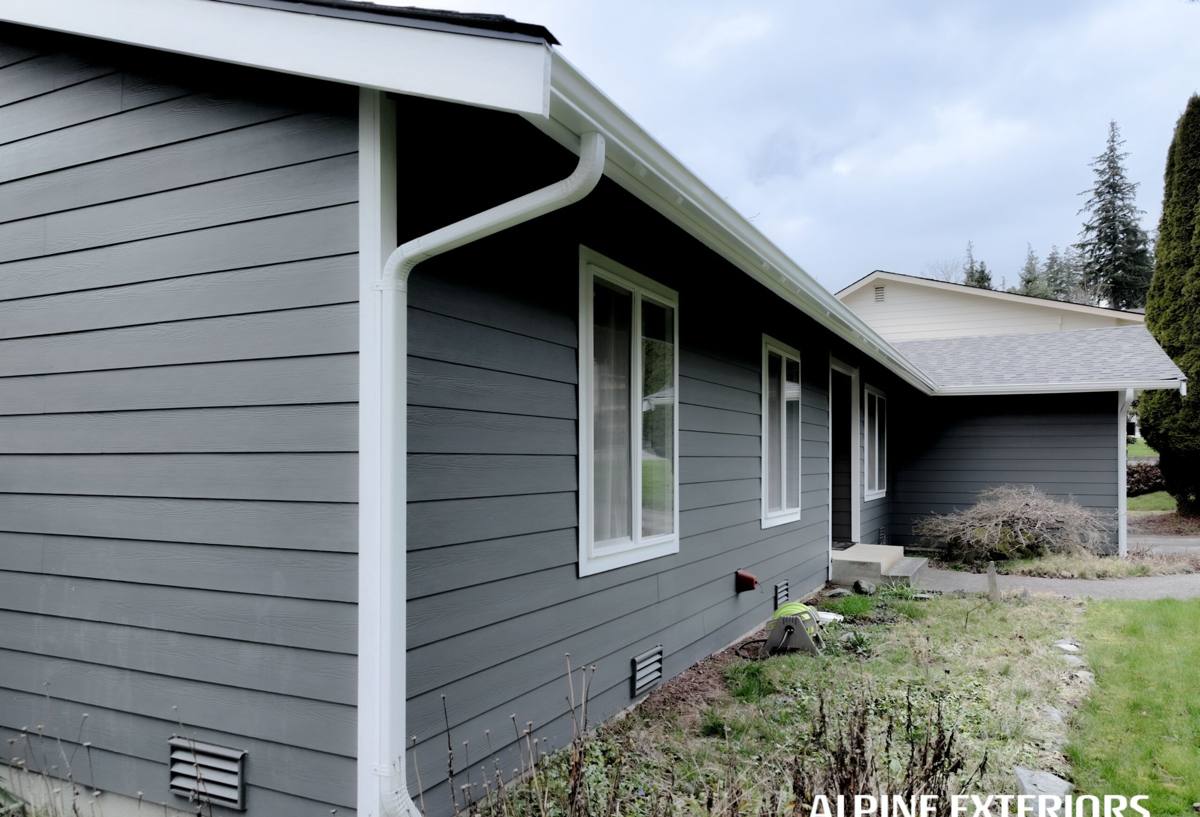
 James Hardie Siding, Sized for Happy Valley's Conditions
Happy Valley sits on the hillside on Bellingham's south side, inside Whatcom County's core weather pattern: close enough to the water for salt air to reach most lots, exposed to rain that comes in sideways more often than it falls straight down, and shaded by enough mature tree cover on many streets that moss has a long, easy season to work with. None of that is unique to this one neighborhood, but the combination is real, and it's why siding that performs fine somewhere drier and calmer can start showing its age here well ahead of schedule.
This page is about one product, in one place: James Hardie fiber cement siding, installed on Happy Valley homes. We install James Hardie exclusively — no vinyl, no LP SmartSide, no Cemplank or Allura, no primed spruce or cedar. That's a professional standard, not a sales angle, and it comes out of watching how differently those materials age in this exact climate compared to a fiber cement system engineered and finished for it. Below is what that actually means for a house in this neighborhood: what the climate demands, what a correct installation involves, how our process runs, and why a crew that already works here brings something a one-time out-of-area bid can't.
What Happy Valley's Climate Actually Puts Siding Through
Three conditions do most of the damage here, and they compound rather than act alone.
Salt Air Off the Sound
Bellingham's proximity to the water means salt-laden air reaches well past the properties with an actual water view. Salt accelerates corrosion on exposed fasteners, hinges, and trim hardware, and it keeps painted or coated surfaces damp longer than they'd stay in a drier inland market. A finish that holds up fine in a landlocked climate doesn't automatically get the same service life here — the gap just shows up slowly, over years, rather than as an obvious early failure.
Wind-Driven Rain
Rain pushed sideways by wind doesn't behave like rain falling straight down. It gets forced into lap joints, under trim, and into any seam where the water management wasn't detailed correctly the first time. That's a much harder ongoing test for caulked joints and any material that depends on an intact surface coating than an annual rainfall total suggests.
A Long Moss Season Under Tree Cover
Happy Valley's hillside streets carry more mature tree canopy than a lot of newer Whatcom County development, and shaded, tree-lined lots hold moisture on the siding surface far longer after a rain than an open, sunny wall does. Mild temperatures and steady dampness add up to active moss and mildew growth for most of the year on those shaded walls. Organic growth on a siding surface isn't just cosmetic — it traps moisture against the wall behind it, and that compounding effect is where a lot of long-term siding problems actually start.
The Hardie Product System Built for This Climate
James Hardie siding is fiber cement: a blend of Portland cement, sand, and cellulose fiber, cured into a rigid, inorganic board. It doesn't have a wood-based or petroleum-based core that can absorb water and swell, rot, or feed insects, and it's non-combustible. Two parts of the Hardie system matter specifically for a Happy Valley home.
The HZ5 Formulation
James Hardie engineers its siding into different formulations for different climate zones, and the HZ5 line is built for regions with sustained moisture exposure and freeze-thaw cycling — which fits a Pacific Northwest winter far better than a formulation engineered primarily for hot, dry climates. Specifying the right HZ line for this region isn't a minor detail; it's part of installing the product correctly.
ColorPlus Factory Finish
Instead of relying on paint applied on site, ColorPlus is baked on in a controlled factory environment, in multiple coats, before the boards ever reach the truck. That matters in a neighborhood with sustained damp and salt exposure, because a factory-cured finish resists the fading and chalking that constant moisture and UV cycling cause over time far better than a field-applied coat does. It carries its own finish warranty, separate from the substrate warranty on the board itself, and that warranty is transferable if you sell the home before it runs out.
What a Correct Installation Actually Involves Here
Fiber cement's reputation depends heavily on how it's installed, and in a wet, shaded neighborhood like Happy Valley the margin for error is smaller than it would be somewhere drier. A few details separate a job that holds up for decades from one that starts failing at year eight or ten.
Clearances and a Drainage Plane
Siding has to be held off grade, decks, and rooflines by the manufacturer's specified clearances, and there needs to be a properly lapped weather-resistive barrier — ideally with a rain screen gap — behind the boards. On a hillside lot where water sheets across the ground during a heavy rain, a board sitting too close to grade or a deck ledger becomes a moisture trap that wicks water into the cut edge over years.
Fastening and Flashing
Nails have to be the correct type, driven to the correct depth, at the correct spacing, with corrosion-resistant fasteners suited to salt-influenced air. Flashing at every window, door, and roof-to-wall intersection — including kick-out flashing wherever a roofline dies into a wall — is what actually keeps wind-driven rain out of the wall assembly. None of this is visible on day one. Missing kick-out flashing in particular is behind a lot of the hidden wall rot we find during tear-offs, and it's completely invisible until the siding comes off.
Cut-Edge Sealing and Touch-Up
Every field cut on ColorPlus-finished board has to be sealed or touched up with the manufacturer's approved paint, not whatever's sitting in the truck. On a shaded wall that stays damp longer, an unsealed cut edge is exactly the kind of small shortcut that turns into a visible problem within a few years.
| Installation Detail | Why It Matters on a Happy Valley Home |
|---|---|
| Manufacturer-specified clearances above grade, decks, and roofs | Keeps splash-back and standing moisture off the board edge on sloped, damp lots |
| Corrosion-resistant fasteners, correct spacing and depth | Salt-influenced air accelerates rust and fastener failure faster than inland |
| Kick-out flashing and window/door flashing | Directs wind-driven rain away from seams instead of trapping it behind the wall |
| Rain screen or drainage plane behind the siding | Lets moisture that gets past the surface drain and dry instead of sitting on the sheathing |
| Sealed field cuts on ColorPlus boards | Preserves the factory finish's protection at every edge, especially on shaded walls |
Signs an Existing Happy Valley Home's Siding Is Falling Behind
A lot of people reach out after noticing one specific thing, not because they've been tracking their siding's condition closely. Worth knowing what to look for before a small issue turns into an expensive one:
- Visible moss or green staining on shaded or north-facing walls
- Paint or coating that keeps failing no matter how often it's redone
- Soft spots or slight give when you press near a window or door trim
- Siding that's cupping, warping, or separating at seams or lap joints
- Rust streaks running down from fasteners or trim hardware
- Caulk filling gaps that should have flashing behind them instead
- Musty smell or visible staining on an interior wall that backs up to an exterior wall
Any one of these on its own doesn't automatically mean a full re-side. But in this climate, moisture-related damage tends to compound rather than sit still, so it's worth having someone actually look rather than assuming it'll resolve on its own.
Why Hiring a Crew That Already Works Happy Valley Matters
A lot of what makes a siding job hold up here comes down to decisions a generic, out-of-area crew tends to make on autopilot rather than deliberately: how much wind-driven rain a given wall orientation actually takes on a hillside lot, where moss is likely to establish first based on tree cover and drainage, how much clearance a board needs above grade given how consistently damp the ground stays under shade, and how flashing has to be layered so it sheds water through an entire wet season rather than just looking right on install day.
A crew that works Whatcom County exteriors regularly starts to recognize these patterns from one property to the next, and that familiarity shows up in small on-site calls — where a piece of flashing actually needs to go, where caulk is appropriate versus where it's papering over a detail that should have been flashed, how fastener spacing should adjust for a particularly exposed wall. Homeowners rarely notice these decisions directly, but they're exactly what determines how the exterior performs over the following one or two decades.
What the Process Looks Like, Start to Finish
Every project starts with a site visit, not a phone quote. We walk the property, look at what's on the walls now, and give an honest read on the sheathing condition we can reasonably infer before tear-off begins. From there:
- A written estimate that spells out scope, the specific Hardie product and profile, color, and warranty terms — no vague line items.
- Tear-off of the existing siding and an actual look at the sheathing and framing underneath, with any hidden rot or damage priced honestly before we cover it back up.
- Installation of the weather-resistive barrier, flashing at every window, door, and penetration, and kick-out flashing at roof-to-wall intersections — photographed before the siding goes over it, so there's a record of what's behind the boards.
- Hardie installation to the manufacturer's published spec: correct clearances, fastening, and cut-edge sealing.
- Manufacturer warranty documentation and our own workmanship warranty, handed over in writing at the end of the job.
What Drives the Cost of a Happy Valley Hardie Project
Every house prices on its own merits, and anyone quoting a firm number without walking the walls is guessing. As a broad, honest frame, a full re-side runs into the mid-to-upper five figures on a typical single-family home, with partial re-sides and accent work below that. What actually moves the number:
| Cost Factor | Why It Matters |
|---|---|
| Wall area and number of stories | Square footage is the base driver; hillside lots often add staging and access complexity |
| Tear-off and sheathing condition | Removing old siding and repairing anything damaged underneath is real money and where surprises hide |
| ColorPlus vs. field-painted primed board | ColorPlus raises material cost upfront and removes repainting later; primed does the opposite |
| Trim and accent scope | HardieTrim at corners and windows, any board-and-batten accent work, soffit and fascia |
| Tree cover and access | Mature trees close to the house can mean extra care, pruning coordination, or staging adjustments |
| Site complexity | Slope, multiple gables, and tight setbacks between homes all add labor |
Before You Commit to Any Contractor
Hire us or hire someone else — this is the list we'd want a homeowner to run through either way:
- Confirm current Washington state contractor licensing and liability insurance, and ask how long they've worked in Whatcom County specifically.
- Ask what percentage of their work is James Hardie product, not siding in general.
- Ask exactly how they handle flashing at windows, doors, and roof-to-wall intersections — a vague answer is a real warning sign.
- Ask which Hardie product line they're specifying and whether it's the HZ5 formulation appropriate for this region.
- Get the manufacturer's product and finish warranty terms in writing, along with the contractor's own workmanship warranty.
- Ask how hidden sheathing or framing damage gets priced if it turns up mid-job, before you sign anything.
If you're weighing a re-side on a Happy Valley home, we're glad to walk the property, look at what's actually on the walls now, and give you a straight answer about what we'd recommend and why. Use the form below to schedule a free, no-pressure estimate.