 Whatcom County
 Fiber Cement Siding for South Hill Homes
South Hill is one of Bellingham's older, established hillside neighborhoods, sitting up above downtown with views over Bellingham Bay and the waterfront below. That elevation gives South Hill homes some of the best outlooks in the city, but it also puts them squarely in the path of weather systems moving in off the water — wind that isn't slowed down by lower ground first, and rain that often arrives sideways rather than straight down. Add in Whatcom County's long, damp shoulder seasons, and it's easy to see why the siding on a lot of South Hill's older homes has taken a beating over the years, whether that's original wood siding well past its service life or a later replacement that wasn't built for this specific exposure.
We install James Hardie fiber cement siding exclusively, and on South Hill in particular, that standard is shaped by exactly the two things that wear on a house here — the wind and moisture pattern this hillside position creates, and the age of the housing stock in the neighborhood, where many homes are due for their first or second full siding replacement.
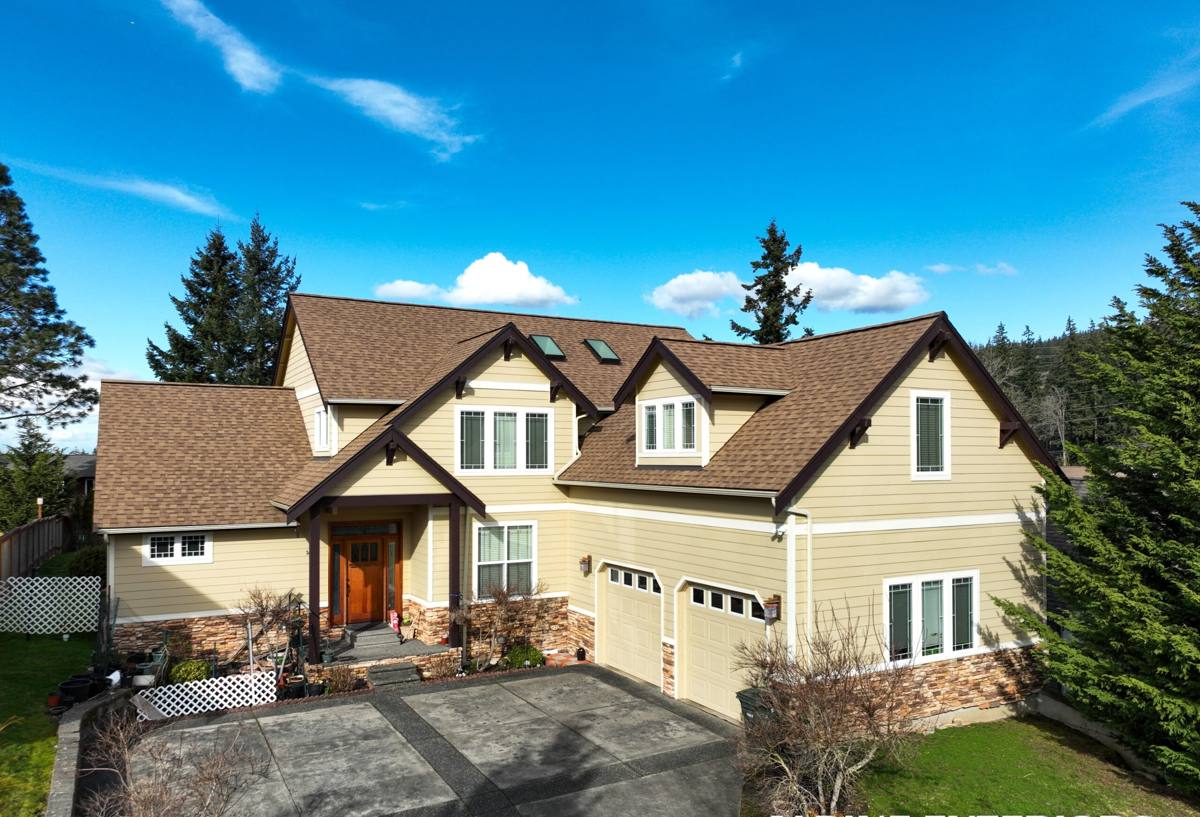
What South Hill's Position Does to a House's Exterior
Salt Air Off the Bay
South Hill's hillside homes sit within a fairly short distance of Bellingham Bay's saltwater, and even without a direct waterfront lot, that proximity means a steady low dose of salt-laden air reaches most of the neighborhood. Salt speeds up corrosion on fasteners, flashing, and any exposed metal trim, and it wears down paint and lower-grade finishes faster than a dry inland climate ever would. On a slope like this, air also moves more freely across the exterior walls, which means salt exposure doesn't just settle on the waterside of a house — it reaches all four elevations more evenly than it would on a sheltered, low-lying lot.
Driving Rain and Wind Exposure
Because South Hill sits higher than the flatter parts of the city, it catches wind coming off the water with less to slow it down first. That wind pushes rain sideways into wall assemblies, window flashing, and the joints where trim meets siding — a very different load than the same rainfall falling straight down on a sheltered lot. Sideways-driven rain finds gaps that a careless installation leaves behind, and it's a bigger factor on an exposed hillside than in a low, tree-shaded neighborhood elsewhere in the city.
A Long Moss Season
Whatcom County's mild, wet weather adds up to a moss and mildew season that runs most of the year on shaded or north-facing walls, and South Hill's mature trees and older lot layouts mean plenty of homes have at least one wall that stays damp for long stretches at a time. Any siding material with even a little surface porosity becomes a growth surface eventually, and it shows up first on the walls that get the least direct sun.
Why We Only Install James Hardie Fiber Cement Siding
We used to work with a wider range of siding materials. What changed our minds wasn't a supplier relationship or a marketing decision — it was what we kept finding on tear-offs and service calls on hillside, wind-exposed homes like the ones on South Hill.
- Non-combustible core: Fiber cement doesn't feed a fire the way wood-based siding can, which matters for both safety and homeowners' insurance considerations.
- Factory-applied ColorPlus finish: The color is baked on under controlled factory conditions instead of brushed on in the field, so it holds up longer against fading, chalking, and the moisture exposure common on an exposed hillside lot.
- Climate-engineered HZ product lines: Hardie's HZ5 formulation is built specifically for regions with sustained moisture and freeze-thaw cycling — a fair description of Whatcom County, and especially of a wind-exposed hillside like South Hill.
- Dimensional stability: Fiber cement doesn't swell, cup, or warp the way engineered wood siding can after repeated wetting from wind-driven rain.
- Strong transferable warranty: Hardie backs the product with one of the stronger warranty structures in the industry, provided installation follows their published spec.
We don't install LP SmartSide, vinyl siding, Cemplank, Allura, primed spruce, or cedar. Every one of those has a place in the market, and plenty of homeowners are satisfied with them. But on a hillside neighborhood that takes this much combined salt, wind, and moisture, we made a professional decision to stand behind one system fully rather than offer a lower-cost option that quietly shifts maintenance risk onto the homeowner a few years down the line.
Fiber Cement Compared to Other Siding Options
Homeowners on South Hill often ask us to explain, in plain terms, why fiber cement costs more up front than some alternatives. Here's how the materials compare on the factors that matter most in this specific setting:
| Material | Moisture Behavior | Maintenance in This Climate | Realistic Lifespan |
|---|---|---|---|
| James Hardie fiber cement | Dimensionally stable; resists swelling and warping | Low; factory finish resists moss and fading | 30+ years with correct installation |
| LP SmartSide (engineered wood) | More sensitive to moisture at cut edges and fastener holes | Moderate; edge sealing needs regular upkeep | 15-25 years, climate-dependent |
| Vinyl | Can warp or gap in wind and temperature swings | Low visible upkeep, but hidden moisture issues are hard to spot | 20-30 years, variable |
| Cedar | Absorbs moisture readily without a consistent sealing schedule | High; recurring painting or staining cycle | 15-25 years with consistent upkeep |
The up-front cost gap narrows considerably once you account for what each product actually needs over the following two or three decades. Fiber cement's higher install cost buys a material that doesn't need the recurring attention the others do, which matters on a house exposed to South Hill's wind and salt air as much as anywhere in the county.
What a Correct Fiber Cement Installation Involves
Hardie siding only performs the way it's engineered to when it goes on correctly, and on an exposed hillside lot, the installation details carry even more weight than they would somewhere more sheltered. The basics we won't skip:
- A rain screen gap behind the siding so moisture that gets past the surface can drain and evaporate instead of sitting against the wall sheathing
- Correct fastener type and spacing, per Hardie's published spec — loose spacing or the wrong fastener is one of the most common causes of early failure we find on tear-offs
- Properly lapped house wrap and flashing at every seam and penetration, so water sheds downward and outward rather than working its way in
- Sealed butt joints and trim transitions, which are where wind-driven, salt-tinged moisture finds its way behind the siding first
- Cut edges primed before installation, since factory ColorPlus finish only covers the face and factory-cut edges of the board
None of this is exotic — it's the manufacturer's own installation requirements, applied consistently rather than shortcut on the parts that are hardest to inspect once the wall is closed up.
Our Process for a South Hill Siding Project
Walkthrough and Assessment
We start by walking the property and looking specifically at which walls take the most direct wind and rain, which stay shaded and slow to dry, and whether there's already moisture damage hiding behind the existing siding. On older South Hill homes, that assessment often turns up sheathing or framing issues that need addressing before new siding goes on — covering a problem with new material just delays it.
Tear-Off and Prep
Removing old siding gives us a direct look at the wall assembly underneath. Any soft sheathing, missing house wrap, or poorly flashed openings get addressed at this stage, not discovered later as a callback.
Installation to Manufacturer Spec
Every fastener, gap, and flashing detail follows James Hardie's published requirements for this climate zone. That's what keeps the manufacturer's warranty intact, and it's also simply what makes the siding perform the way it's designed to for decades rather than years.
Final Walkthrough
We walk the finished project with you, go over what little maintenance fiber cement actually needs, and make sure you know what to look for if you ever want to check the wall yourself down the road.
Cost Factors for Fiber Cement Siding on South Hill
| Factor | Why It Matters |
|---|---|
| Home size and wall complexity | More corners, dormers, and trim transitions add labor and flashing detail |
| Existing wall condition | Rot or moisture damage found during tear-off needs repair before new siding goes up |
| Siding profile | Lap, shingle, and board-and-batten styles differ in material and labor cost |
| Site access and slope | Hillside lots can add labor time for staging and material handling |
| Trim and window detailing | More openings mean more flashing and finish work at each one |
These are general drivers, not a quote. Hillside lots on South Hill vary a lot from house to house in slope, access, and how exposed each wall is, so we walk the specific property before putting a real number on the work rather than pricing off square footage alone.
Signs a South Hill Home Needs New Siding
- Moss or dark staining that returns quickly after cleaning, especially on shaded or north-facing walls
- Soft or spongy siding, particularly low on the wall or around window and door trim
- Paint that's peeling, bubbling, or chalking faster than it used to
- Visible warping, cupping, or gapping in wood-based or engineered siding
- Rust staining around fasteners or trim, more noticeable this close to the bay
- Rising energy bills that suggest the wall assembly isn't sealing the way it should
Why a Crew That Already Works South Hill Matters
A contractor who works across South Hill and the rest of Bellingham regularly sees how wind, salt air, and moss actually behave on real houses on this hillside over a full year — not just how a product looks on a spec sheet. That experience shapes decisions on install day: which walls need extra flashing attention because of their orientation to the wind, which older homes are likely to have hidden sheathing issues under their original siding, and where the extra time on fastener and flashing detail is worth it so a homeowner isn't dealing with a callback after the next storm off the water. South Hill's elevated, wind-exposed position isn't identical to more sheltered parts of Whatcom County, and a crew that's worked the difference builds accordingly instead of applying a one-size-fits-all approach.
If your South Hill home needs new siding, or you're not sure whether what's on the wall now is holding up the way it should, we're glad to take a look. Reach out using the form below to schedule a free, no-pressure estimate.