 Whatcom County
 Why South Hill Siding Wears Differently
South Hill sits up above Bellingham Bay, which means homes here catch weather that flatter, more sheltered parts of Whatcom County don't deal with in the same way. Elevation and exposure bring wind-driven rain straight at wall surfaces instead of down onto a roof, and the proximity to salt water adds a corrosive element that slowly works on fasteners, trim, and any siding material not built to handle it. Add in the long stretch of gray, damp months typical of this part of Washington, and you get a climate that's genuinely hard on exterior materials — not in a dramatic, all-at-once way, but as a slow grind that shows up as soft trim boards, discolored panels, and fastener staining years before most homeowners expect it.
We repair siding all over Whatcom County, but South Hill jobs tend to have their own pattern: older housing stock mixed with newer remodels, hillside lots where wind hits at odd angles, and a heavier moss and mildew load on north- and west-facing walls that never fully dry out between storms. A repair here needs to account for all of that, not just patch the visible damage and move on.
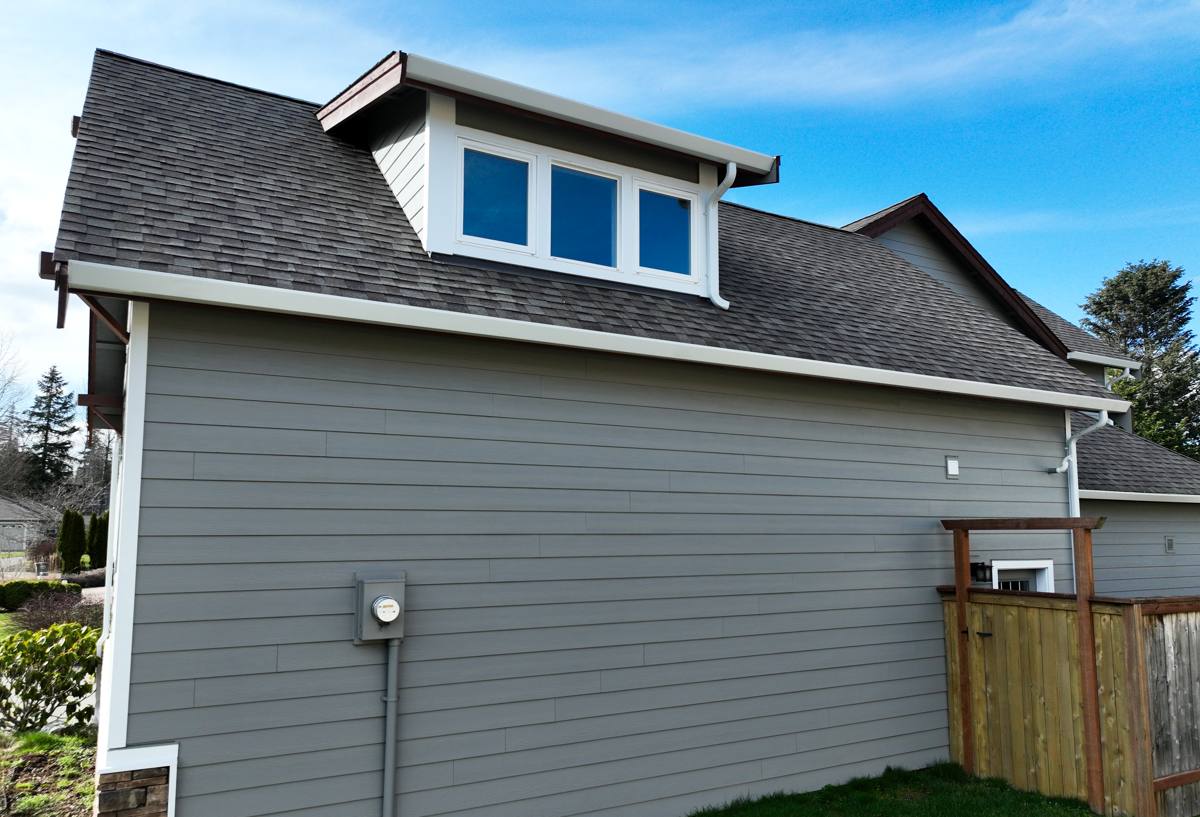
Early Signs South Hill Homeowners Shouldn't Ignore
Because the damage builds slowly, a lot of siding problems on South Hill homes get written off as cosmetic until they aren't. Here's what we tell homeowners to watch for between now and the next wet season:
- Soft or spongy spots when you press on siding or trim, especially near the bottom of walls and around window and door casings
- Persistent moss or dark green-black staining that comes back within weeks of being cleaned
- Paint that's bubbling, peeling, or chalking unevenly rather than uniformly across a wall
- Visible gaps, warping, or cupping in individual boards or panels
- Rust streaks below fastener heads, a sign moisture is getting behind the material
- A musty smell or visible staining on interior walls that share an exterior wall with a damaged section
Any one of these on its own might be minor. Several together, especially on a wall that faces the prevailing wind and rain, usually means water has been finding a way in for a while.
Why Small Problems Grow Fast Here
The issue with the local climate isn't any single storm — it's that damp conditions stick around long enough for wood-based materials, house wrap, and sheathing to stay wet instead of drying out between rain events. A gap that would dry out in a week in a drier climate can stay wet for a month here, which is long enough for rot to set in behind the siding where you can't see it. That's why a South Hill repair often turns up more damage once a wall is opened up than what was visible from the outside.
What a Correct Repair Actually Involves
A siding repair that's done right is not just swapping a damaged board for a new one and caulking the edges. Done properly, it means:
- Removing enough surrounding material to see the full extent of water intrusion, not just the visible symptom
- Checking the house wrap or weather-resistive barrier underneath for tears, gaps, or improper lapping
- Inspecting and, where needed, correcting flashing at windows, doors, and butt joints — flashing mistakes are one of the most common root causes of repeat siding failure
- Replacing any rotted sheathing or framing found behind the siding, not just covering it back up
- Matching the new material's profile, reveal, and finish closely enough that the repair doesn't stand out
- Re-fastening and sealing to the manufacturer's actual specifications, not just "close enough"
Skip any of those steps and you've done a cosmetic fix that buys a season or two before the same spot fails again — often worse than before, because now there's compromised wood behind it.
Repair or Replace? How We Make That Call
Not every damaged section needs a full re-side, and we're not going to tell a homeowner they need one when a targeted repair will genuinely hold up. But there's a point where patching stops making sense. Here's roughly how we think through it:
| Situation | Usually a repair | Usually points to replacement |
|---|---|---|
| Damage location | Isolated to one or two wall sections | Spread across multiple elevations |
| Underlying sheathing | Sound once opened up | Soft, delaminating, or rotted in several spots |
| Age of existing siding | Mid-life, otherwise in decent shape | Near or past the material's realistic service life |
| Cause of damage | A single identifiable failure point (flashing, caulk, impact) | Systemic moisture issues or a material mismatched to this climate |
| Material match | Original product still available or close enough to blend | Discontinued profile, faded color, or a product we won't warranty a repair on |
Cost is proportional to scope more than anything else — a straightforward repair on an isolated section is often a few hundred dollars, while a job involving hidden rot, multiple wall sections, or sheathing replacement can run into the low thousands. We'll always give you the real number after we've actually opened up the damaged area, not before.
Our Process for a South Hill Repair Job
- Inspection. We walk the exterior, check the specific problem area, and probe for soft spots nearby that haven't shown visible symptoms yet.
- Diagnosis, not guessing. If we suspect hidden moisture, we open up a small section before quoting so the estimate reflects what's actually there, not just what's visible.
- Written scope and estimate. You get a clear explanation of what's damaged, what caused it, and what it'll take to fix correctly — including if we find more than expected.
- Repair. We remove and replace only what needs it, correct the underlying cause (flashing, barrier, fastening), and match the surrounding material as closely as the situation allows.
- Final check. We walk the repaired area with you before we consider the job done.
Why We Repair With James Hardie, Not Whatever's On the Wall
This company installs James Hardie fiber cement exclusively — we don't install vinyl, LP SmartSide, or other engineered wood products, and that shapes how we handle repairs too. If your home already has Hardie siding, a repair is usually straightforward: Hardie's HZ5 product line was engineered specifically for wet, moderate climates like ours, and its ColorPlus factory finish means a matched replacement board can blend in without repainting the whole wall.
If your home has a different material and the damaged section needs replacing, we'll be straight with you about the trade-offs rather than just patching it with more of the same. Engineered wood products can take on moisture at cut edges and butt joints if flashing and sealing aren't maintained exactly to spec, and once that starts, it tends to keep going. Vinyl doesn't rot, but it can't be feathered into a damaged section the way fiber cement can, and it has its own limits in high-wind, high-moisture exposure. We'll always tell you honestly whether a like-for-like patch makes sense, or whether stepping up to fiber cement on that section is the better long-term call — not because it's the only thing we install, but because it's genuinely a better match for what this climate does to a house.
Why Local Experience Matters on South Hill
A repair crew that's worked this specific area knows things a generalist doesn't: which elevations on a hillside lot tend to catch the worst wind-driven rain, how long moss growth typically takes to come back after a cleaning in this particular microclimate, and what the older housing stock in this part of Bellingham tends to be built with underneath the visible siding. That local pattern-recognition shortens the diagnosis and reduces the chance of a repair that looks fine for a year and fails again.
It also matters for something more basic: a crew that's local shows up, stands behind the work, and is still around if a repair needs a follow-up look after the next wet season. That accountability is worth more than a slightly lower bid from someone passing through.
A Quick Checklist Before You Hire Anyone for a Siding Repair
- Ask them to physically inspect the area, not just quote off a photo
- Ask what they expect to find once the damaged section is opened up
- Ask whether the quote includes checking the house wrap and flashing, or just the visible siding
- Ask how they'll match the existing material's color and profile
- Ask what warranty applies to both the material and their labor
- Ask for a written scope before work starts, not a verbal estimate
Get an Honest Look at What Your Siding Needs
If you're seeing soft spots, recurring moss stains, or peeling paint on a South Hill home, it's worth having someone look before the next round of rain adds to the problem. We'll give you a straight assessment of whether it's a targeted repair or something bigger — no pressure, no upsell, just what we'd actually recommend if it were our own house. Use the form below to request a free estimate.