 Whatcom County
 Bellingham's Climate Is Hard on Roofs in Ways Homeowners Don't Always See
A roof in Bellingham doesn't fail the way a roof does in a dry climate. It fails slowly, from the top down and the edges in, because of three things that never really let up here: salt-laden air moving off the water, long stretches of driving rain, and a moss season that can run nearly nine months of the year. None of these show up as a dramatic leak on day one. They show up as granule loss, soft spots at the eaves, and dark streaking that homeowners assume is just dirt.
Salt air accelerates corrosion on any exposed metal — nail heads, flashing, gutter hangers, vent caps. Once that metal starts to pit or rust, it stops sealing the way it should, and water finds the gap. Driving rain, especially the sideways rain that comes with Whatcom County's wind patterns, gets pushed up and under roofing materials that would shed a straight-down rain just fine. And moss doesn't just sit there looking bad — its root structure lifts shingle edges, holds moisture against the roof deck, and slowly works its way into every seam it can reach.
Roof repair here has to account for all three at once. Patching a single leak without addressing the moss growth or the corroding flashing around it is a short-term fix that usually needs redoing within a year or two.
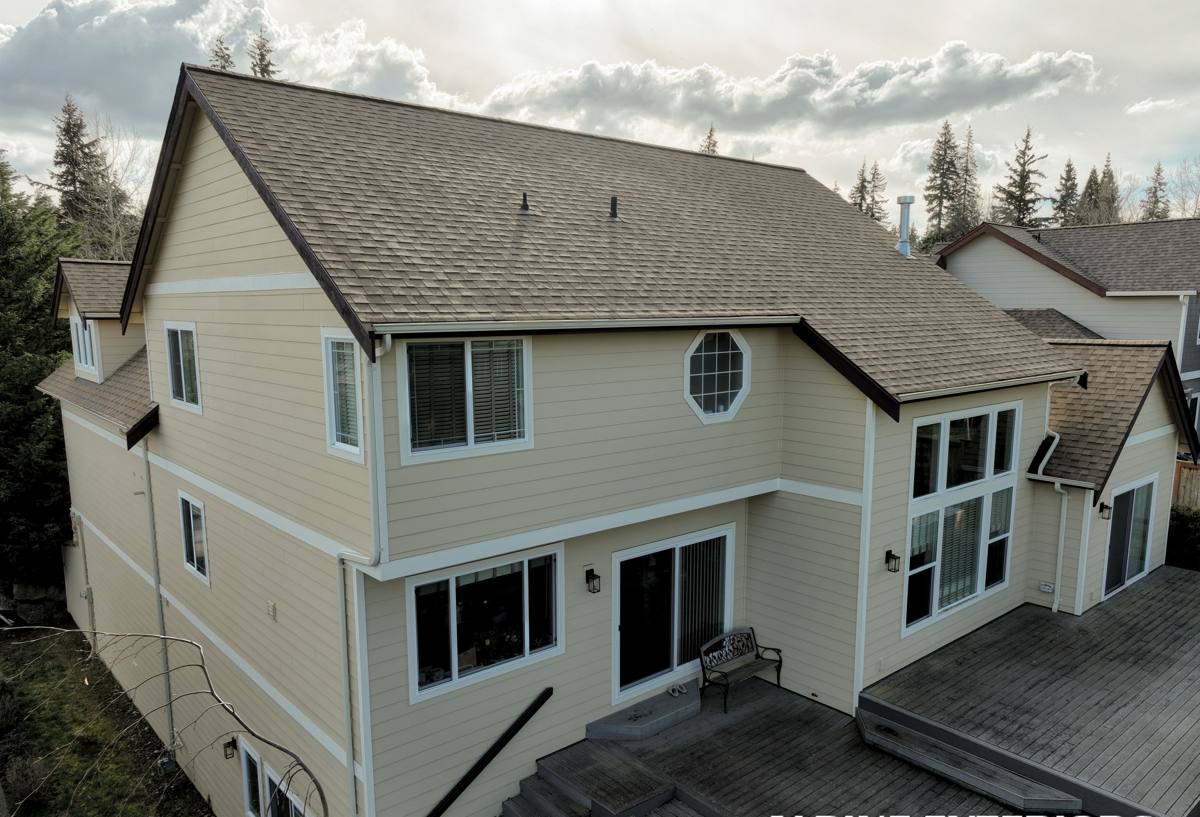
Common Roof Repair Issues We See on Bellingham Homes
Most repair calls in this area fall into a handful of categories. Recognizing which one you're dealing with helps set expectations for what the fix actually involves.
Moss-related damage
Moss holds water against the roof surface longer than the material was designed to tolerate. Over time it lifts shingle tabs, breaks the granule coating loose, and creates channels where water backs up instead of running off. By the time moss is visible from the ground, it's usually already doing damage underneath.
Flashing failures
Flashing around chimneys, skylights, vent pipes, and roof-to-wall transitions is the single most common leak source we find. Salt air corrosion, combined with the constant expansion and contraction from temperature swings, breaks down the seal faster than on materials elsewhere in the assembly.
Wind-driven rain intrusion
Bellingham's storms often come with enough horizontal push to force water under shingle edges, around ridge caps, and through gaps that would be a non-issue in calmer weather. This shows up as staining on interior ceilings that seems to appear "out of nowhere" after a storm.
Gutter and edge deterioration
When gutters clog with moss debris and fir needles, water backs up under the roof edge instead of draining away. This is one of the more preventable causes of repair calls we see, and it's often mistaken for a roofing problem when the real issue is drainage.
What a Correct Roof Repair Actually Involves
A repair that holds up in Whatcom County weather is more than sealing the spot where water is currently showing up inside the house. The visible leak point and the actual point of water entry are often several feet apart, because water travels along the underlayment or roof deck before it finds a way through the ceiling.
A proper repair starts with tracing the water back to its actual entry point, not just caulking the symptom. That usually means pulling back the surrounding roofing material to inspect the underlayment and deck condition, checking for soft or delaminated wood, and confirming that the flashing detail in that area was installed correctly in the first place. If the original flashing work was undersized or poorly lapped — which we do find on older Bellingham roofs — the repair needs to correct that detail, not just seal over it.
Material matching matters too. Shingles fade and weather over time, so a patch using new material next to 12-year-old material will look different for a while, but the bigger issue is compatibility — using the wrong underlayment or an incompatible sealant can trap moisture instead of shedding it.
Repair or Replace? Honest Cost Factors
Not every roof problem needs a full replacement, but not every leak is a simple patch either. These are the factors we actually weigh when advising a homeowner one way or the other.
| Factor | Leans Toward Repair | Leans Toward Replacement |
|---|---|---|
| Roof age | Under roughly 15 years, good overall condition | Near or past manufacturer's expected service life |
| Extent of damage | Localized — one flashing point, one section | Widespread granule loss, multiple failure points |
| Moss history | Recently treated, minimal deck impact | Long-term moss growth with deck softening |
| Deck condition | Solid, no rot found on inspection | Soft spots, delamination, or water staining across multiple areas |
| Prior repairs | First or second repair on this roof | Repeated patch history, same areas failing again |
Cost for a straightforward, localized repair is usually a modest fraction of replacement cost. Where it gets more expensive is when the underlying deck has to be replaced along with the roofing material — that's a different scope of work, and we'll always tell you plainly when we find it rather than downplaying it to sell a cheaper visit.
How Our Repair Process Works
- Inspection first. We look at the roof, the attic side if accessible, and the drainage path — not just the spot where you noticed a leak.
- Honest diagnosis. We explain what we found, what's causing it, and what the realistic options are, including if a repair isn't the right long-term answer.
- Written estimate. No verbal-only pricing. You get a clear scope before any work starts.
- Correct-detail repair. We fix the actual failure point — flashing, underlayment, deck, or moss root cause — not just the symptom.
- Debris and moss cleanup. Any moss or organic buildup contributing to the problem gets cleared as part of the job, not left to cause the same issue again next season.
- Walkthrough. We show you what was done and what to keep an eye on going forward.
Materials We Use — and Why
For flashing and fasteners, we favor corrosion-resistant metals suited to a marine-influenced climate. Standard galvanized fasteners can start showing surface rust within a few years this close to the water; stepping up to a more corrosion-resistant option costs a bit more per repair but avoids calling a customer back out for the same failure.
For patch material, matching the existing roofing system — asphalt composition, metal, or cedar — as closely as possible is our standard, both for appearance and so the repaired section weathers and drains the same way as the rest of the roof. We don't mix roofing systems within a single repair area; combining materials that expand, contract, or shed water differently is a common cause of repeat leaks, and we treat avoiding that as a baseline standard, not an upsell.
On sealants, we use products rated for continuous exposure to UV and moisture cycling rather than general-purpose caulks. A sealant that isn't built for sustained wet conditions can look fine for a season and then fail right when the next round of fall storms hits.
Repair Considerations by Roof Type
Composition (asphalt) shingle
The most common roof type in the area, and generally the most repairable when caught early. Granule loss and lifted tabs from moss are the main issues; flashing repairs blend in well since the material is widely available in matching profiles and colors.
Metal roofing
Holds up well against moss compared to shingles, but seam and fastener integrity is everything. Salt air corrosion at exposed screws or panel seams is the main repair driver, and those repairs need to be done with compatible metal to avoid galvanic corrosion between dissimilar materials.
Cedar shake or shingle
Beautiful, but the highest-maintenance option in a wet, mossy climate. Cedar repair work is less about patching and more about ongoing moss and moisture management — if a cedar roof is showing widespread rot rather than isolated damage, that's usually a sign the whole system's service life is being reached rather than a repair-scale problem.
Timing Repairs Around Whatcom County's Weather
Late summer and early fall are the best windows for roof repair here — the roof surface is dry, moss growth has slowed for the season, and any work gets done before the fall storms and rain arrive in force. Waiting until a leak shows up mid-winter means diagnosing and repairing in wet, sometimes freezing conditions, which limits what can be done safely and effectively in a single visit.
That said, an active leak shouldn't wait for ideal weather. Emergency tarping or a temporary seal to stop active water intrusion can be done in most conditions, with the permanent repair scheduled for the next reasonable dry stretch.
Checklist: Signs Your Bellingham Roof Needs a Repair Call
- Visible moss growth on the roof surface, especially on north-facing slopes that stay shaded and damp
- Granules collecting in gutters or at downspout outlets
- Dark streaking or staining that doesn't wash off with rain
- Ceiling stains or soft spots appearing after a windy rainstorm
- Curling, lifted, or missing shingle tabs visible from the ground
- Rust streaking below metal flashing, vents, or fasteners
- Gutters overflowing or pulling away from the fascia during heavy rain
- A roof approaching or past the 15–20 year mark with no recent inspection
If more than one or two of these apply, it's worth having someone look before the next storm rather than after.
Why It Matters to Hire a Crew That Already Works in Bellingham
Roof repair advice that works in a dry inland climate can be the wrong advice here. A contractor unfamiliar with Whatcom County conditions might treat moss as a cosmetic issue, use standard fasteners that weren't chosen with salt air in mind, or miss that a leak traced to "the flashing" is really being driven by wind-driven rain patterns specific to this area's storms. Local experience means recognizing these patterns quickly instead of guessing, and it means standing behind the work with an understanding of how this climate will actually test it over the coming winters.
If you're seeing signs of a roof problem — or just want an honest read on where your roof stands before the wet season sets in — we're glad to take a look. Reach out for a free, no-pressure estimate using the form below.