 Whatcom County
 Why Siding in Blaine Wears Differently Than Siding Inland
Blaine sits right up against the water, and that changes what siding has to survive. Homes here deal with a steady drift of salt air off the bay, wind-driven rain that hits walls sideways instead of falling straight down, and a moss and algae season that runs long and heavy for most of the year because the air rarely dries out for good. None of these things are dramatic on their own, but stacked together over years they do real damage to siding that a house twenty miles inland simply doesn't see at the same rate.
Salt air is corrosive to metal fasteners and trim, and it accelerates the breakdown of caulking and paint film faster than plain moisture does. Driving rain finds any gap at a seam, a butt joint, or a piece of trim and pushes water where it shouldn't go, especially on walls that face the water or sit exposed with no windbreak. And moss doesn't just look bad — it holds moisture against the siding surface for weeks at a time, which is exactly the condition that rots wood-based products and lifts paint and caulk from any material.
None of this means every Blaine home needs new siding. Most of the time it means specific sections — usually lower walls, north-facing walls, areas under roof valleys, or spots near sprinklers and downspouts — need real repair before a small problem becomes a big one.
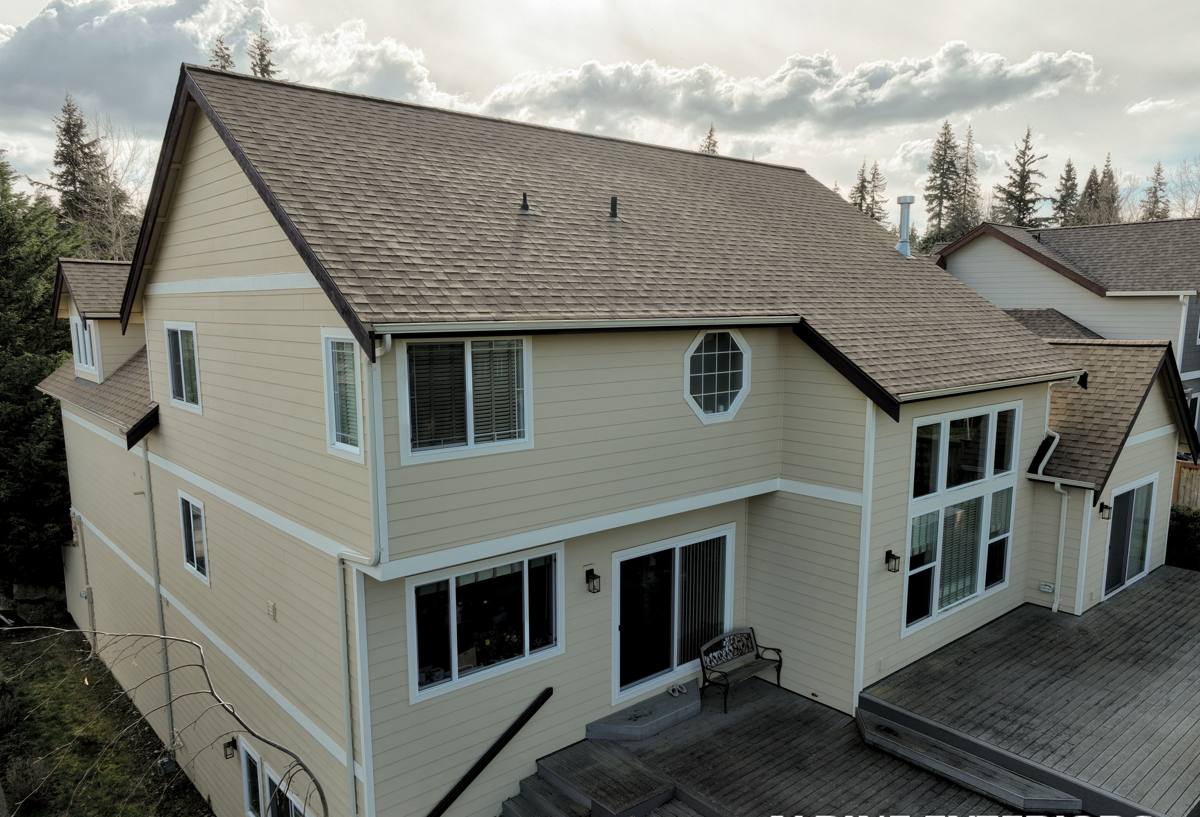
Signs Your Siding Needs Repair, Not Just a Look
Some damage is obvious. A lot of it isn't, and that's the damage that costs the most to ignore. Here's what we'd want you to check for or have us check for:
- Soft or spongy spots when you press on the siding, especially near the bottom courses
- Paint or caulk that's cracked, peeling, or pulling away at seams and corners
- Visible gaps where boards or panels meet trim, windows, or doors
- Dark streaking, persistent moss, or algae that keeps coming back after cleaning
- Fastener heads that are rusting, bleeding rust stains, or backing out of the wall
- Warping, bowing, or boards that no longer sit flat against the wall
- Musty smell or visible staining on interior walls that share an exterior wall with damaged siding
- Siding that feels noticeably colder or damp to the touch compared to surrounding sections
Any one of these can be minor. Several of them together, especially on the same wall, usually mean water has been getting behind the siding for a while — and that's a different repair than just replacing a cracked board.
What's Actually Causing Most Repair Calls in This Area
Salt Air and Fastener Corrosion
Standard fasteners that hold up fine in drier, inland parts of Whatcom County corrode faster this close to the water. Once a fastener starts to fail, the board or panel it's holding loosens, which opens a path for water and accelerates every other problem on that wall.
Wind-Driven Rain at Seams and Penetrations
Flat, straight-down rain is easy for siding to shed. Rain that's being pushed sideways by wind off the water behaves differently — it works its way into horizontal seams, around window and door trim, and behind poorly sealed penetrations for hose bibs, vents, and light fixtures. This is almost always where we find the worst hidden rot.
Extended Moss and Algae Exposure
A long moss season means more months of the year where siding surfaces stay damp instead of drying out between rains. Moss holds that moisture directly against the material, and on shaded or north-facing walls it can establish itself again within a season or two of cleaning if the underlying moisture problem isn't addressed.
What a Correct Repair Actually Involves
A lot of siding "repairs" are really just cosmetic patches — caulk over a gap, a fresh coat of paint over a stain, a new board nailed over a soft spot without checking what's underneath. That kind of work looks fine for a season and then fails again, usually faster than the original problem took to show up, because it never addressed why the damage happened.
A repair done correctly starts with figuring out the cause, not just covering the symptom. That means:
- Removing enough siding to see the sheathing, house wrap, and framing behind the damaged area
- Checking for rot or water damage that extends past what's visible from outside
- Identifying the actual water entry point — a failed seam, missing flashing, bad caulk, a fastener hole — rather than just replacing the board it happened to damage
- Correcting that entry point as part of the repair, not leaving it to fail again
- Replacing damaged sheathing or framing if it's found, not just the siding on top of it
- Matching the replacement material and finish as closely as possible so the repair doesn't stand out or age differently than the surrounding siding
- Re-sealing and re-flashing the repaired area to current best practice, not just how it was originally done
If a contractor's repair plan doesn't include opening the wall up to look, it's a patch, not a repair. That distinction matters a lot on a coastal property where hidden moisture is the actual enemy.
Repair vs. Replacement: How We Actually Decide
Not every damaged section needs full replacement, and not every home benefits from a patchwork of small repairs stretched over years. The honest answer depends on how widespread the damage is, what's causing it, and what condition the siding is in overall.
| Factor | Repair Usually Makes Sense | Replacement Usually Makes More Sense |
|---|---|---|
| Extent of damage | Isolated to one or two sections or walls | Present on multiple walls or throughout the exterior |
| Underlying cause | Single identifiable failure point (one bad seam, one penetration) | Systemic issue — original installation problems, no house wrap, chronic moisture |
| Siding age and condition | Siding is otherwise sound and has years of service life left | Siding is near or past its expected life, or material is failing broadly |
| Material availability | Matching material or a close match is available | Original product is discontinued or color/texture can't be matched |
| Cost over time | One-time fix, low likelihood of recurrence | Repeated repairs are adding up close to replacement cost |
We'll walk a property and tell you honestly which side of that table it falls on. A lot of the time, targeted repair is the right call and we say so — we're not trying to sell every visit into a full replacement.
Our Siding Repair Process for Blaine Homes
- Inspection. We look at the damaged area from outside and, where needed, open it up to check what's happening behind the siding — sheathing condition, moisture, and how the water is actually getting in.
- Diagnosis and honest recommendation. We tell you what caused the damage, whether repair or replacement makes sense for that section, and what it involves either way.
- Sourcing material. For repairs to James Hardie fiber cement, we match the specific profile and ColorPlus finish so the repair blends in rather than standing out as a patch.
- Correcting the cause, not just the symptom. We fix the flashing, seam, or penetration that let water in, not only the board it damaged.
- Repair or replacement of damaged material. Rotted sheathing or framing gets replaced along with the siding — patching siding over damaged structure just hides a bigger problem.
- Final check. We confirm the repair is sealed, flashed, and finished correctly before we consider the job done.
Why a Crew That Already Works Blaine Matters Here
Coastal exposure isn't uniform even within a small area — a wall facing open water takes a different beating than one tucked behind a neighboring structure, and Whatcom County's mix of marine air and inland weather patterns means the right repair approach for a home a few miles from the water can be different from the right approach for one further inland. A crew that's already worked on homes in this specific area has seen which walls fail first, which fastener and sealant choices actually hold up against salt air over years, and which "quick fixes" don't last through another wet season.
That local track record also means faster, more accurate diagnosis. Instead of guessing based on general siding knowledge, we're working from what we've actually seen fail — and hold up — on homes exposed to the same coastal conditions yours is.
What We Use for Repairs
We install James Hardie fiber cement siding exclusively, and that's what we recommend and use when a repair calls for new material on Hardie siding — the factory-applied ColorPlus finish means a properly matched repair holds its color the same way the surrounding siding does, instead of a field-painted patch that starts to look different within a year or two.
If your home currently has vinyl, LP SmartSide, cedar, or another material, we can still assess and, in many cases, repair it. Where we're honest with homeowners is when matching that material isn't realistic — many vinyl and engineered wood colors and profiles get discontinued, and a mismatched patch is often more noticeable than the original damage. In those cases, we'll tell you that plainly and let you decide whether a visible patch is acceptable or whether it's worth planning for a longer-term fix. We won't install anything other than Hardie ourselves, but we're not going to pretend a repair will look seamless when it won't.
A Straightforward Way to Get Started
If you're seeing soft spots, gaps, staining, or persistent moss on your siding, it's worth having someone take a real look before another wet season adds to the damage. We'll give you a straightforward, no-pressure assessment of what's going on and what it would take to fix it right — use the form below to request a free estimate.