 Whatcom County
 Board & Batten in Sehome: A Look That Has to Work as Hard as It Looks Good
Sehome's mix of older bungalows, mid-century homes, and newer infill construction means a lot of different rooflines and wall heights, but the same vertical board & batten look keeps showing up as an accent or a full-facade choice. It's a strong fit for the neighborhood's craftsman and modern-farmhouse styling. But in Whatcom County, a board & batten wall isn't just an aesthetic decision — it's a moisture-management decision. The vertical battens create dozens of extra seams and fastening points compared to horizontal lap siding, and every one of those seams is a place water can find its way in if the installation isn't done with the local climate in mind.
This page is specifically about board & batten siding for homes in and around Sehome. If you're comparing it to lap siding generally, or want the broader case for fiber cement, that's covered elsewhere on our site — here we're focused on what this particular siding style needs to hold up on this particular ground.
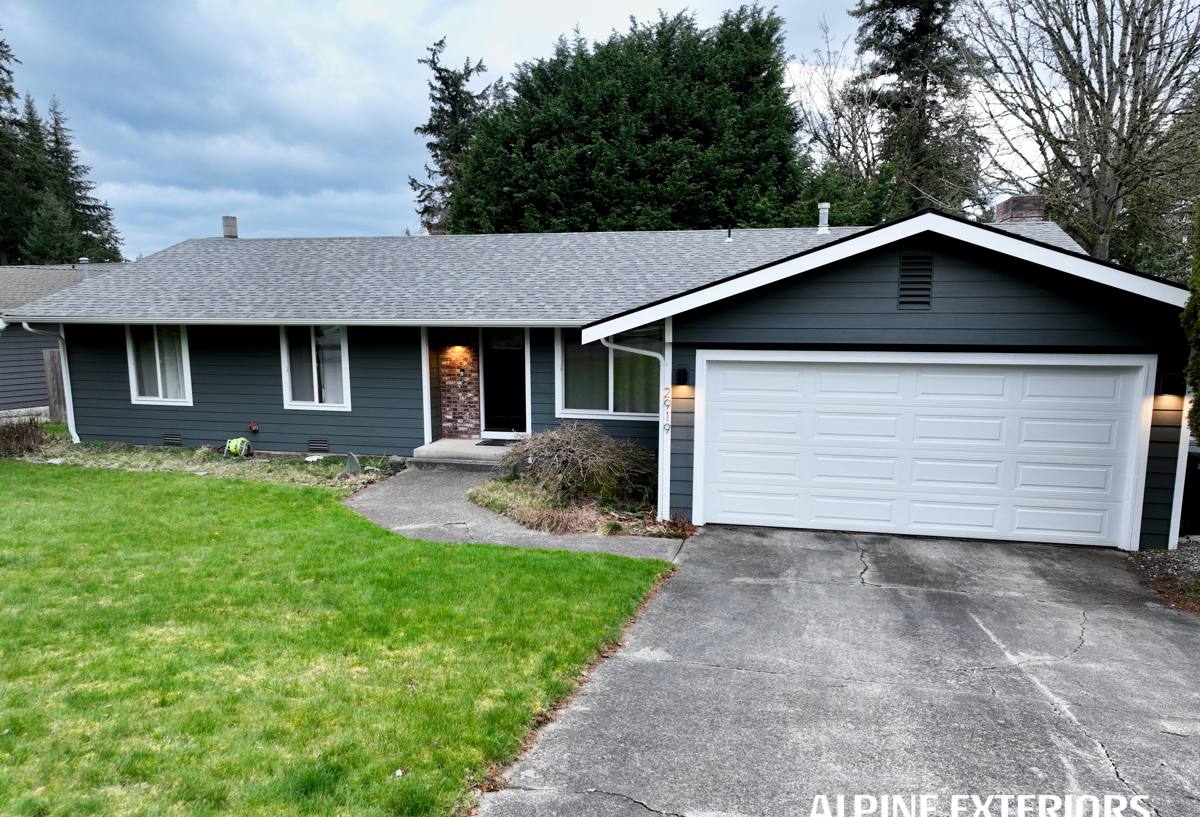
What Whatcom County's Climate Does to Vertical Siding
Bellingham and the surrounding Whatcom County area sit close enough to the Salish Sea that salt-laden air is a real factor on exterior materials, especially on homes with any exposure toward the water or open west-facing walls. Combine that with the region's long stretch of driving rain from fall through spring, and a moss season that can run most of the year on shaded or north-facing elevations, and you've got three separate stressors working on a siding system at once:
- Salt air accelerates corrosion on fasteners, flashing, and any hardware that isn't rated for coastal exposure.
- Driving rain doesn't just fall straight down — wind-driven rain pushes water sideways into seams, and board & batten has more vertical seams per square foot than lap siding.
- Moss and algae thrive in the persistent damp and shade common on Sehome's tree-lined lots, and they hold moisture against the wall surface longer than a clean, dry surface would.
None of these are exotic problems — every siding contractor in this part of Washington deals with them. But they mean the margin for error on a board & batten install is smaller here than it would be in a drier climate. Gaps in the water-resistive barrier, undersized flashing, or battens fastened without a drainage plane behind them tend to show their consequences faster in Whatcom County than they would somewhere with less rain.
What a Correct Board & Batten Installation Actually Involves
A board & batten wall is really a layered system, and the visible boards and battens are only the last step. Done right, the sequence looks like this:
- Water-resistive barrier installed over the sheathing, lapped correctly at every seam and around every penetration.
- Rainscreen furring or a drainage mat behind the siding — this is what lets any water that does get past the surface drain and dry out instead of sitting against the wall.
- Flashing at every horizontal transition — window and door heads, the base of the wall, roof-to-wall intersections — sized and lapped to shed water downward and outward.
- Panel or board installation with correct fastener spacing and embedment, keeping penetrations out of the field where water collects.
- Batten strips fastened over the seams, into framing where possible, with consistent reveal spacing for both appearance and function.
- Sealant and trim detailing at inside/outside corners, window and door surrounds, and any wall penetrations — the small stuff that's easy to rush and expensive to redo.
Skipping or rushing any one of these steps doesn't usually show up as a problem in year one. It shows up in year three or four, as trapped moisture, staining, or fastener corrosion working its way through the finish. That's the core reason we don't treat board & batten as a "simpler" install just because the boards are wider — the assembly behind it carries the same requirements as any other siding system, and in this climate, more of them matter more often.
Why We Install James Hardie Board & Batten and Nothing Else
We install James Hardie fiber cement exclusively — no vinyl, no LP SmartSide, no Cemplank or Allura, no primed spruce or cedar. For board & batten specifically, that means James Hardie's vertical siding panels paired with matching batten strips, finished in factory-applied ColorPlus finish rather than field-painted after install.
Why not the alternatives, for this style specifically
Board & batten is a style where the trade-offs of other materials show up faster than usual, because the vertical seam count is higher:
- Vinyl board & batten panels are lightweight and low-cost, but they rely on expansion gaps and can visibly warp or buckle under temperature swings and direct sun exposure — a real issue on south- and west-facing Sehome walls. They also don't hold paint, so your color options are locked to the manufacturer's line for the life of the product.
- LP SmartSide is an engineered wood product, and wood-based sidings are dependent on an intact factory finish and careful field sealing at every cut edge and seam. Board & batten has more of those edges per square foot than lap siding, which means more places where a maintenance lapse can let moisture into the substrate.
- Primed spruce or cedar boards look great initially but require ongoing paint maintenance, and in a climate with this much sustained dampness and moss pressure, real wood board & batten needs more frequent inspection and recoating than most homeowners plan for.
James Hardie's fiber cement doesn't expand and contract the way vinyl does, doesn't rely on an intact paint film the way wood does, and is non-combustible — a factor more homeowners in Washington are weighing given regional wildfire smoke seasons, even away from direct fire risk zones. The ColorPlus factory finish is baked on under controlled conditions, which holds up more consistently than field-applied paint, and it comes with a stronger factory warranty structure than most site-painted systems.
Comparison: Board & Batten Material Options
| Material | Moisture Behavior | Maintenance | Finish Longevity |
|---|---|---|---|
| Vinyl board & batten | Doesn't absorb water, but can trap it behind panels; prone to warping | Low, but limited repair options if damaged | Fixed color, fades over time, not paintable |
| LP SmartSide | Engineered wood — dependent on intact seals at edges and seams | Regular inspection of caulked seams and cut edges | Factory finish holds reasonably well if maintained |
| Primed spruce/cedar | Real wood — absorbs moisture if finish fails | Repainting cycle typically every 5-8 years | Dependent entirely on paint maintenance |
| James Hardie fiber cement | Dimensionally stable, non-combustible, engineered for moisture exposure | Occasional wash-down; no repainting needed for ColorPlus finish | Factory-baked finish with long transferable warranty |
How We Approach a Sehome Board & Batten Project
Because we already work in this part of Whatcom County, we're familiar with the housing stock here — the older single-wall construction common in some of Sehome's original bungalows, the mix of roof pitches, and the amount of tree cover that keeps certain walls damp longer than others. Our process on a board & batten job runs:
- Site walk-through to check existing wall condition, sheathing, and any signs of past moisture intrusion before we ever talk product.
- Scope and material plan, including where rainscreen furring is needed based on your wall's current assembly and sun/shade exposure.
- Tear-off and substrate check — we don't side over rot or compromised sheathing; if we find it, we'll show you before covering it up.
- Barrier, flashing, and drainage installation — the unglamorous part that determines whether the siding lasts.
- Board, batten, and trim installation to spec, including correct fastener schedule for our wind and moisture exposure.
- Final detailing and walk-through so you know what you're looking at and how to keep it clean.
What Drives Cost on a Board & Batten Project
| Factor | Why It Matters |
|---|---|
| Existing wall condition | Rot, moisture damage, or outdated sheathing found during tear-off adds repair scope |
| Rainscreen requirement | Homes with heavy shade or wind exposure often need a full drainage gap, not just a barrier |
| Wall height and trim complexity | Multi-story sections, dormers, and detailed window trim add labor time |
| Panel vs. board-and-batten-style siding | Individual boards with separate battens take longer to install than pre-scored panel systems |
| Color and finish selection | Standard ColorPlus colors are more cost-efficient than custom field-painted finishes |
Maintaining Board & Batten Siding in This Climate
- Rinse siding down once or twice a year, focusing on shaded and north-facing walls where moss and algae build up fastest.
- Keep gutters and downspouts clear so water isn't sheeting down wall sections during heavy rain.
- Trim back vegetation and tree cover that keeps specific wall sections damp longer than the rest of the house.
- Inspect caulking at trim, corners, and window surrounds annually — this is the first place wear shows up, regardless of material.
- Watch for any staining or dark streaking at seams, which can signal a flashing or drainage issue worth catching early.
Why Hiring a Crew That Already Works Sehome Matters
Board & batten installation quality depends heavily on details that are easy to get wrong on paper but obvious once you've installed a few hundred feet of it in this specific climate — how much rainscreen gap a given exposure actually needs, where moss pressure will be worst on a given lot, which flashing details matter most given our rain patterns. A crew that installs Hardie board & batten regularly in Whatcom County has already made the adjustments that matter here; a crew installing it for the first time, or one used to a drier climate, is more likely to build in someone else's assumptions instead of ours.
If you're weighing board & batten for a home in Sehome or nearby, we're happy to take a look at your walls, talk through what your specific exposure needs, and give you a straightforward estimate — no pressure, no upsell into a product we don't stand behind. The form below gets you a free assessment from a crew that already works this neighborhood.