 Whatcom County
 Decking Built for Silver Beach's Lakefront Climate
Silver Beach sits close enough to Lake Whatcom that homes here deal with a specific mix of conditions: moisture-laden air off the water, long stretches of steady rain through fall and winter, shaded lots under mature evergreens, and a moss season that can run six months or more. A deck built for a dry inland lot doesn't automatically hold up here. The wood substructure, the fastening, the drainage path under the boards, and the material you choose on top all need to account for water that doesn't leave in a hurry.
Composite decking has become the go-to choice for a lot of Silver Beach homeowners for a simple reason: it doesn't absorb water the way wood does, it doesn't need annual staining, and it resists the moss and algae growth that thrives in shaded, damp corners near the lake. But "composite" isn't one product — the board, the hidden structure underneath it, and the way it's installed all determine whether a deck looks good in year eight or needs boards replaced by year four.
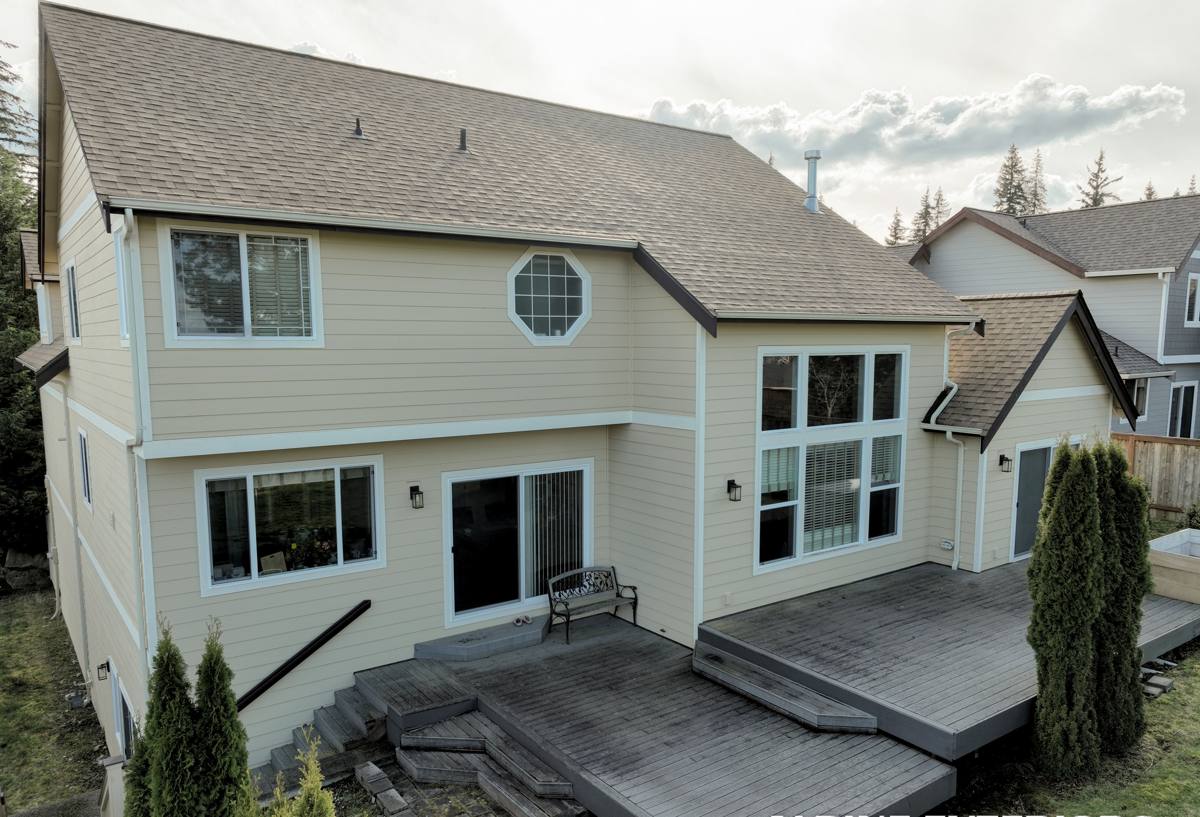
What Whatcom County's Climate Actually Does to a Deck
We're not guessing at this — it's the same pattern on every deck rebuild we look at in this part of the county.
Constant moisture, not just rain
It's not only the rain totals. It's the number of days a surface stays damp. Near Lake Whatcom, humidity lingers under decks and around ground-level framing longer than it does on more open, sun-exposed lots elsewhere in the county. That extended dampness is what rots joists, corrodes fasteners, and feeds mold and moss growth on any organic surface.
Salt and mineral air
Homes closer to open water pick up airborne moisture carrying salts and minerals that accelerate corrosion on hardware, fastener heads, and any exposed metal railing components. Over years, cheap or mismatched hardware shows rust stains on the deck surface long before the boards themselves fail.
Shade and moss
Tree cover common around Silver Beach keeps decks shaded and slow to dry after rain. Moss and algae take hold fastest on surfaces that stay wet — north-facing decks and areas under overhangs are usually the worst offenders. Left alone, that growth turns boards slick and, on wood decks, feeds rot in the grain itself.
Freeze-thaw cycling
Whatcom County doesn't get brutal winters, but it does get repeated freeze-thaw swings. Water that's worked into a board's surface, a fastener hole, or a poorly sealed cut edge expands and contracts through the season. On wood, that's how splitting starts. On composite, it's why board core type and edge sealing matter more than people assume.
Why Composite Makes Sense Here — And Where It Doesn't Automatically Solve Everything
Composite decking is not maintenance-free, and we won't tell a homeowner it is. What it does well in this climate:
- Resists moisture absorption into the board itself, so it doesn't swell, cup, or splinter the way untreated or even pressure-treated wood can after repeated soaking.
- Doesn't need annual staining or sealing — a real advantage given how often a lakefront deck sees enough dry weather to actually complete a stain job.
- Resists rot outright, since there's no exposed wood grain for fungus to colonize.
- Holds color better under UV exposure than most wood species, which matters on the lot's sun-exposed side even if the rest of the deck sits shaded.
What it still requires:
- Regular cleaning to keep moss, pollen, and organic film from building up on the surface — composite doesn't grow moss the way wood does, but it can still host a surface film if it's never washed.
- Correct substructure underneath. Composite boards are only as good as the treated framing, joist tape, and hardware supporting them. A beautiful composite deck on a rotting or poorly flashed frame is a short-term fix, not a long-term one.
- Attention to hidden fastener and clip systems, which are more failure-prone in damp climates than the boards themselves if the wrong hardware grade is used.
What a Correctly Built Composite Deck Involves
Substructure first
Every composite deck we install starts with pressure-treated or, where the budget allows, better-grade framing, properly spaced joists per the manufacturer's span tables (composite often requires tighter joist spacing than wood decking), and joist tape over every top edge to stop water from wicking into the lumber through screw penetrations. This is the single most skipped step on decks that fail early, and it's invisible once the boards go down — which is exactly why it's worth asking a contractor about directly.
Drainage and airflow underneath
A deck that traps water underneath is a deck that rots its frame regardless of what's on top. On lots with limited clearance near the lake or under low decks, we pay close attention to grading, ventilation gaps, and — where the situation calls for it — under-deck drainage systems that channel water away instead of letting it pool against framing members.
Fastener and hardware grade
Given the corrosive air near the water, we use stainless steel or heavily coated fasteners and hidden-clip systems rated for coastal or high-moisture exposure, not the base-grade hardware that's fine on a dry inland lot but starts staining and weakening within a few seasons here.
Board layout and expansion gaps
Composite boards expand and contract with temperature more than people expect. Gaps at butt joints, around posts, and against the house need to be set correctly per manufacturer spec — too tight and boards buckle in summer heat; too loose and the deck looks sloppy and traps debris.
Railing and post integration
Railing posts are common failure points because they penetrate the deck surface and framing, creating an entry point for water if not flashed and sealed properly. We treat every post base as its own small waterproofing detail, not an afterthought.
Composite vs. Other Decking Options for This Location
| Material | Moisture resistance | Maintenance | Moss/algae resistance | Typical lifespan here |
|---|---|---|---|---|
| Composite decking | High — doesn't absorb water into the board | Periodic cleaning, no staining | Good with regular washing | 20-30 years with correct install |
| Pressure-treated wood | Moderate — absorbs and releases water, prone to swelling | Annual stain/seal to perform well | Poor if not maintained; feeds rot | 10-15 years, often less in shaded lakefront spots |
| Cedar | Moderate — naturally rot-resistant but still absorbs moisture | Regular oiling/sealing to hold color and resist decay | Fair, better than treated pine, still needs upkeep | 15-20 years with diligent maintenance |
| PVC decking | Very high — fully synthetic, no organic content | Low, similar to composite | Very good | 25-30+ years, higher upfront cost |
For most Silver Beach homeowners, composite lands in the sweet spot of upfront cost, appearance, and low-maintenance performance in a damp climate. PVC decking is a reasonable step up for homeowners who want maximum moisture resistance and are comfortable with the added cost. We're honest about that trade-off rather than pushing one material as the only right answer.
Our Process for a Silver Beach Deck Project
- On-site assessment. We look at existing framing (if replacing a deck), drainage patterns, sun/shade exposure, and proximity to the water to understand what this specific lot is dealing with.
- Material selection. We walk through composite board options, color and grain choices, and hidden fastening systems suited to the site's moisture exposure — not a one-size-fits-all recommendation.
- Framing and structural work. Any rot, undersized joists, or inadequate ledger attachment gets addressed before a single composite board is installed. This step is non-negotiable regardless of what decking material sits on top.
- Waterproofing details. Joist tape, flashing at the house connection, and proper post-base sealing go in before decking begins.
- Board installation. Correct spacing, expansion gaps, and fastening per manufacturer specification, with attention to consistent board alignment and clean end cuts.
- Railing, stairs, and finish details. Integrated so the whole structure sheds water the same way the deck surface does.
- Final walkthrough. We go over basic care — cleaning frequency, what to watch for at fastener points, and how to keep moss from getting a foothold — so the deck actually gets the lifespan it's built for.
Why Local Experience on This Specific Site Type Matters
A contractor who mostly builds decks on dry, open, inland lots and occasionally does one near Lake Whatcom is going to make different assumptions than a crew that works Silver Beach and similar Whatcom County lakefront neighborhoods regularly. The difference shows up in things like joist spacing adjusted for the specific composite product, hardware grade chosen for the air quality this close to water, and drainage details sized for how long this ground actually stays saturated after a fall storm system — not textbook averages from a manufacturer's install guide written for a different climate.
It also shows up in scheduling and sequencing. Framing and waterproofing work needs reasonably dry conditions to go in correctly. A crew that knows this area's weather patterns plans around the wetter stretches instead of rushing critical waterproofing steps between rain events.
Questions worth asking any decking contractor before you hire
- What joist tape and flashing details do you use at the house ledger and railing posts?
- What fastener and hidden-clip grade do you install, and is it rated for coastal or high-moisture exposure?
- How do you handle drainage and airflow underneath a low-clearance deck?
- What's your plan if you find rot or undersized framing once the old decking comes up?
- What does the manufacturer's warranty actually cover, and does your installation meet its requirements?
Maintaining a Composite Deck Near the Water
Composite decking cuts maintenance dramatically compared to wood, but "low maintenance" isn't "no maintenance," especially this close to Lake Whatcom. A simple seasonal routine keeps a composite deck performing the way it's supposed to:
- Sweep debris and organic buildup (leaves, pollen, needles) off the surface regularly, especially in shaded areas where it accumulates and stays damp.
- Wash the deck surface at least once or twice a year with a soft-bristle brush and mild soap-and-water solution to prevent surface film and early moss growth — avoid pressure washers on composite unless the manufacturer explicitly rates the product for it.
- Check railing post bases and any visible fastener points periodically for signs of water staining or corrosion, which can signal a flashing detail that needs attention.
- Keep gutters and downspouts near the deck clear so runoff isn't dumping directly onto or under the structure.
- Trim back overhanging vegetation where practical to reduce shade and speed up drying time after rain.
Getting Started
Every lot around Silver Beach has its own combination of shade, water proximity, and drainage, and that's exactly what determines the right framing, hardware, and board choice for a composite deck that holds up. If you're planning a new deck or replacing one that's showing its age, we're happy to walk the site with you and put together a straightforward, no-pressure estimate — just fill out the form below.