 Whatcom County
 Why Cordata Homes Put Extra Demands on Siding
Cordata sits close enough to Bellingham Bay and the broader Whatcom County coastline that homes here deal with a specific combination of punishment: salt-laden air moving in off the water, driving rain that comes sideways during fall and winter storms, and long stretches of gray, damp weather that give moss and algae months to establish themselves on north- and west-facing walls. None of these factors is dramatic on its own, but stacked together year after year, they're exactly the conditions that expose weak siding systems. Paint that isn't factory-cured chalks and fades faster. Wood-based products swell, split, or delaminate at the edges where moisture gets in and can't get back out. Vinyl gets brittle and can pull away from fasteners as the temperature swings between a cold snap and a warm, wet spell.
A siding job in Cordata isn't just a cosmetic upgrade — it's a decision about how well the exterior of the house will hold up against a marine climate that doesn't let up for long. That's the lens we use on every estimate we do in this neighborhood.
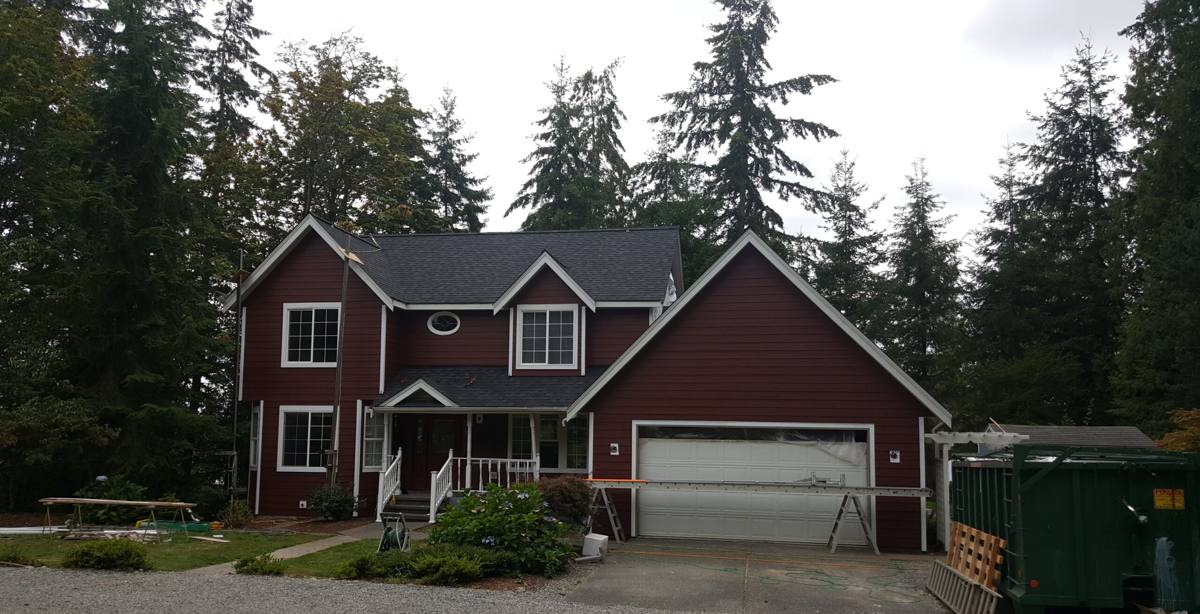
What James Hardie Fiber Cement Brings to This Climate
We install James Hardie exclusively, and in a location like Cordata that's not a marketing preference — it's a practical one. Fiber cement is made from cement, sand, and cellulose fiber, which means it doesn't rot, doesn't attract wood-boring insects, and doesn't absorb water the way wood-based sidings do. It's also non-combustible, which matters more each year as wildfire smoke and dry-season fire risk creep further into Western Washington's summers.
The HardieZone system
James Hardie engineers its products by climate zone, and Whatcom County falls into HZ5, the zone built for wetter, more humid regions. HZ5 products are formulated with a moisture and mold resistance profile suited to exactly the kind of weather Cordata sees most of the year — not a generic national product applied everywhere regardless of climate.
ColorPlus factory finish
Most of what fails on painted siding starts at the finish, not the substrate. James Hardie's ColorPlus technology bakes a multi-coat finish onto the board in a factory-controlled environment before it ever leaves the plant. That finish is more consistent and more resistant to fading and moisture intrusion than anything applied on-site with a brush or sprayer after installation, and it carries its own dedicated finish warranty separate from the product warranty.
What a Correct Installation Actually Involves
Fiber cement is only as good as the installation behind it. Hardie's own published requirements are specific, and skipping steps is where most siding failures we get called out to inspect actually originate — not the material itself.
Moisture management first
Correct installation starts before a single board goes up: a weather-resistant barrier, properly lapped and taped, with flashing at every window, door, and roofline intersection. In a rain-heavy area like this one, a rain screen gap behind the siding — a small drainage space that lets any moisture that does get behind the boards drain and dry out — is not optional detail work, it's the difference between siding that lasts decades and siding that traps water against the sheathing.
Fastening and clearances
Hardie specifies fastener type, spacing, and placement precisely, along with minimum clearances from grade, roof lines, and decks. Cutting corners here — nailing too close to a board edge, skipping clearance at the foundation, caulking joints that should be left to move — is exactly the kind of shortcut that voids warranty coverage and shows up as cracking or water staining a few years down the road.
Caulking and joints done right
Every butt joint, corner, and penetration needs the correct sealant, applied to the correct depth, at the correct locations — and just as important, left out where Hardie's install guide says a joint should be uncaulked to allow for expansion. Over-caulking is almost as common a mistake as under-caulking, and it traps moisture instead of shedding it.
Installation Mistakes We See Most Often in This Area
| Mistake | Why It Happens | What It Causes Over Time |
|---|---|---|
| Skipped or thin rain screen gap | Saves labor time on the wall prep | Trapped moisture behind siding, sheathing damage |
| Face-nailing at incorrect spacing | Rushed crews, unfamiliar with HZ5 specs | Cracked boards, loosened panels in wind |
| Missing kickout flashing at roof-wall junctions | Detail often left off on general contractor jobs | Water intrusion at the wall, hidden rot |
| Insufficient clearance from grade or decks | Landscaping or hardscape installed after siding | Wicking moisture into the bottom courses |
| Field-painted board without proper primer | Using non-ColorPlus product or touch-up shortcuts | Premature fading, peeling at cut edges |
Our Process for a Cordata Siding Project
- On-site assessment. We walk the exterior, check existing sheathing and moisture barrier condition, and note problem areas — north walls, low clearance spots, and anywhere moss has already taken hold.
- Product and color selection. We help you choose the right HardiePlank, HardiePanel, or HardieShingle profile and ColorPlus color for the home's exposure and your style preference.
- Tear-off and inspection. Old siding comes off down to the sheathing so we can address any hidden rot or moisture damage before it's covered up again.
- Weather barrier and rain screen install. This is the step that determines how the wall performs for the next 30-plus years, and we don't shortcut it.
- Flashing at every penetration. Windows, doors, vents, and roof intersections all get properly integrated flashing before siding goes on.
- Siding installation to Hardie spec. Correct fastener type, spacing, clearances, and joint treatment throughout.
- Final walkthrough. We review the finished exterior with you and register the warranty paperwork.
Cost Factors on a Cordata Home
Every home is different, but the line items that move the estimate up or down are consistent. We give straightforward numbers during the on-site visit rather than a phone quote, because the condition of the sheathing underneath the old siding matters as much as the square footage.
| Factor | Effect on Cost |
|---|---|
| Extent of hidden moisture or rot damage found during tear-off | Can add repair costs before new siding goes on |
| Home size and number of stories | Larger and taller homes require more material and labor/access equipment |
| Siding profile (lap, panel, or shingle style) | Shingle and architectural profiles run higher than standard lap |
| Trim and detail work (corners, fascia, soffit) | More architectural detail adds labor time |
| Number of window and door penetrations | Each one requires flashing and precise cutting |
Why It Matters to Hire a Crew That Already Works Cordata
A crew that's worked this neighborhood already knows which walls take the worst weather exposure, how the moss and moisture problems here tend to show up first, and what the local building department expects on inspection. That's not something a crew from outside the county picks up on a single job. It also means we're not guessing about how a HZ5 product performs here — we're basing it on siding we've already installed on homes a few streets away, in the same rain and salt-air conditions your house deals with every winter.
It also matters for accountability. A company that's based in Whatcom County and plans to keep working here has every reason to install correctly the first time, because a callback isn't a quick trip — it's a job we're going to be asked about by neighbors.
Maintaining Your Siding After Installation
James Hardie siding is low-maintenance compared to wood or vinyl, but "low-maintenance" doesn't mean "no maintenance," especially in a moss-prone climate like this one.
- Rinse the exterior with a garden hose once or twice a year to knock off pollen, dust, and early moss growth — avoid high-pressure washing directly at joints and edges.
- Keep gutters clear so overflow doesn't run down the face of the siding and feed algae growth.
- Trim back shrubs and trees so foliage isn't holding moisture against the wall.
- Check caulked joints every couple of years and have any cracked or missing sealant addressed.
- Watch for any staining or soft spots near the bottom courses, which can indicate a clearance or flashing issue worth having inspected.
Ready to Talk About Your Home
If your Cordata home's siding is showing its age — fading, moss buildup, soft spots, or paint that won't hold anymore — we're happy to come take a look and give you a straightforward, no-pressure estimate on a James Hardie installation built for this climate. Fill out the form below and we'll get in touch to schedule a time.