 Whatcom County
 Why Window Work in Lynden Is Different From a Catalog Install
Lynden sits in the Nooksack River valley, in the heart of Whatcom County's farm country. It doesn't get hammered by surf spray the way a bluff-top home near Bellingham Bay might, but it shares the same marine-influenced weather pattern that defines this whole corner of Washington: long wet stretches from fall through spring, humidity that doesn't let up, and a moss and mildew season that can run eight months or more on north-facing walls and shaded trim. Add in the cold outflow winds that funnel down from the Fraser Valley in winter, and you've got a climate that's harder on window assemblies than most manufacturers' standard installation instructions assume.
A window that's rated fine for a showroom in a dry climate can still fail in Lynden if it's installed without the right flashing detail, the right sealant, or the right attention to how water moves down a wall. Most window leaks we get called out to fix aren't glass problems — they're installation problems that took a year or two of driving rain to show up.
What the climate actually does to windows here
- Wood-clad frames without proper end-grain sealing absorb moisture at the corners first, then rot from the inside out.
- Moss and algae on siding and trim hold moisture against the window perimeter longer than open air would.
- Repeated freeze-thaw cycles in winter stress any caulk joint that wasn't done right the first time.
- Wind-driven rain finds gaps that would never leak in a calmer climate, especially on west and south-facing walls.
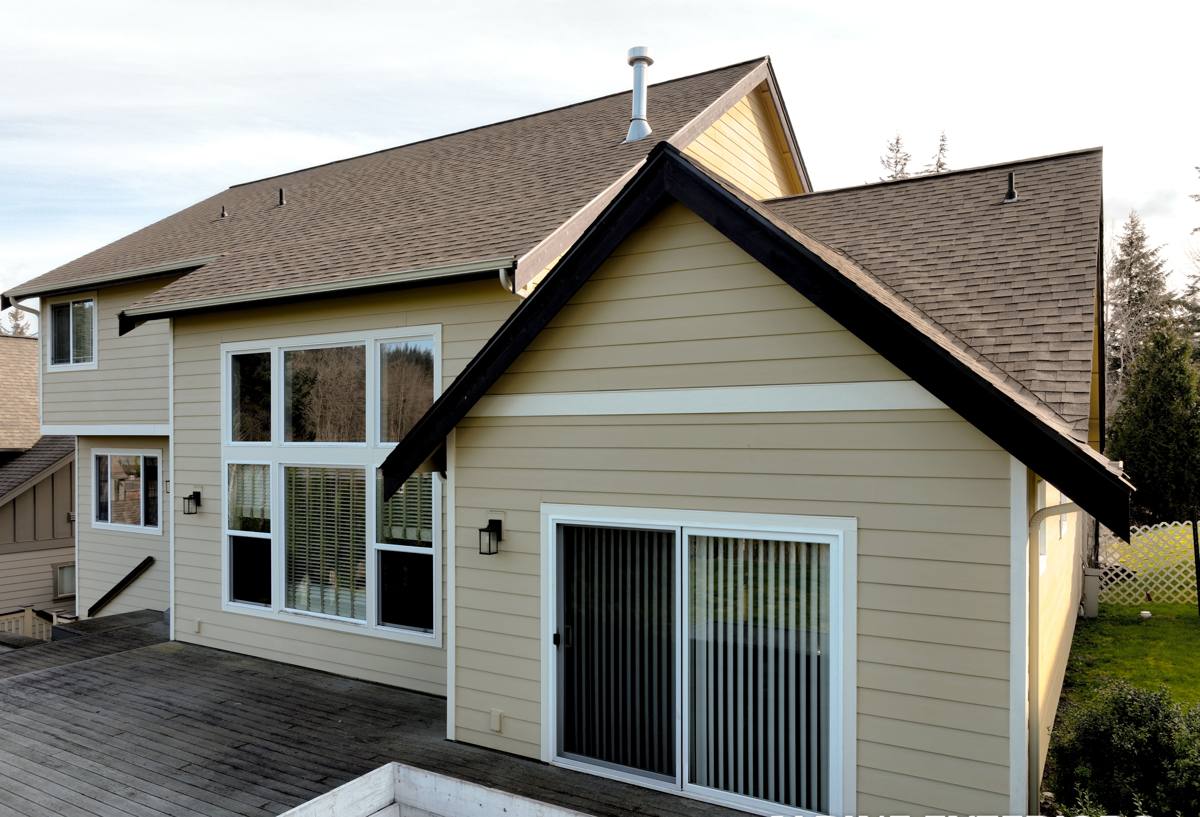
What "Custom" Actually Means for a Window Job
"Custom" doesn't mean exotic shapes or premium upcharges — it means the window is built and installed to fit the actual rough opening in your actual wall, not forced into a stock size. Older Lynden homes, especially farmhouses and homes built before standardized window sizing became common, often have openings that are slightly out of square or slightly off from modern manufacturer dimensions. A custom-measured window accounts for that instead of papering over the gap with extra trim and caulk.
Custom also means we're specifying the frame material, glass package, and installation method to match the specific wall — a shaded north wall that stays damp longer gets treated differently than a sun-exposed south wall, even on the same house.
Choosing the Right Frame Material
There's no single "best" window material — there's a right trade-off for your house, your budget, and how much upkeep you want to sign up for. Here's how the common options actually compare for a wet, moss-prone climate like Lynden's:
| Frame Material | Moisture Performance | Maintenance | Typical Lifespan |
|---|---|---|---|
| Vinyl | Very good — won't rot or corrode, but seals matter | Low — occasional cleaning | 20-30 years |
| Fiberglass | Excellent — dimensionally stable in temperature swings | Low | 30-40+ years |
| Wood (unclad) | Poor without diligent upkeep | High — repainting, sealing | Varies widely with maintenance |
| Wood-clad (vinyl or aluminum exterior) | Good if end grain is properly sealed at install | Moderate | 25-35 years |
We don't push unclad wood exteriors on homes in this climate unless a homeowner specifically wants the look and understands the maintenance commitment. It's not that wood windows are bad — it's that the upkeep burden in a climate with this much sustained moisture is real, and we'd rather tell you that upfront than sell you a callback in five years.
Glass Packages Worth Considering
For most Lynden homes, a dual-pane window with a low-E coating and argon gas fill is the practical baseline — it handles our temperature swings and cuts heat loss without a big price jump. Triple-pane adds meaningful sound and thermal performance but costs more and adds weight, which matters on larger openings or older framing. We'll walk through whether it's worth it for your specific rooms rather than upselling it across the board.
The Installation Details That Actually Prevent Leaks
This is the part that separates a window that lasts thirty years from one that leaks in three. The window unit itself is often the least important variable — how it's tied into the wall is what determines whether water gets in.
- A sloped sill pan under the opening so any water that does get past the window drains back out, not into the wall cavity
- Proper flashing sequence — house wrap, flashing tape, and window flange layered so water always sheds downward and outward, never trapped behind a layer
- Correct shimming so the frame isn't racked or bowed, which stresses seals and can cause the sash to bind
- Backer rod and sealant at the exterior joint, sized and installed to stay flexible through freeze-thaw cycles
- Insulation in the gap between frame and rough opening — not packed too tight, which can bow the frame
- Interior air sealing so conditioned air isn't pushing moisture into the wall cavity from the inside
Skip any one of these and the window can still look fine for a year or two before a problem shows up — which is exactly why so many leak issues get blamed on the window brand when the real cause was the install.
Retrofit vs. Full-Frame Replacement
Not every window needs to come out down to the studs. If the existing frame is square, dry, and structurally sound, a retrofit (or "pocket") install — where the new window fits into the existing frame — is faster, less disruptive, and often more affordable. But if there's any sign of rot, water staining on interior trim, or a frame that's already out of square, we recommend full-frame replacement so we can actually inspect and fix what's underneath before it's covered back up. Installing a new window into a wet or compromised frame just hides the problem for a while — it doesn't solve it.
On homes where we're also doing siding work, this is a natural point to coordinate: pulling siding back around a window opening gives a clean look at the sheathing and flashing before anything gets closed back up, which is the right time to catch and fix hidden moisture damage.
How Our Process Works
- On-site assessment — we look at each opening individually, not just take one measurement and assume they're all the same.
- Measure and specify — frame material, glass package, and install method chosen per opening based on exposure and condition.
- Order and prep — windows are built to the actual opening; we prep the site to minimize disruption to your home.
- Removal and inspection — old windows come out, and we check the framing and sheathing underneath before anything new goes in.
- Installation — sill pan, flashing, shimming, insulation, and sealant done in the correct sequence, not shortcuts.
- Cleanup and walk-through — we show you the finished work and how the hardware operates before we consider the job done.
What Affects the Cost
We don't quote firm numbers without seeing the house, but these are the factors that move the price up or down on most Lynden projects:
| Factor | Effect on Cost |
|---|---|
| Retrofit vs. full-frame replacement | Full-frame costs more but is often necessary if framing is compromised |
| Frame material (vinyl vs. fiberglass vs. wood-clad) | Fiberglass and wood-clad typically cost more than vinyl |
| Glass package (dual vs. triple pane) | Triple-pane adds cost per unit but improves comfort and sound control |
| Number and size of openings | Larger and non-standard sizes cost more to custom-build |
| Hidden damage found during removal | Rotted framing or sheathing adds repair cost, but skipping the repair costs more later |
| Access and site conditions | Second-story or hard-to-reach openings take more labor time |
Why a Crew That Already Works Lynden Matters
A contractor who works this specific area regularly has already seen how homes here age — which wall orientations hold moisture longest, how moss builds up on shaded trim, and what the local building department expects for permitting on window replacement projects. That's not something you get from a national installer who's in town for one job and gone. We also do siding work throughout Whatcom County, so when a window opening needs attention beyond the window itself — trim, flashing, or siding tie-in — we can handle it as one coordinated job instead of passing you to a second contractor and hoping the details line up between the two.
If you're weighing whether it's time to replace windows on a Lynden home, we're happy to take a look and give you a straight assessment — what's actually needed, what can wait, and what it will cost. Reach out for a free, no-pressure estimate using the form below.