 Whatcom County
 Siding That Has to Work in Everson, Not Just Look Good on Day One
Everson sits in the Nooksack River valley in Whatcom County, in the rural stretch between Bellingham and the Canadian border. It's a working landscape — farmland, tree cover, low elevation, and a lot of standing moisture in the cooler months. Siding here doesn't just need to look right when it goes up. It needs to hold paint, resist swelling, shed water at every seam, and keep moss and mildew from taking hold on north-facing walls that barely see direct sun from October through March.
That's a different set of demands than siding sold for a dry climate has to meet. A lot of exterior products perform fine in a showroom or in a low-humidity region and then struggle once they're exposed to a full Whatcom County winter, year after year. This page walks through what that exposure actually does to a home's exterior, what a correctly installed fiber cement job looks like, and why we've standardized on one product system rather than offering several.
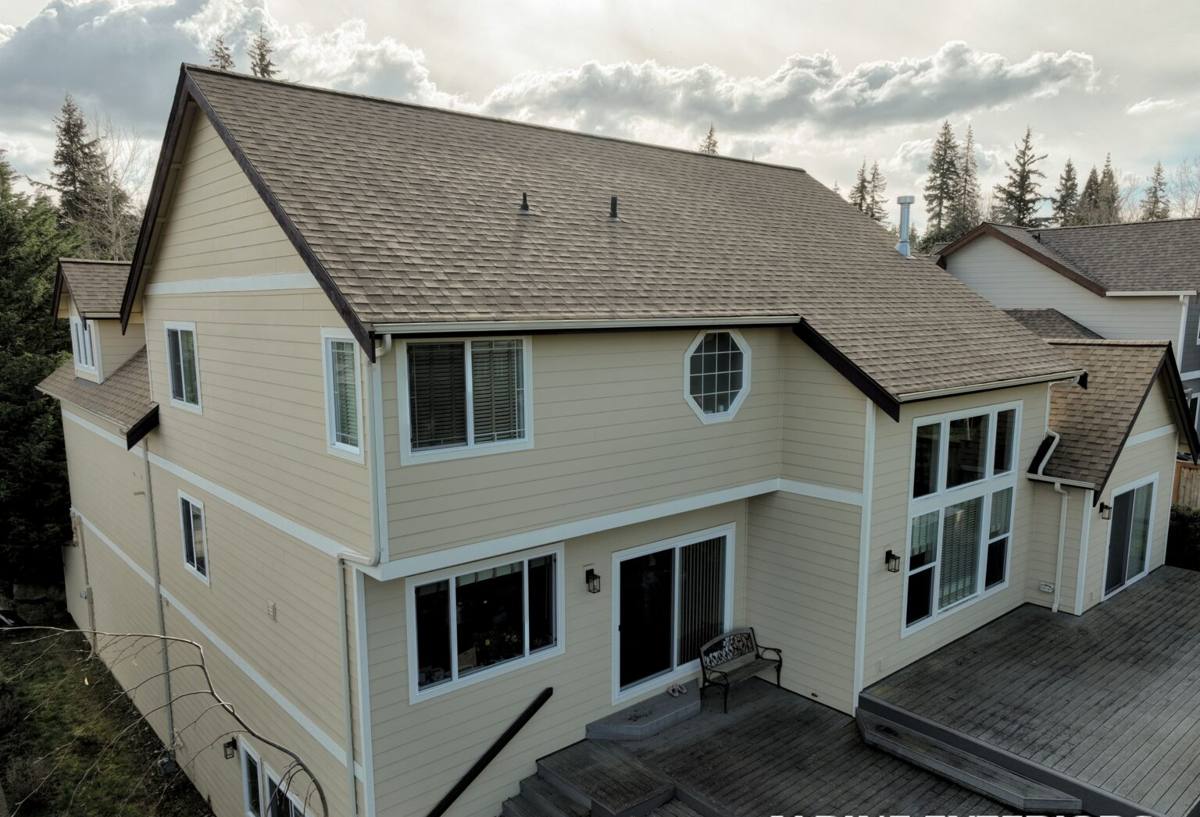
What Whatcom County's Climate Actually Does to Siding
Three things drive most of the siding failures we see in this part of the county:
- Sustained moisture exposure. Long stretches of drizzle and low cloud cover mean siding surfaces stay damp for days at a time, not hours. Materials that absorb water or swell at the edges lose dimensional stability over repeated wet-dry cycles.
- Driving rain against exposed walls. Wind-driven rain pushes water sideways into seams, laps, and butt joints — areas that are fine under a garden hose test but fail under real storm conditions if they weren't flashed and caulked correctly.
- A long moss and algae season. Shaded, north- and west-facing walls in river-valley terrain stay cool and damp long enough for moss, lichen, and mildew to establish. Once organic growth takes hold on a porous or damaged surface, it holds moisture against the wall and accelerates whatever damage started the problem.
None of this is exotic — it's the normal climate for Everson and the rest of Whatcom County. But it means siding decisions that would be reasonable in Spokane or Sacramento aren't automatically reasonable here.
Why We Install Only James Hardie Fiber Cement
We don't install vinyl, LP SmartSide, Cemplank, Allura, or unfinished wood siding. That's a deliberate standard, not a supply issue, and it's worth explaining honestly rather than just stating it.
Vinyl is inexpensive and low-maintenance in the sense that it never needs paint, but it's a thin plastic product that flexes, fades, and can crack in cold snaps — and it can't stop moisture the way a rigid board can once a seam opens up. Engineered wood products like LP SmartSide are wood-based, and wood-based siding depends entirely on an intact factory coating and careful field sealing at every cut edge to keep water out; in a climate that stays wet for months, any breach in that coating is an invitation for rot. Cedar and primed spruce look great when new but require an ongoing maintenance commitment — recoating, caulking, and moisture monitoring — that most homeowners underestimate until the siding is already showing damage.
James Hardie fiber cement is cement, sand, and cellulose fiber — non-combustible, dimensionally stable, and engineered specifically for wet climates through its HZ5 product line, which is formulated for the Pacific Northwest. It doesn't swell with moisture the way wood-based products can, it holds its factory-applied ColorPlus finish far longer than field-painted siding, and it gives us a warranty structure we're comfortable standing behind on a home that's going to face fifty or sixty Whatcom County winters. We install it because it's the product that actually matches the climate Everson homes sit in, not because it's the only option on the market.
How the Common Siding Options Stack Up in This Climate
| Material | Moisture behavior | Maintenance in Whatcom County | Typical lifespan here |
|---|---|---|---|
| Vinyl | Doesn't absorb water, but seams and edges can let it behind the panel | Low, but prone to cracking in cold and fading in UV over time | Moderate; varies widely with installation quality |
| LP SmartSide / engineered wood | Wood-based; relies on intact coating and sealed cuts to resist rot | Regular inspection and caulk maintenance recommended | Good if maintained; shorter if coating fails |
| Cedar / primed wood | Absorbs and releases moisture; prone to cupping and checking | High — recoating and moisture monitoring on a regular cycle | Shortest without diligent upkeep |
| James Hardie fiber cement | Dimensionally stable; not wood-based, resists swelling | Low — factory finish, periodic washing | Long-term, built for wet regional climates |
What a Correct Fiber Cement Installation Involves
Fiber cement siding is only as good as the installation behind it. In a climate like Everson's, the details that get skipped on a rushed job are exactly the details that cause problems in year three or four, not year one.
The elements that actually matter
- A proper weather-resistive barrier installed and lapped correctly behind the siding, with all penetrations sealed before a single board goes up.
- Rainscreen or drainage gap detailing where the wall assembly calls for it, so any moisture that does get behind the cladding has a path to drain and dry rather than sitting against the sheathing.
- Correct fastener placement and type — Hardie specifies fastener patterns and materials for a reason, and shortcuts here show up as popped nails, cracked boards, or panels that work loose in wind.
- Flashing at every horizontal transition — window and door heads, roof-to-wall intersections, deck ledgers, and butt joints — so driving rain has nowhere to collect.
- Manufacturer-specified clearances from grade, roofing, and decking, which keep splashback and standing water away from the bottom edge of the siding.
- Caulking and paint at cut edges, since a factory-finished board that gets field-cut without sealing the exposed edge loses part of its moisture protection right at that seam.
Skip any one of these and the siding can still look fine going up. The problems show up later, after a few wet seasons, which is exactly why installation quality matters more than the brand name on the box.
Our Process, From Estimate to Finished Job
We keep the process straightforward because homeowners deserve to know what's happening on their house at every stage:
- On-site walkthrough. We look at the existing siding, sheathing condition, trim, and any problem areas — especially shaded walls and spots with a history of moisture.
- Written scope and estimate. You get a clear breakdown of what's being removed, what's being repaired underneath if needed, and what's going back up, including the specific Hardie product line and color.
- Tear-off and inspection. Removing the old siding lets us actually see the sheathing and framing underneath rather than guessing — this is where hidden moisture damage, if any, gets caught and addressed before new siding goes on top of it.
- Weather barrier and flashing installation. This is the stage that determines how the wall performs for the next few decades, and it's done to spec, not shortcut.
- Hardie siding installation, following manufacturer fastening, clearance, and joint specifications throughout.
- Final walkthrough with you, covering care and what normal weathering looks like versus something that should get a call back.
Maintenance and What to Expect Over Time
One of the practical advantages of a ColorPlus-finished Hardie installation in a climate like Everson's is how little ongoing attention it needs compared to wood-based or field-painted siding. A periodic rinse to keep moss and pollen from building up on shaded walls, an eye on caulk lines around windows and trim every year or two, and prompt attention if anything ever gets damaged by a fallen branch or equipment — that's most of it. There's no recoating cycle to manage and no annual moisture inspection required the way there is with wood siding.
That said, no siding is maintenance-free in a river valley climate. North-facing walls under tree cover will still collect moss faster than sun-exposed walls, and that's true regardless of material — it's a function of shade and moisture, not a defect. Keeping gutters clear and vegetation trimmed back from the walls does more for long-term siding performance than almost anything else a homeowner can control.
What to Look for When Hiring Someone for This Work
Fiber cement is not a forgiving material for a crew that's unfamiliar with it — improper cutting, fastening, or clearances can undermine the product's long-term performance even though the boards themselves are excellent. Before hiring anyone for a fiber cement job in Everson or elsewhere in Whatcom County, it's worth asking:
- Are they factory-trained or certified on the specific Hardie product line being installed?
- Will they specify the fastener type and pattern in writing, not just "we'll handle it"?
- Do they inspect and address sheathing condition during tear-off, or just cover over whatever's there?
- Can they explain their flashing and drainage plan for your specific wall assembly, not a generic answer?
- Are they licensed, insured, and willing to put warranty terms in writing?
Why It Matters That We Already Work in Everson
A crew that regularly works Whatcom County communities like Everson already knows what the local moisture and moss patterns do to a wall assembly, which sides of a house typically need the most attention, and how the region's rainfall affects sequencing and drying time during a project. That's not something you get from a general contractor passing through the area once. It shows up in small decisions — where extra flashing attention goes, how tight the schedule can run before weather becomes a factor, which product line actually makes sense for a given exposure — that add up to a siding job that holds up rather than one that needs revisiting in a few years.
If you're weighing a siding replacement or repair in Everson, we're glad to walk the property, look at what's there now, and give you a straightforward, no-pressure estimate for what a correct James Hardie installation would involve on your home. There's a form below to get that started.