 Whatcom County
 A Deck That Has to Work in Ferndale's Weather, Not Just Look Good in a Showroom
Composite decking gets sold on a simple promise: less upkeep than wood. That promise only holds up if the deck underneath the surface boards is built for the climate it's sitting in. In Ferndale, that means a structure that can handle rain that blows in sideways as much as it falls straight down, air with a steady low-level salt influence off the county's coastline, and long overcast stretches where moss and algae never fully lose their grip. A composite deck that ignores any one of those conditions can still end up needing early repair, even though the boards themselves are marketed as low-maintenance.
We build composite decks in Ferndale the way we'd want one built for our own home here — starting with the framing and fastener choices most homeowners never see, not just the surface material everyone points to when picking a color.
Ferndale's Setting Adds a Few Specific Wrinkles
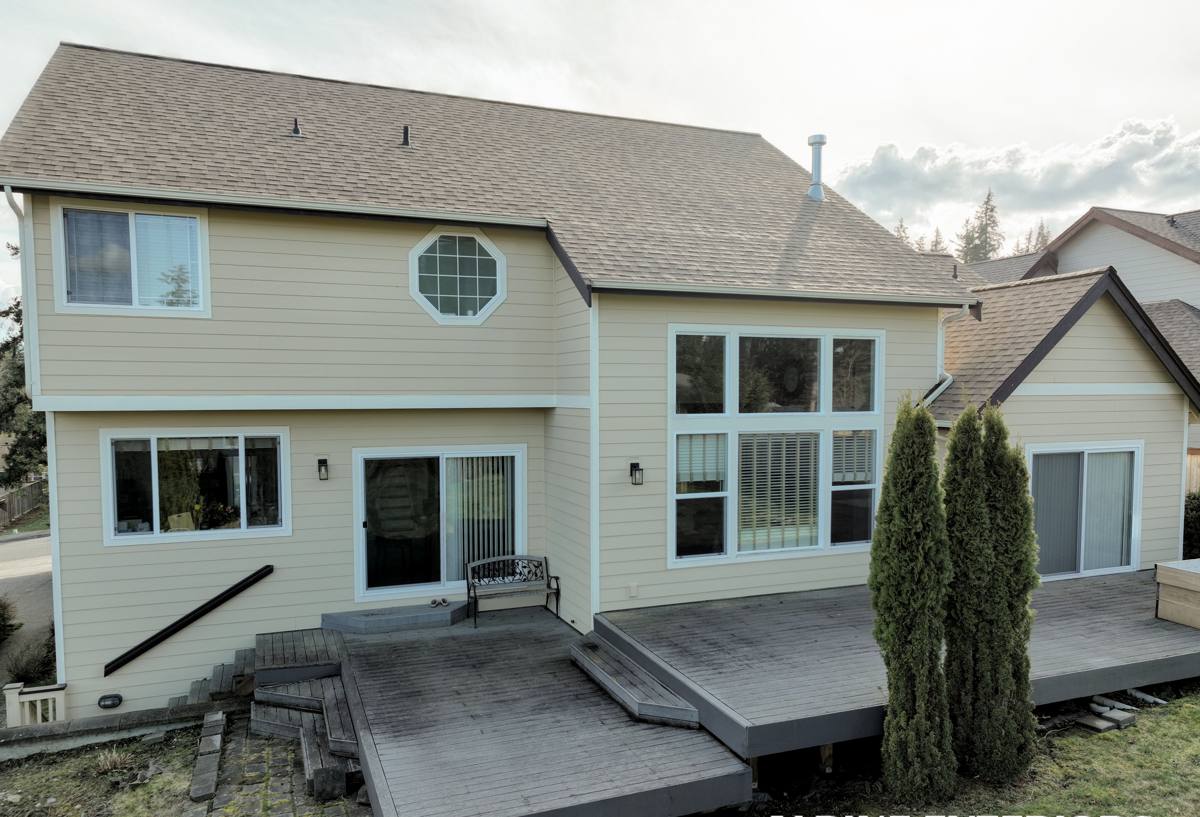
Ferndale sits close enough to the coast and to river-bottom land that many lots deal with heavier moisture and slower drainage than homes further inland or up on higher ground. A deck footprint on a low, flat lot holds dampness longer after a storm than one on a well-drained slope, and that difference should show up in how the footings, framing, and ventilation underneath the deck are designed — not just in which board color gets picked.
What This Climate Actually Does to a Deck Over the Years
Wind-Driven Rain
Storms moving through Whatcom County rarely drop rain straight down for long. Wind pushes it at an angle, up under railing caps, into board gaps, and behind any trim piece that was installed assuming water only ever falls from above. A deck detailed for this climate treats every horizontal surface and every seam as a place water can get in sideways, because here, sooner or later, it will.
A Steady Dose of Salt in the Air
Coastal-influenced air carries a low, constant level of salt further inland than most people assume, and that steady exposure shortens the working life of standard fasteners, screws, and hidden hardware faster than it would in a drier, inland climate. It's not dramatic or sudden — it's a slow corrosion clock running on every piece of metal in the structure, including the connectors buried inside joints nobody looks at again after the build is finished.
A Moss Season That Runs Most of the Year
Frequent rain combined with long stretches of overcast weather means a lot of Ferndale decks don't get enough sustained dry time to fully dry out, especially in shaded corners, under overhangs, or near trees and fence lines. Moss and algae aren't just a cosmetic complaint — a mossy surface traps moisture against whatever is underneath it, which accelerates wear on fasteners, framing connectors, and even some composite substrates well beyond what open rain exposure alone would cause.
Why the Combination Is the Real Challenge
Any single one of these factors is manageable on its own. What makes Ferndale decks demanding is that rain, salt-influenced air, and moss pressure all run at the same time for most of the year, without the extended dry season that would otherwise let a deck fully recover between wet spells. A detail that would hold up fine in a drier region can come up short here simply because the deck never gets that recovery window.
Why Composite Makes Sense for This Climate — and Where It Doesn't Solve Everything
Composite decking's core advantage in a climate like this is that the boards themselves don't need sanding, staining, or sealing to resist rot the way wood does. That's a real benefit here, where a wood deck's maintenance schedule fights an uphill battle against near-constant dampness. But composite isn't maintenance-free, and it isn't a substitute for correct framing, fastening, and drainage underneath it. The board is only one part of a deck that has to perform in this weather for decades.
| Factor | Wood Decking | Composite Decking |
|---|---|---|
| Upfront cost | Lower material cost | Higher material cost |
| Ongoing upkeep | Regular cleaning, sealing, and re-staining to fight moss and moisture | Occasional washing; no sealing or staining required |
| Moss and algae resistance | Needs consistent treatment to keep growth from taking hold | More resistant on the surface, though shaded areas still need cleaning |
| Behavior in standing moisture | Can rot, cup, or split if moisture sits against it repeatedly | Won't rot, but poor drainage underneath can still shorten hardware life |
| Typical service life here | Shorter without disciplined annual maintenance | Longer with far less owner effort, if the substructure is built correctly |
The honest way to frame this: composite shifts the maintenance burden away from the board and onto the build quality underneath it. If the framing, flashing, and fastening are done right the first time, that trade works strongly in the homeowner's favor. If they aren't, composite decking can still develop problems — they just show up in the structure instead of on the surface.
What a Correct Composite Deck Install Actually Involves
Framing and Footings Sized for the Actual Lot
Footing depth and spacing need to match the soil conditions on that specific property, not a generic assumption carried over from a different job across town. On lower, flatter Ferndale lots where drainage is naturally slower, we pay particular attention to footing placement and post base height so hardware isn't sitting in standing water after every storm.
The Ledger Connection — Where the Deck Meets the House
If the deck attaches to the home, the ledger board connection is the single highest-consequence joint on the entire structure. It sits directly behind the siding and water-resistive barrier already protecting that wall, so how that joint is flashed affects the house itself, not just the deck. We treat this connection as part of the home's overall exterior water management, not an isolated deck detail — which matters, since siding and moisture control is our core trade to begin with.
Fastener and Hardware Grade
Given the salt-influenced air here, we use corrosion-resistant fasteners and structural connectors throughout the build, not just at the points that are visible after the project wraps. The hidden hardware inside a deck's framing does the real structural work, and it's the last thing you want cutting corners on to save a few dollars on a job that's supposed to last decades.
Board Spacing, Ventilation, and Airflow
Composite boards need proper gapping to allow for thermal movement and to let water drain through rather than pool on the surface. Just as important — and often overlooked — is airflow underneath the deck itself. A low deck with poor ventilation underneath traps moisture against the framing long after the surface boards look dry, which is exactly the kind of hidden problem that shows up as sagging or soft framing years down the road.
Hidden Fastener Systems vs. Face-Screwed Boards
Most composite decking today is installed with a hidden clip system that leaves no screw heads visible on the board surface, which gives a cleaner look and eliminates a common water-entry point at each screw hole. Face-screwing is sometimes still used at borders, stair treads, or certain board profiles. Either approach can be done correctly — what matters is using the fastening method the specific board manufacturer engineered that product around, rather than defaulting to whatever's fastest to install.
Capped Composite vs. Uncapped Composite
Not all composite decking is built the same way, and the difference matters more in a wet climate than it does in a dry one.
| Feature | Capped Composite | Uncapped Composite |
|---|---|---|
| Outer surface | Protective polymer shell bonded over the core | No protective shell — core material is more directly exposed |
| Moisture absorption | Significantly more resistant | More prone to absorbing moisture over time |
| Staining and fading resistance | Better resistance to staining, mold, and UV fading | More susceptible to staining and surface wear |
| Typical cost | Higher upfront cost | Lower upfront cost |
| Best fit for this climate | Generally the stronger long-term choice in a wet, moss-prone environment | Can still work, but needs more attentive cleaning and upkeep here |
We'll walk through both options honestly during an estimate, including where each one fits a given budget, rather than steering every job toward the highest-margin product on the shelf.
How Our Process Works, From First Call to Finished Deck
- Site visit and walk-through — we look at drainage patterns, sun and shade exposure, and how the deck will connect to the house before talking about materials.
- Design and material conversation — we go over board options, capped vs. uncapped, railing systems, and a realistic cost range based on your specific footprint and site conditions.
- Permitting — we handle the permit process for the scope of work involved, so you're not chasing paperwork on your own.
- Framing and footings — built to the soil and drainage conditions on your lot, with corrosion-resistant hardware throughout.
- Ledger flashing and structural connections — detailed to protect both the deck and the wall it attaches to.
- Decking, railing, and finish work — installed with correct spacing, fastening method, and attention to airflow underneath.
- Final walk-through — we go over the finished deck with you and explain what little maintenance it does need going forward.
Maintaining a Composite Deck in a Climate Like This
Composite decking cuts the maintenance list way down compared to wood, but "low-maintenance" isn't the same as "no maintenance," especially with a moss season that runs most of the year.
- Sweep debris out of board gaps and off the surface regularly, more often under trees or near fences that hold shade.
- Wash the surface periodically with a mild cleaner and soft brush to keep moss and algae from getting established in shaded areas.
- Check railing post connections and any visible hardware once a year for early signs of corrosion.
- Keep gutters and downspouts near the deck clear so runoff isn't draining directly onto or under the structure.
- Confirm airflow underneath a low deck isn't blocked by stored items, overgrown landscaping, or added skirting that traps moisture.
A Quick Pre-Install Checklist for Homeowners Comparing Bids
- Ask whether the fastener and connector hardware is rated for a coastal-influenced, wet climate — not just standard interior-grade hardware.
- Ask how the ledger connection will be flashed, since that joint affects your home's siding and water management, not just the deck.
- Ask whether the quote specifies capped or uncapped composite, since the price difference should reflect a real material difference, not just a markup.
- Ask how footing depth and post base height were determined for your specific lot, especially on flatter or low-lying ground.
- Get the fastening system, board brand, and warranty terms in writing before work starts.
Why Hiring a Crew That Already Works Ferndale Matters
A deck built to a generic national spec sheet can still fail here on schedule, because that spec sheet was written assuming a real dry season that lets a structure fully recover between storms. Ferndale doesn't reliably get that. A crew that already works this area and the rest of Whatcom County knows which lots hold water longest, how far salt-influenced air realistically reaches inland, and which fastener and flashing choices actually hold up through a moss season that doesn't take much of a break. That local pattern recognition is the difference between a deck that needs real repair in five years and one still performing well past fifteen.
It also means fewer surprises during the build itself — knowing ahead of time how a particular part of Ferndale drains, or how exposed a given lot is to wind-driven rain, lets us plan the framing and flashing correctly the first time instead of adjusting after something starts to fail.
Ready to Talk Through Your Project?
If you're weighing a new composite deck or replacing an aging one, we're glad to walk the site with you and give you a straightforward read on what it'll take to build it right for a Ferndale lot. Reach out for a free, no-pressure estimate using the form below.