 Whatcom County
 Why Siding Choice Matters More in Bellingham Than Most Places
Bellingham sits in a tough spot for exterior building materials. You've got Bellingham Bay pushing salt-laden air inland, a wet season that stretches for months at a time, and enough shade and moisture on north-facing walls to keep moss and algae established year-round. Add in the freeze-thaw swings that show up most winters, and you've got a climate that will find every weakness in a siding product within a few years, not a few decades.
That's the backdrop for every siding decision a Whatcom County homeowner makes. A product that performs fine in a drier inland climate can struggle here. We install James Hardie fiber cement siding exclusively — not vinyl, not LP SmartSide, not primed wood, not other fiber cement brands — because after years of working on homes in this exact climate, it's the product we trust to hold up without turning into a recurring maintenance project.
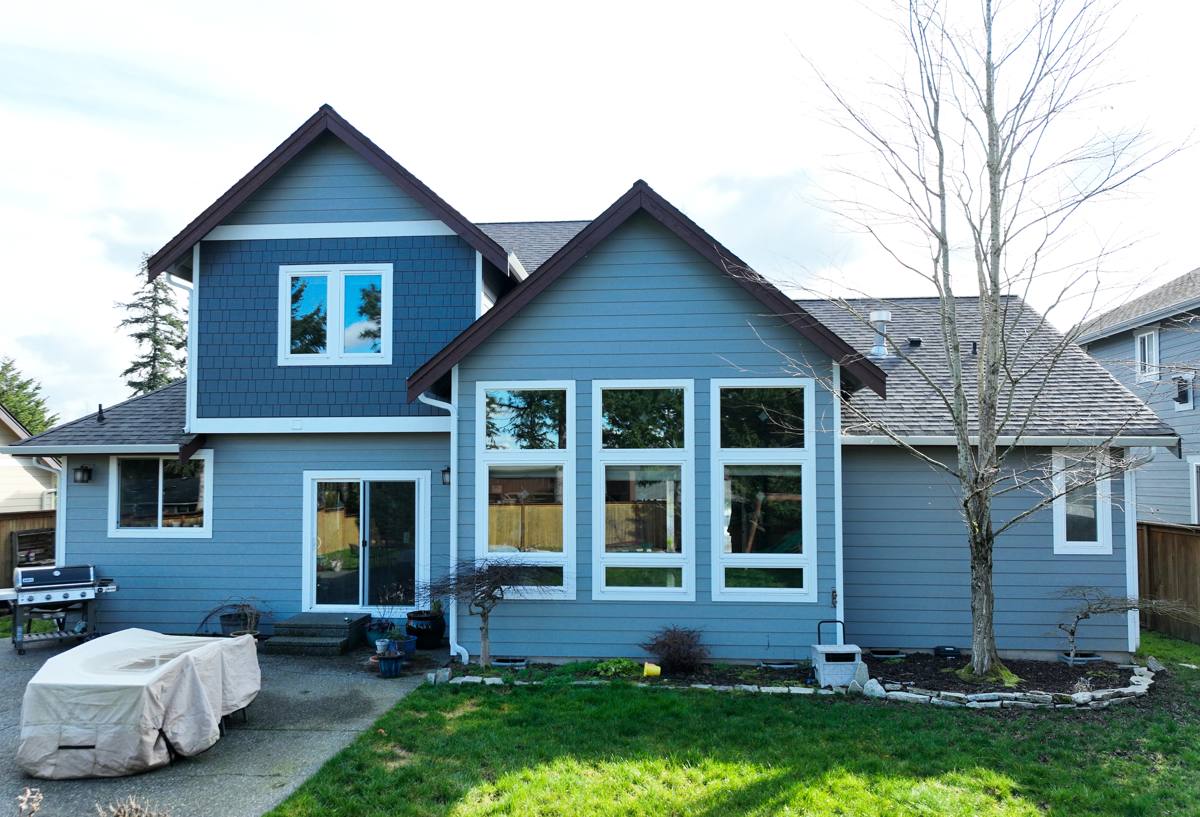
What Bellingham's Climate Actually Does to Siding
Salt Air and Moisture
Proximity to the bay means airborne salt settles on exterior surfaces and accelerates corrosion of fasteners, trim, and any metal components in a siding system. It also means moisture stays present in the air longer, which matters for materials that swell, warp, or absorb water at the seams.
Driving Rain
Whatcom County doesn't just get rain, it gets wind-driven rain that hits walls at an angle rather than falling straight down. That puts real pressure on how siding is lapped, how seams are sealed, and how water is directed away from the wall assembly rather than behind it. Poor flashing or caulking details that might get away with it in a calmer climate get exposed here fast.
Moss and Algae Season
Shaded, north- and west-facing walls in Bellingham stay damp for extended stretches, especially under mature tree cover, which is common in this region. That's ideal growing conditions for moss and algae on porous or textured siding surfaces. Once established, it holds moisture against the wall and accelerates whatever underlying decay process is already in motion.
Freeze-Thaw Cycling
It's not Whatcom County's harshest weather, but the occasional freeze after a long wet stretch is enough to punish any siding material that has already absorbed water. Wood swells and splits. Some composite products delaminate. Fiber cement, correctly installed and sealed, doesn't take on enough water to be vulnerable to this in the first place.
Why We Install James Hardie and Nothing Else
We get asked why we don't offer vinyl or LP SmartSide as a lower-cost option. The honest answer is that we've standardized on one product because it's the one we're confident will still look and perform the way it should in fifteen or twenty years on a home exposed to this specific coastal, high-moisture climate.
- Non-combustible material: fiber cement doesn't feed a fire the way wood-based or vinyl products can.
- Engineered for the Pacific Northwest: Hardie's HZ5 product line is formulated for wetter, more humid climates like ours, rather than a one-size-fits-all formulation.
- Factory-applied ColorPlus finish: the color is baked on at the factory under controlled conditions, which holds up better against UV and moisture than field-applied paint.
- Dimensionally stable: it doesn't swell, warp, or rot the way wood-based siding can when it stays damp for weeks at a time.
- Backed by a strong transferable warranty when installed to manufacturer spec, which matters on a resale-heavy market like Bellingham's.
None of this is a knock on every other product across the board. Vinyl is inexpensive and low-maintenance in dry climates. LP SmartSide performs reasonably well when kept dry and well-maintained. But we're not willing to put a product on a Bellingham home that depends on ideal conditions this region doesn't reliably provide.
How Fiber Cement Compares for Whatcom County Conditions
| Factor | James Hardie Fiber Cement | Vinyl | Wood / Engineered Wood |
|---|---|---|---|
| Moisture resistance | High — doesn't absorb water like wood-based products | Good, but seams can trap moisture behind panels | Vulnerable to swelling, rot if moisture gets in |
| Performance in salt air | Strong, minimal corrosion concerns with proper fasteners | Can become brittle over time in coastal exposure | Fasteners and finish degrade faster near salt air |
| Moss/algae resistance | Good with correct finish; cleans up well | Moderate — smooth surface sheds growth fairly easily | Poor — textured, porous surface holds moisture and growth |
| Fire resistance | Non-combustible | Melts/deforms under heat | Combustible |
| Expected lifespan (correctly installed) | 30+ years | 20-30 years | 15-25 years, climate-dependent |
| Maintenance | Periodic wash, repaint on a longer cycle | Low, but limited repair options | Regular repainting/sealing required |
What Correct Fiber Cement Installation Involves
Fiber cement siding's reputation depends almost entirely on installation quality. The material itself is durable, but a rushed or improperly detailed installation is where problems start, especially in a wet climate like Bellingham's.
Weather-Resistive Barrier and Flashing First
Before a single piece of siding goes up, the wall needs a properly lapped weather-resistive barrier and correctly integrated flashing around every window, door, and penetration. In a driving-rain climate, this layer is what actually keeps water out of the wall assembly — the siding itself is the second line of defense, not the only one.
Proper Clearances
Hardie siding needs specific clearances from grade, roof lines, decks, and other horizontal surfaces to avoid wicking moisture. Skipping these clearances is one of the most common causes of premature siding failure we see on homes that weren't installed to spec.
Fastener Placement and Type
Fasteners have to be corrosion-resistant, properly spaced, and driven correctly — not overdriven, not underdriven. Given the salt air here, using the wrong fastener type is a mistake that shows up as staining and corrosion well before the siding itself would ever fail.
Caulking and Sealant Details
Every seam, joint, and penetration needs the right sealant applied correctly. In wind-driven rain, a gap that seems minor can push water behind the siding over time.
Field-Cut Edge Sealing
Any time a Hardie board is cut on site, that exposed edge needs to be sealed per manufacturer specification. Skipping this step is a shortcut that doesn't show consequences immediately, but it undermines the product's moisture resistance right at the cut.
Our Process on a Bellingham Home
- On-site assessment: we look at your home's exposure, existing siding condition, moisture issues, and any problem areas (shaded walls, poor grading, existing rot).
- Detailed proposal: a clear scope covering product line, color, trim details, and what we'll address in the underlying wall assembly, not just the visible siding.
- Tear-off and inspection: once old siding comes off, we inspect sheathing and framing for hidden moisture damage before anything new goes on.
- Weather barrier and flashing installation: this step gets done right, every time, because it's the part that matters most in this climate.
- Hardie siding installation to manufacturer spec: correct clearances, fasteners, and sealant application throughout.
- Final walkthrough: we go over the finished work with you before calling the job done.
Signs Your Current Siding Isn't Keeping Up
- Persistent moss or algae growth that returns quickly after cleaning
- Soft spots, bubbling, or visible warping, especially on shaded or north-facing walls
- Peeling or chalking paint that needs repainting more often than it used to
- Visible gaps or separation at seams and trim
- Rising energy bills that suggest the wall assembly isn't performing the way it should
- Staining around fasteners or trim, a sign of corrosion or water intrusion
Why a Crew That Already Works Whatcom County Matters
Manufacturer installation guidelines are written for a range of climates, but experience with this specific region — the wind direction off the bay, which walls stay shaded longest, how fast moss establishes on a given exposure — is what separates a technically correct install from one that's actually built for Bellingham conditions. A crew that installs fiber cement siding across Whatcom County regularly has already seen how these details play out over years on real homes, not just in a manufacturer's spec sheet.
That familiarity also matters when it comes to permitting, local building department expectations, and knowing which details tend to get overlooked on homes in this area. It's the difference between a siding job that looks right on installation day and one that's still performing the way it should a decade later.
Get a Straightforward Estimate
If your Bellingham home's siding is past its prime, or you're planning ahead for a replacement, we're happy to take a look and give you a clear, no-pressure estimate. Fill out the form below and we'll get back to you with honest answers, not a sales pitch.