 Whatcom County
 Blaine's Marine Climate Is Harder on Siding Than Most Homeowners Realize
Blaine sits right where Puget Sound weather meets the Canadian border, with Semiahmoo Bay and Drayton Harbor putting homes close to open salt water year-round. That proximity matters more for siding than most people think. Salt-laden air carries fine mineral particles that settle on exterior walls, and combined with near-constant marine humidity, it accelerates corrosion of fasteners, degrades paint film faster than an inland location would, and keeps wall surfaces damp longer after every storm. Add driving rain that comes in sideways off the water during winter systems, and you have a climate that tests every seam, joint, and coating a siding product has.
Then there's moss. Whatcom County's long wet season, low winter sun angle, and tree cover give moss and algae months at a time to establish themselves on north-facing and shaded walls. On the wrong siding material, that's a slow but steady path to trapped moisture, surface staining, and eventually rot or delamination. On the right material, installed correctly, it's a cosmetic issue you rinse off — not a structural one.
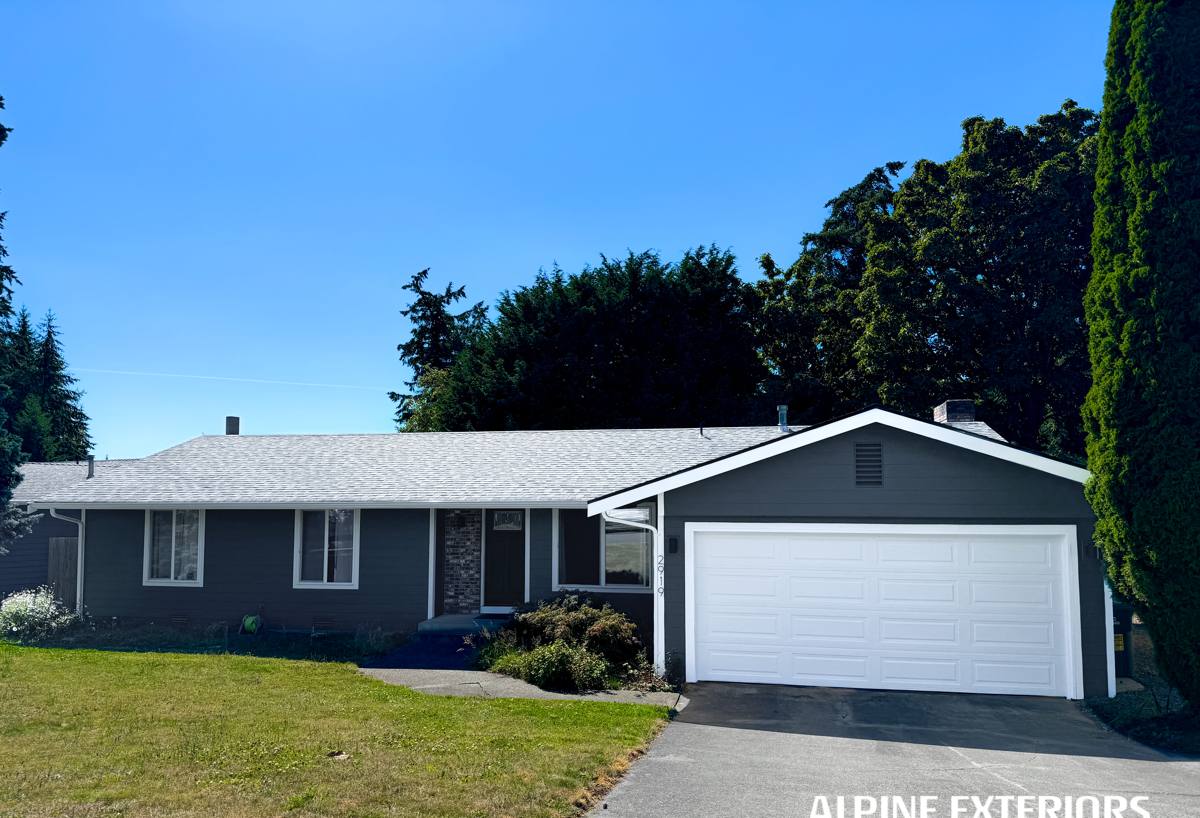
Why We Install James Hardie Fiber Cement in Blaine — and Nothing Else
We install James Hardie fiber cement exclusively. We don't install vinyl, LP SmartSide, primed wood, cedar, or other fiber cement brands like Allura or Cemplank, and we're upfront about why: in a marine, high-moisture climate like Blaine's, the material and the finish system matter as much as the installation. Hardie's fiber cement is non-combustible, dimensionally stable when wet, and doesn't feed moss or fungal growth the way wood-based products can. Its ColorPlus factory-applied finish is baked on and formulated to resist fading and moisture intrusion better than field-applied paint, which matters when a house is getting rinsed in humid salt air most of the year.
Hardie also builds region-specific product engineering into their HZ5 line for the Pacific Northwest, which accounts for exactly this kind of climate — freeze-thaw cycling, sustained moisture exposure, and coastal air. That's not marketing to us; it's the reason we standardized on one manufacturer instead of installing whatever a homeowner asks for. We'd rather turn down a job than install something we don't think will hold up on a Blaine house.
What We're Not Installing, and Why
- Vinyl siding — expands and contracts significantly with temperature swings, can warp under direct sun exposure off the water, and its seams are a long-term weak point against driving rain.
- LP SmartSide and other wood-strand products — engineered wood is more moisture-sensitive at cut edges and fastener penetrations than fiber cement, which is a real liability in a climate this wet.
- Primed spruce or cedar — beautiful when new, but demands a repainting and caulking schedule that's tough to keep up with in a marine climate, and untreated cut edges are an entry point for rot.
What a Correct Fiber Cement Installation Actually Involves
Fiber cement siding is only as good as the installation behind it. In Blaine specifically, a few details separate a job that lasts decades from one that fails early:
Weather-Resistive Barrier and Flashing
Every wall gets a properly lapped weather-resistive barrier before siding goes up, with flashing detailed at every window, door, and penetration so that any water that gets behind the cladding has a way out, not a way in. Given how much wind-driven rain Blaine gets off the bay, this layer is arguably more important than the siding itself.
Clearances and Fastening
Hardie specifies minimum clearances from grade, roof lines, decks, and other horizontal surfaces — typically 6 inches from soil and 1-2 inches from roofing — specifically so splash-back and ponding water don't sit against the bottom edge of the boards. Fasteners need to be corrosion-resistant (we use stainless or hot-dipped galvanized, not standard coated fasteners) because salt air will find any weak metal over time. Fastener placement and spacing also need to follow Hardie's published fastening schedule, not a generic "close enough" approach — under-fastened boards can rattle loose or crack in coastal wind.
Joints and Caulking
Butt joints get flashed or backed, not just caulked and hoped for. Caulk is a maintenance item, not a waterproofing strategy, and in a climate this wet we don't rely on it as the primary defense.
| Detail | Done Right | Common Shortcut We See |
|---|---|---|
| Bottom clearance | Minimum gap maintained above grade, decks, walkways | Siding installed tight to grade or hardscape, wicking moisture |
| Fasteners | Corrosion-resistant, correct spacing per Hardie spec | Standard fasteners, inconsistent spacing |
| Butt joints | Flashed or backed with proper gap | Boards butted tight and caulked only |
| Weather barrier | Continuous, properly lapped, integrated flashing | Housewrap installed but not detailed at penetrations |
| Cut edges | Sealed per manufacturer spec | Left raw, especially at field cuts |
How Our Process Works on a Blaine Home
- On-site walkthrough: We look at wall exposures, existing moisture damage, current siding condition, and how much salt-air and moss exposure specific walls actually get — north and west faces near the water usually need the most attention.
- Written estimate: Scope, product line, trim details, and timeline in writing, no pressure to sign that day.
- Tear-off and inspection: Once old siding is off, we inspect sheathing for hidden rot or moisture damage before anything new goes up — this is often where a job's real scope becomes clear.
- Weather barrier and flashing: Installed and inspected before a single piece of siding goes on.
- Siding installation: Following Hardie's fastening and clearance specs, not shortcuts.
- Final walkthrough: We go over the finished job with the homeowner and address anything before we consider it done.
Because we already work in Blaine and the surrounding Whatcom County coastline, we're familiar with which walls on a typical local house take the worst weather, and we plan installation sequencing and detailing around that instead of treating every wall identically.
Product Lines and Colors That Make Sense for This Area
Most Blaine jobs use Hardie's lap siding for the main field, with panel siding for accent areas or modern-style homes, and trim boards for corners and window surrounds. ColorPlus finishes come pre-baked in a range of colors designed to resist fading, which matters given how much UV and moisture exposure a west or south-facing wall gets even in a generally cloudy climate. Darker colors show less moss staining between cleanings; lighter colors show it sooner but also read as cleaner right after a wash. Neither is wrong — it's a maintenance-preference conversation we have with each homeowner.
What Drives Cost on a Job Like This
| Factor | Why It Matters in Blaine |
|---|---|
| Existing sheathing condition | Hidden moisture damage from prior siding failures adds repair scope before new siding goes up |
| Wall exposure | Walls facing the water or prevailing storm direction often need extra flashing detail |
| Trim complexity | Corners, window surrounds, and architectural detail affect labor time more than material cost |
| Siding profile mix | Combining lap, panel, and trim styles costs more than a single uniform profile |
| Access and site conditions | Waterfront lots, slopes, and mature landscaping can affect staging and labor time |
We give real ranges once we've actually seen the walls — not a number pulled from a national average that ignores what a Whatcom County coastal home is dealing with.
Living With Fiber Cement Siding in a Salt-Air, Moss-Prone Climate
Fiber cement is low-maintenance compared to wood or vinyl, but "low-maintenance" isn't "no-maintenance," especially this close to the water. A simple seasonal routine keeps it performing the way it's supposed to:
- Rinse siding with a garden hose (not a pressure washer aimed directly at joints) once or twice a year, more often on north-facing or shaded walls prone to moss
- Check caulking at trim and window surrounds annually and re-caulk hairline gaps before winter storms
- Keep gutters clear so overflow doesn't run down and pool against siding at roof lines
- Trim back vegetation and tree cover that keeps walls shaded and damp longer than necessary
- Address any impact damage or chips in the ColorPlus finish promptly with manufacturer-matched touch-up rather than letting raw edges sit exposed
Why a Crew That Already Works Blaine Matters
Siding installation quality varies enormously based on whether a crew understands the specific climate they're working in. A crew used to installing in a dry inland climate can do a technically fine job that still underperforms on a Blaine house, because clearance details, flashing choices, and fastener selection all need to account for sustained salt air and driving rain exposure. We work this stretch of Whatcom County regularly, which means we're not guessing about which details matter most here — we're applying what we've already seen hold up, and what hasn't, on homes facing the same weather.
If you're considering fiber cement siding for a Blaine home, we're happy to walk the property, look at your current siding condition, and give you a straight, no-pressure estimate — fill out the form below to get started.