 Whatcom County
 Deck Building in Happy Valley: Why the Approach Has to Be Local
Happy Valley sits close enough to Bellingham Bay that homes here deal with a version of Whatcom County weather that's a notch harder on outdoor structures than what you'd see further inland. Salt-tinged air off the water, long stretches of driving rain through fall and winter, and a moss season that can run half the year all work against a deck that wasn't built with this specific environment in mind. A deck design that's perfectly fine in a drier climate can start showing rot, corrosion, or slick, moss-covered boards within a few seasons here if it was framed and finished without those conditions in mind.
This page is about one thing: building decks correctly for Happy Valley homes. Not a generic deck-building overview, but what actually changes when the job site is a few blocks from the bay in a part of Whatcom County that stays damp for most of the year.
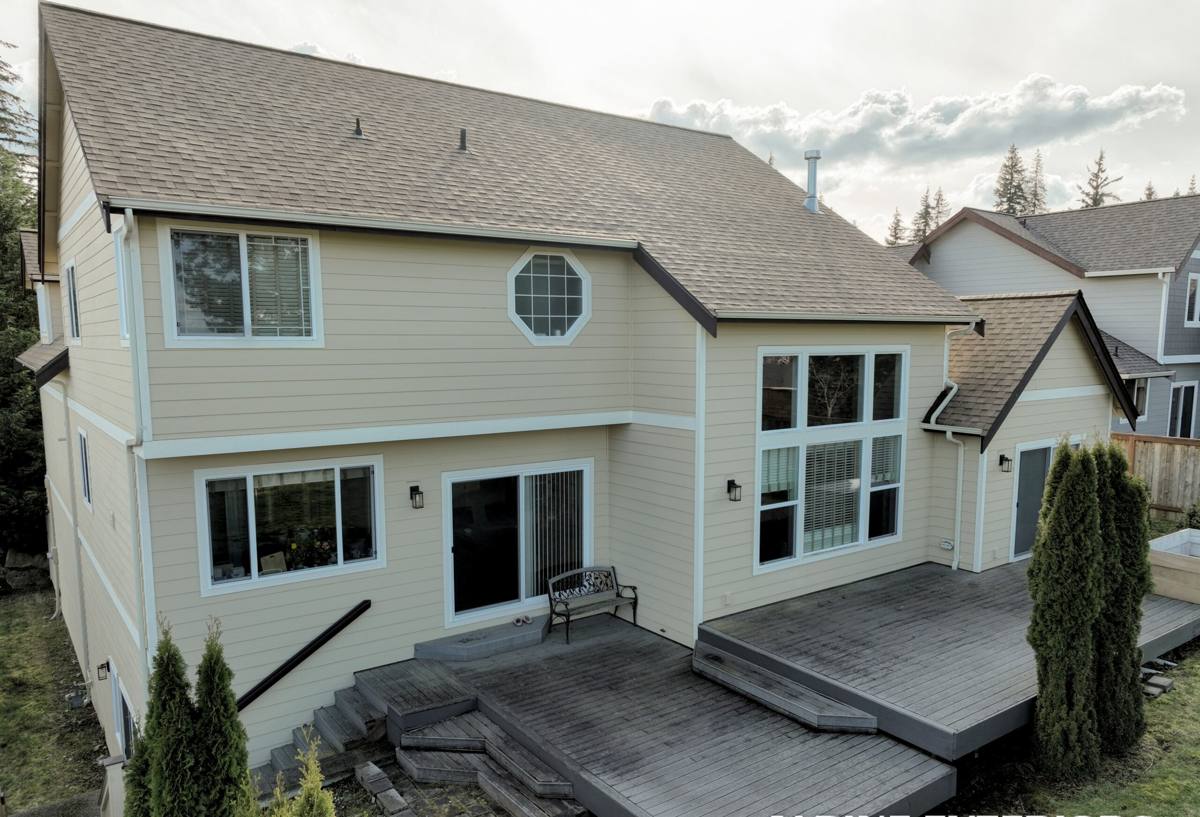
What Whatcom County's Climate Actually Does to a Deck
Salt Air
Proximity to Bellingham Bay means airborne salt finds its way onto exposed metal — fasteners, joist hangers, railing hardware, structural screws. Standard zinc-coated fasteners that hold up fine inland can start corroding noticeably faster this close to the water. Corrosion in a fastener you can't see (a joist hanger buried under decking, for example) is the kind of problem that doesn't show itself until it's already serious.
Driving Rain
Rain here doesn't just fall straight down — wind-driven rain gets pushed sideways into ledger connections, under flashing, and into any gap in the building envelope where the deck meets the house. A deck ledger that isn't properly flashed and sealed is one of the most common sources of hidden water damage to a home's rim joist and sheathing, and it's a slow, invisible problem until someone finally pulls the decking up.
Moss and Algae
Shaded, damp surfaces in Whatcom County grow moss fast, and a deck with poor drainage, tight board spacing, or standing water becomes a moss farm. Beyond looking neglected, moss holds moisture against the wood surface and creates a genuinely slippery, unsafe walking surface for a good part of the year.
What a Correctly Built Deck Involves Here
A deck that's going to hold up in Happy Valley's conditions is built differently in a handful of specific ways, not just "built well" in the abstract.
- Ledger flashing done properly — a continuous, correctly lapped flashing system where the deck attaches to the house, sealed to shed water outward, not into the wall assembly.
- Corrosion-resistant fasteners and hardware throughout, not just at points that are easy to inspect later.
- Adequate board spacing and deck slope so water actually drains off the surface instead of pooling.
- Joist and beam sizing that accounts for our snow load and moisture exposure, not just the minimum code allows.
- Footings set below frost depth and on stable, well-draining soil, which matters more in low-lying or heavier-soil parts of the county.
- Airflow underneath the deck so the substructure can dry out between rain events instead of staying damp continuously.
None of this is exotic. It's standard good practice — the difference in a place like Happy Valley is that skipping any one of these items shows up faster and worse than it would somewhere drier.
Choosing Decking Material for a Bay-Adjacent Climate
Every decking material has real trade-offs. We'll walk homeowners through what each option actually means for a deck near the bay rather than just quoting whatever's cheapest.
| Material | Moisture Behavior | Moss/Algae Resistance | Maintenance | Typical Lifespan Here |
|---|---|---|---|---|
| Pressure-treated wood | Absorbs and releases moisture; prone to cupping/checking if not sealed regularly | Low — needs regular cleaning | Annual cleaning and re-sealing recommended | 10–15 years with upkeep |
| Cedar | Naturally moderate rot resistance but still needs sealing | Low-moderate | Regular sealing and cleaning | 15–20 years with upkeep |
| Capped composite | Doesn't absorb water into the core; surface sheds moisture | Higher — smooth cap resists moss adhesion | Occasional washing, no sealing | 25+ years |
| PVC decking | Fully non-absorbent | Highest of the common options | Occasional washing | 25+ years |
Wood is a legitimate choice for homeowners who want the look and are willing to keep up with sealing on a schedule — we're honest that this is real, recurring work in our climate, not a one-time task. Capped composite and PVC cost more upfront but ask far less of the homeowner over time, which is part of why we see more of them go in near the water. There's no universally "right" answer here — it depends on budget and how much annual maintenance a homeowner actually wants to take on.
The Substructure: Where Deck Failures Actually Start
Most deck problems people notice on the surface — soft spots, sagging, rust streaks — actually started underneath, out of sight. This is the part of the build that matters most and gets inspected least once the decking boards go down, which is exactly why it has to be done right the first time.
Ledger Attachment
The connection where the deck ties into the house carries structural load and is the single most common point of hidden water intrusion. Proper flashing, correct fastener spacing, and a sealed connection here are non-negotiable in a climate that sees this much wind-driven rain.
Joist Hangers and Hardware
We use hardware rated for exterior, moisture-exposed use, and we pay attention to fastener compatibility with pressure-treated lumber, which can accelerate corrosion in incompatible metals. Near the bay, this detail matters more than it does further inland.
Footings and Post Bases
Post bases that hold the wood post up off the concrete footing keep the end grain out of standing water — a small detail that meaningfully extends the life of the structure in a wet climate.
Living With Moss and Salt Air After the Build
No deck material is completely maintenance-free in Whatcom County, and we'd rather tell homeowners that upfront than have it be a surprise. A few things go a long way:
- Sweep debris and standing leaves off the deck surface regularly, especially in fall — trapped organic matter is what moss needs to get started.
- Rinse or lightly wash the deck surface a couple of times a year to interrupt algae and moss growth before it takes hold.
- Keep gutters and downspouts near the deck clear so runoff isn't dumping extra water onto or under the structure.
- Check railing and structural hardware periodically for early signs of corrosion, particularly on homes closer to the water.
- Re-seal wood decking on the schedule the product calls for — skipping a year is often when moisture damage gets a foothold.
Our Deck Building Process
- On-site assessment — we look at drainage, sun/shade exposure, proximity to the water, and how the deck will tie into the existing structure.
- Design and material discussion — honest conversation about material trade-offs for this specific site, not a one-size-fits-all recommendation.
- Permitting — we handle the permit process required for the project, including any setback or structural review specific to the jurisdiction.
- Build — footings, framing, ledger flashing, and decking installed to the standards outlined above.
- Final walkthrough — we go over the finished deck and basic care so the homeowner knows what upkeep, if any, is expected.
Permits and Local Requirements
Deck projects in Whatcom County, including in and around Happy Valley, generally require a building permit once the deck exceeds certain size or height thresholds, and there are setback rules relative to property lines that vary by lot and zoning. Rather than guess at specifics that change lot to lot, we pull the actual requirements for each property before design work gets locked in, so there are no surprises partway through the project.
Why a Crew That Already Works in Happy Valley Matters
A deck builder who's worked this specific pocket of Whatcom County already knows how the wind comes off the bay, which lots tend to hold water, and where moss becomes a problem faster than expected. That's not something you get from a crew that mostly works drier inland areas and treats every coastal job as a one-off. It shows up in small decisions — how the ledger gets flashed, what hardware gets specified, how the deck is sloped — that add up to a structure that's still solid a decade from now instead of one that needs early rework.
What Affects the Cost of a Deck Build Here
| Factor | Why It Matters in This Climate |
|---|---|
| Decking material | Wood costs less upfront but carries ongoing sealing costs; composite/PVC cost more upfront, less over time |
| Ledger and flashing detail | Doing this correctly takes more time and material than a bare-minimum install, but it's where most water damage originates if skipped |
| Footing depth and count | Frost depth and soil conditions in the area affect how many footings are needed and how deep |
| Deck size and height | Larger or elevated decks require more structural framing and may trigger additional permit review |
| Railing and hardware | Corrosion-resistant hardware costs more than standard but matters more this close to the bay |
We give homeowners a straightforward estimate that breaks these factors down, so it's clear what's driving the cost rather than a single lump number.
If you're planning a new deck or replacing an aging one in Happy Valley, we're happy to walk the property, talk through material options honestly, and put together a free, no-pressure estimate — just fill out the form below.