 Whatcom County
 Why Ferndale Homes Need Siding Built for This Specific Climate
Ferndale sits close enough to the water and to the open farmland north of Bellingham that its houses take a particular kind of beating. Salt-laden air drifts in off the Strait of Georgia and Bellingham Bay, wind-driven rain comes in sideways during fall and winter storms, and the mix of shade, moisture, and mild temperatures year-round gives moss and algae a long runway to establish on anything that stays damp. None of that is dramatic on any single day. It's the accumulation over years that separates siding that still looks sharp at year fifteen from siding that's chalky, streaked, or delaminating by year eight.
James Hardie fiber cement siding is engineered specifically for problems like this. It's not a universal fix, and no siding is maintenance-free, but the material science and the factory finish are built to resist exactly the conditions Whatcom County throws at a house. This page covers what that means in practice for a home in Ferndale, what a correct installation actually involves, and why the crew installing it matters as much as the product itself.
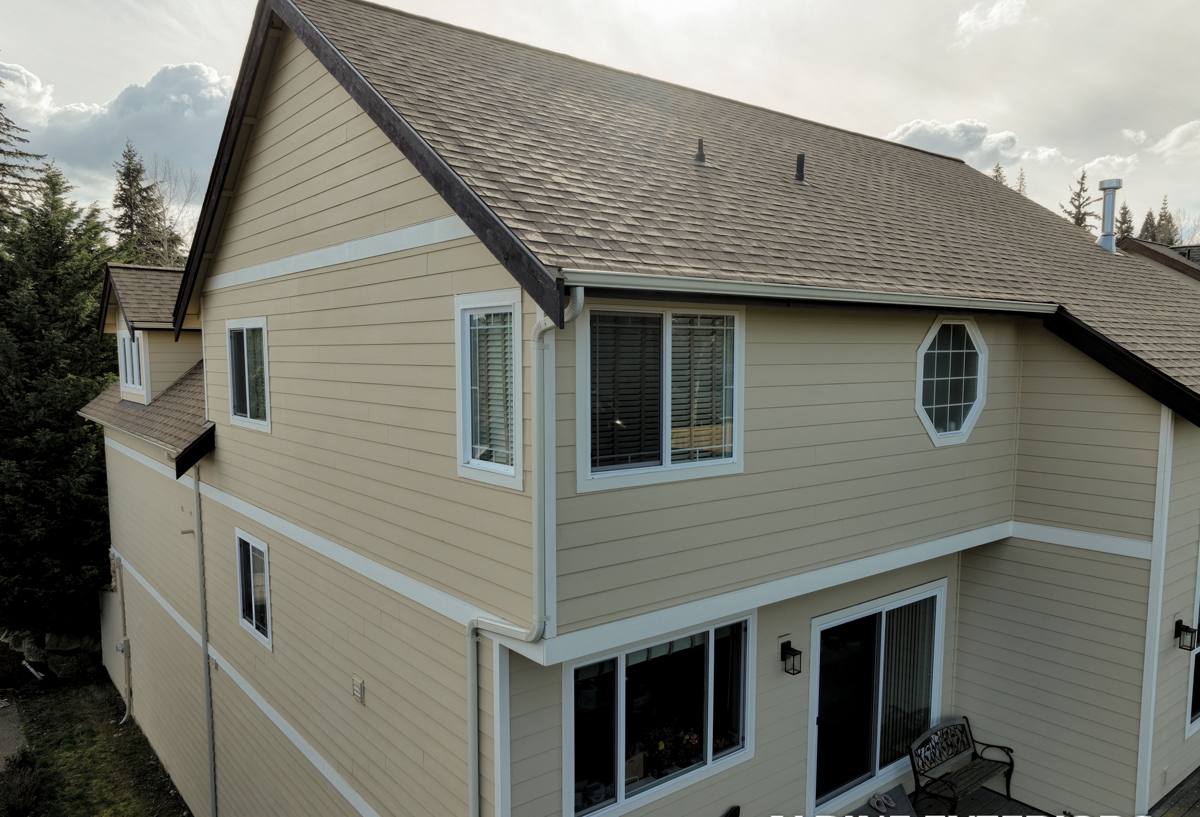
What Salt Air, Driving Rain, and Moss Actually Do to Siding
Salt Air
Airborne salt is corrosive and hygroscopic — it pulls moisture out of the air and holds it against whatever surface it lands on. On wood-based siding, that means slower drying cycles and faster paint and coating breakdown. On metal fasteners and trim that aren't rated for coastal exposure, it accelerates corrosion. Homes closer to open water or exposed to prevailing wind off the bay see this fastest, but Ferndale's proximity to the coast means most homes in the area get some degree of salt exposure, even a few miles inland.
Driving Rain
Pacific storm systems don't just drop rain straight down — wind pushes it sideways into wall assemblies, especially on the windward side of a house and around penetrations like windows, hose bibs, and light fixtures. Siding systems that rely on face-sealing (caulk and paint alone keeping water out) tend to fail here over time as sealants age and crack. What actually protects a wall long-term is a combination of the siding's own water resistance, correct flashing, and a drainage plane behind the cladding that lets any water that does get in find its way back out.
Moss and Algae
Whatcom County's combination of mild temperatures, high annual rainfall, and shaded lots (mature evergreens are everywhere) creates ideal conditions for moss, algae, and mildew to colonize any siding surface that stays damp for extended periods — north-facing walls, areas under eaves that don't get sun, and anywhere siding is installed too close to grade or landscaping. Some materials absorb enough moisture to actively feed organic growth from within, not just on the surface.
How James Hardie Siding Is Built to Handle It
James Hardie's fiber cement is cellulose fiber, sand, and cement, engineered and cured to be dimensionally stable and resistant to moisture absorption in a way that wood-based products simply aren't. A few specifics that matter for a Ferndale house:
- Non-combustible core — fiber cement doesn't burn, rot, or feed insects, which removes several of the failure modes that shorten the life of wood-based siding in damp climates.
- ColorPlus Technology — a factory-applied, baked-on finish that resists fading and holds up to UV and moisture exposure far longer than field-applied paint, and it comes with its own finish warranty separate from the substrate.
- HZ5 product engineering — Hardie's HZ5 line is formulated for climates with more moisture and freeze-thaw cycling, which fits the Pacific Northwest better than a generic national product.
- Low moisture absorption — the material doesn't swell, cup, or wick water the way engineered wood or masonite products can, which matters directly in a region that gets driving rain for months at a time.
None of this means a Hardie installation is immune to moss or algae staining — anything sitting outside in Whatcom County will pick up organic growth on shaded, damp surfaces eventually. What it means is the siding itself isn't degrading underneath that growth, and a simple wash restores the finish instead of revealing damage.
What a Correct Installation Looks Like on a Ferndale Home
The product only performs as designed if it's installed to spec. This is where most siding problems in this region actually originate — not from the material failing, but from shortcuts taken during installation that let water get behind the cladding. On every Ferndale project we treat these as non-negotiable:
- Weather-resistive barrier, installed correctly — a continuous drainage plane behind the siding, lapped properly so water sheds outward instead of pooling behind the wall.
- Rainscreen or drainage gap — furring or a drainable house wrap that creates a gap between the siding and the sheathing, so any incidental moisture can drain and the wall can dry. This matters more in high-rainfall climates than almost any other detail.
- Correct fastener placement and type — Hardie specifies fastener spacing, embedment depth, and corrosion-resistant fastener types. Over-driven or under-driven nails, or the wrong fastener for coastal exposure, are common causes of premature failure.
- Flashing at every penetration — windows, doors, hose bibs, vents, and any other wall penetration need proper flashing integrated with the water-resistive barrier, not just caulked over.
- Correct clearance at grade and roofline — Hardie specifies minimum clearances from grade, roofing, and decks. Siding installed too low or too tight against another surface traps moisture and speeds up moss and mildew growth.
- Factory-cut edges sealed — any field-cut edge needs to be treated per Hardie's specifications to maintain the product's moisture resistance at that cut.
Skip any one of these and you can end up with siding that looks fine from the curb but is trapping moisture against the sheathing — a problem that often isn't visible until it's expensive.
Comparing How Common Siding Materials Handle This Climate
| Factor | James Hardie Fiber Cement | Wood-Based / Engineered Wood | Vinyl |
|---|---|---|---|
| Moisture absorption | Low, dimensionally stable | Higher, prone to swelling | Doesn't absorb, but can trap moisture behind it |
| Coastal/salt air durability | Strong with correct fasteners | Finish breaks down faster | Can become brittle over time |
| Moss/algae resistance | Resists surface growth impact on substrate | Growth can accelerate rot | Growth sits on surface, easy to clean but purely cosmetic issue either way |
| Fire resistance | Non-combustible | Combustible | Can melt/deform under heat |
| Finish longevity | Factory-baked ColorPlus finish | Field-applied paint, shorter cycle | Color molded in, but fades and chalks over time |
This table is about material characteristics in this specific climate, not a claim that other products can't be installed correctly — it's why our crew standardized on one system we can install, flash, and warranty consistently rather than juggling several.
Our Process for a Ferndale James Hardie Project
Every project follows the same sequence, whether it's a full re-side or a targeted repair:
- On-site assessment — we walk the exterior, check for existing moisture damage, evaluate drainage and grade clearance, and look at sun/shade exposure on each elevation since that affects moss risk and color choice.
- Written scope and product selection — plank profile, exposure, HZ5 spec, and ColorPlus color, matched to the home and to what performs well in this climate.
- Tear-off and substrate check — removing existing siding is also when we find out what condition the sheathing is actually in, which matters more than people expect in a region with this much rainfall.
- Weather barrier and rainscreen installation — the part that doesn't show once the project is done but determines how the wall performs for the next 30+ years.
- Hardie installation to manufacturer spec — correct fastening, flashing, clearances, and sealed cut edges.
- Final walkthrough — checking caulking, trim, and touch-up before we call it finished.
Why Hiring a Crew That Already Works Ferndale Matters
A lot of siding problems in this area trace back to installers applying a spec written for a drier climate, or skipping the drainage plane because it's an extra step that doesn't show up in a walk-around inspection. A crew that regularly works Whatcom County jobs already knows which elevations on a Ferndale property tend to take the worst wind-driven rain, where moss problems typically start, and how much clearance to leave at grade given how wet the ground stays for months at a time. That local pattern recognition doesn't replace following the manufacturer's install spec — it's what makes sure the spec gets applied correctly to the actual conditions on your property, not a generic checklist.
It also matters for warranty support. James Hardie's product warranty and any labor warranty we provide are only as good as the paperwork and installation record behind them — a local crew that's still around and reachable years later is part of what that warranty is worth in practice.
Maintenance in a Wet, Shaded Climate
James Hardie siding is low-maintenance, not maintenance-free. In Whatcom County conditions, a few habits keep it performing and looking right:
- Rinse siding annually, especially shaded and north-facing walls, to keep moss and algae from building up.
- Keep landscaping and irrigation from spraying directly onto siding or holding moisture against it.
- Check caulking at trim and penetrations every couple of years and re-caulk as needed — caulk is a maintenance item even on a well-installed wall.
- Keep gutters clear so overflow isn't running down the siding face during heavy storms.
Get a Straight Answer for Your Ferndale Home
If you're weighing a re-side or replacing damaged sections, we're happy to walk your property, tell you honestly what condition your current siding and sheathing are in, and lay out what a correct James Hardie installation would look like for your specific house. Use the form below to request a free, no-pressure estimate.