 Whatcom County
 New-Construction Windows in Lynden: Getting It Right Before the Wall Closes Up
Lynden sits inland from the coast, out toward the Nooksack River valley and the farmland that surrounds it, but it's still squarely inside Whatcom County's wet, marine-influenced climate. Even this far from the water, salt-tinged air off the Sound, driving rain, and a long moss season all take a toll on window components — just more gradually than they would on a home sitting right on the coast. That matters more, not less, on a new build, because a new-construction window only gets one real chance to be installed correctly. Once the siding, trim, and interior finish go on around it, any shortcut taken at the window opening gets buried for years.
We're based in Lynden and work new-construction window packages throughout Whatcom County, coordinating directly with builders and general contractors on the framing and dry-in schedule rather than showing up after the fact. New construction is a different job than replacing an old window in an existing wall — there's no worn-out unit to remove, but there's also no room for a callback once the siding crew has moved past that opening. Getting the sill pan, flashing, and air sealing right the first time is the whole job.
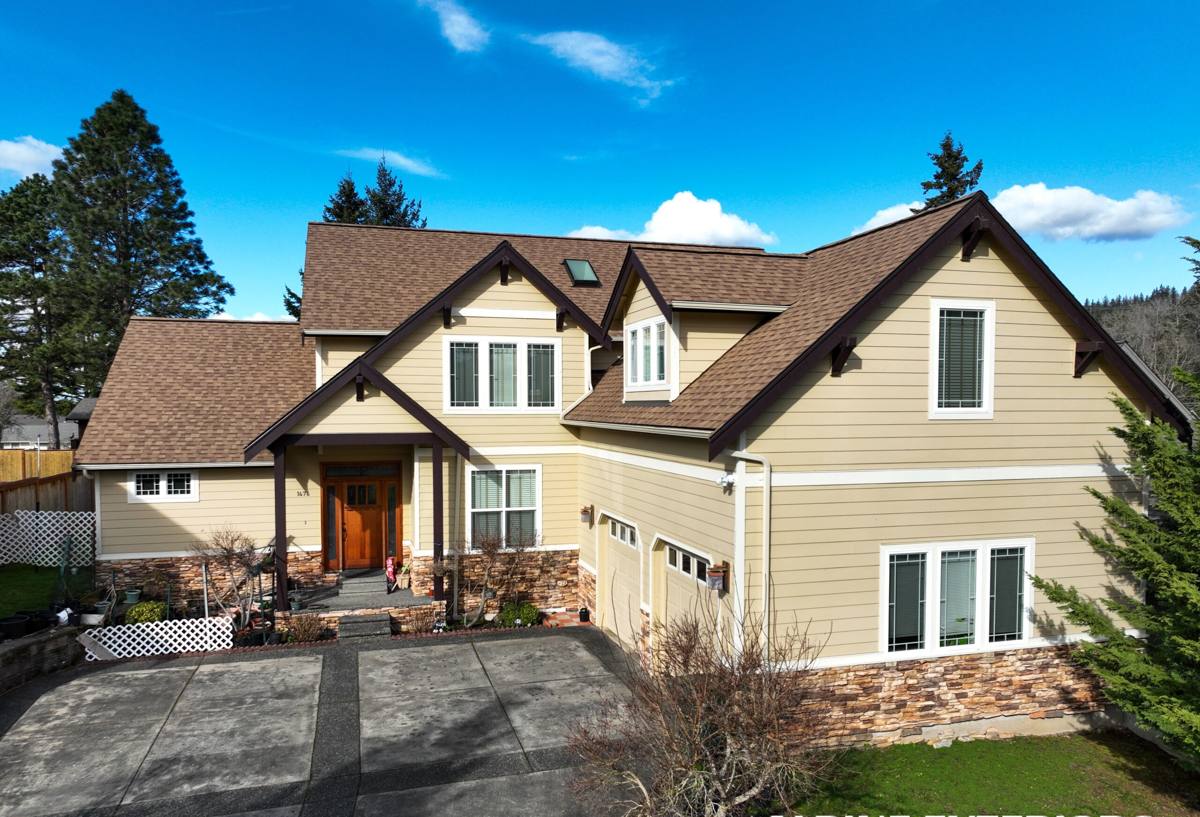
What Lynden's Climate Actually Demands From a New Window Opening
Driving Rain During and After Construction
Whatcom County gets long stretches of steady, wind-driven rain through fall and winter, and a house under construction is exposed to that weather before the building envelope is complete. A rough opening that sits uncovered for even a few days of a wet framing schedule can pick up moisture the sheathing doesn't fully dry out later. Windows need to go in with drainage planned from the start, not caulked over as an afterthought once the water intrusion has already happened.
A Long Moss and Moisture Season
Mild temperatures combined with near-constant dampness give moss, algae, and mildew a long season across Whatcom County, and new homes are not exempt just because everything is fresh. Sills, trim, and any horizontal surface near a window that doesn't shed water cleanly becomes a spot where organic growth and slow rot get a head start, often years before a homeowner notices anything from inside.
Temperature Swings and Interior Condensation
Cold, clear stretches followed by damp, cloudy weeks put real condensation pressure on glass and frames once a home is occupied and heated. A window installed with a tight, correctly insulated rough opening resists that far better than one where the gap around the frame was left loose or over-packed, since air movement around the frame — not just the glass itself — is usually what drives interior fogging and cold spots.
Agricultural Dust and Airborne Moisture
Lynden's surrounding farmland means homes here can see more airborne dust and organic debris than a purely residential subdivision would, which settles into window tracks and weep holes over time. It's a minor factor next to rain and moss, but it's one more reason hardware and drainage paths need to be built to stay functional with minimal maintenance, not just look clean on install day.
Why New Construction Is a Different Job Than Replacement
Replacing a window in an existing home means working around whatever the original builder did — good or bad — inside an opening that's already tied into finished siding and interior trim. New construction is the opposite situation: the opening is bare, the wall isn't closed up yet, and the window installer is one link in a sequence that includes the framer, the weather-resistive barrier, the siding crew, and eventually the trim carpenter. That sequencing is an advantage if it's coordinated well, because every layer can be built to work with the ones around it. It's a liability if it isn't, because a flashing detail installed out of order is often invisible until a leak shows up years later.
On a new build we're not diagnosing old damage — we're preventing it. That shifts the job toward precision in the moment: exact rough opening sizing from the plans, correct sill pan and flashing sequencing with the WRB, and a fastening schedule that meets the window's engineered wind and structural load rating for this region. There's no old caulk line to match or existing trim to work around, which is exactly why there's no excuse for the details to be anything less than correct.
Choosing a Window Package for a New Lynden Home
Frame Material
Vinyl and fiberglass frames are the standard choice for new construction in this climate, and for good reason — both resist the rot that an uncladded wood frame is prone to in a climate this wet, and both insulate better than uncladded aluminum. Fiberglass costs more but holds its shape better across temperature swings and tends to run a slightly better thermal performance; vinyl is more budget-friendly and performs well for most rooms and orientations. We spec the material against the specific opening, budget, and exposure rather than defaulting to one option for an entire house.
Nailing Flange vs. Block Frame Construction
New-construction windows typically come with an integral nailing flange that fastens directly to the sheathing and laps under the WRB and flashing — this is the standard approach for new builds because it creates a continuous, engineered drainage path when installed in the correct order. Block-frame windows, more common in retrofit work, get set into a finished opening without that integral flange. For a new build, flange-style units installed in the correct sequence are almost always the better fit.
Glazing and Energy Code Compliance
Washington's state energy code sets minimum performance requirements for new-construction glazing, and double-pane, low-emissivity glass with an inert gas fill meets that bar comfortably for most Whatcom County homes. Triple-pane glass is available for homeowners who want the extra margin, particularly on north-facing rooms or spaces with specific noise or comfort goals, but the code-minimum double-pane package is the right call for most of the house.
| Factor | Vinyl Frame | Fiberglass Frame |
|---|---|---|
| Upfront cost | Lower | Higher |
| Rot/moisture resistance | Excellent | Excellent |
| Dimensional stability | Good | Better across temperature swings |
| Paintability | Limited, color is baked in | Can be painted or refinished |
| Best fit | Most rooms and budgets | Larger openings, high-exposure walls |
The Installation Sequence That Actually Prevents Leaks
Every step here exists because skipping it creates a specific, predictable failure a few years down the road — usually one that's expensive to trace once the siding and interior finish are in place.
Rough Opening Verification
Before a window ever goes in, the opening gets checked against the actual unit dimensions, not just the plan set, since framing tolerances can shift slightly during the build. A tight but not restrictive fit lets the window seat correctly without binding the frame.
Sill Pan and Flashing Sequence
A sloped sill pan goes in first, giving any water that gets past the window a clear path back outside instead of into the wall cavity. Side and head flashing then lap in the correct order with the weather-resistive barrier — this "shingle-style" layering, water flowing down and out over each layer below it, is the single most important detail in the whole installation and the one most likely to be rushed on a tight framing schedule.
Setting, Shimming, and Fastening
The window gets shimmed level, plumb, and square in the opening before fastening through the nailing flange per the manufacturer's schedule — uneven shimming puts stress on the sash and hardware that shows up later as drafts or a window that won't latch smoothly.
Air Sealing and Interior Finish
The gap between the frame and the framing gets sealed with an appropriate low-expansion insulating material, not stuffed with loose fiberglass, before interior trim goes on. This is what actually determines the window's real-world energy performance, more than the glass rating alone.
- Rough opening measured and verified against the actual unit, not just the plan set
- Sloped sill pan installed with real outward drainage before the window goes in
- Side and head flashing lapped correctly with the weather-resistive barrier
- Window shimmed level, plumb, and square before fastening through the nailing flange
- Fastening schedule matched to the window's engineered wind and structural load rating
- Rough opening gap sealed with appropriate insulating material, not loose-packed fiberglass
- Function check on every unit — operation, locks, and weatherstripping — before the crew moves on
Coordinating With Builders and General Contractors
New-construction window work only goes well if it's timed correctly against the rest of the build. Windows need to go in after the WRB is on but before the siding crew closes the wall, and the flashing details need to be coordinated with whoever is running the weather barrier so nothing gets lapped backward. We work directly with the builder or GC's schedule on framing tolerances, dry-in timing, and inspection windows rather than treating window installation as an isolated trade that shows up whenever it's convenient. On a multi-trade job site, that kind of coordination is what actually prevents the finger-pointing that happens later when a leak traces back to a detail nobody wants to own.
Our Process
- Review of the plan set and window schedule, confirming rough opening sizes, styles, and performance requirements before ordering
- Coordination with the builder or GC on install timing relative to the weather-resistive barrier and siding schedule
- A written scope and quote before ordering, with product and installation warranties spelled out separately
- Correct sill pan, flashing, shimming, and air sealing on every opening, following the sequence above
- A final function and finish check on every window before we sign off with the builder
What Drives the Cost of a New-Construction Window Package
| Factor | What Drives It Up | What Keeps It Reasonable |
|---|---|---|
| Frame material | Fiberglass, larger custom sizes | Standard vinyl in common sizes |
| Glazing upgrade | Triple-pane, specialty coatings | Code-minimum double-pane, low-E |
| Window count and style | Many operable units, large fixed picture windows | A mix of fixed and operable sized to the room |
| Story height and access | Second- and third-story openings, staging needs | Ground-floor installs with easy access |
| Lead time | Custom sizes, non-stock configurations | Standard stock sizes ordered early in the build |
Broad strokes: a full new-construction window package for a typical Lynden home runs from a modest mid five figures for a straightforward, standard-size layout up toward considerably more for larger homes with upgraded glazing, custom shapes, or a high proportion of fixed picture windows. We won't quote a real number without seeing the plan set and window schedule, but we'll walk through where a budget is being spent and where there's room to adjust without giving up performance.
Why a Crew That Already Works Lynden Matters
A contractor who mainly works other regions, or treats a Whatcom County build the same way they'd treat one somewhere drier and calmer, doesn't carry the same working sense of how this climate behaves during a months-long framing and dry-in schedule. That shows up in specific decisions — how much slack gets built into the schedule for wet weather, how carefully the flashing sequence gets checked before the siding crew closes it up, which fastening schedule actually holds up to this region's wind loads. Those are the decisions that determine whether a new home's windows perform for one wet season or for decades, and it means someone local is still reachable years later if a warranty question comes up.
A Checklist Before Hiring for New-Construction Window Work in Lynden
- Ask how they sequence sill pan and flashing installation with the weather-resistive barrier, not just which window brand they order
- Confirm current Washington contractor licensing and active liability insurance
- Get a written scope that separates the manufacturer's product warranty from the contractor's installation warranty
- Ask whether they coordinate directly with the builder or GC's schedule, or expect to be worked in around other trades
- Ask about lead times early — custom or larger window orders for this region can run several weeks and need to be placed well ahead of the dry-in date
If you're building in Lynden and need a window contractor who'll coordinate directly with your builder's schedule and get the flashing right before the wall closes up, we're glad to take a look at your plan set and give you a straightforward, no-pressure estimate. Reach out using the form below to get started.