 Whatcom County
 Why Board & Batten Suits Samish Homes
Board and batten has a clean, vertical-line look that works well on farmhouse-style homes, shops, accent gables, and full exteriors alike, and it's a style we see requested often around Samish. But the look is only half the story. Homes in this part of Whatcom County sit close enough to the water and the lowland weather patterns that siding takes a real beating: salt-laden air moving in off the bay, long stretches of driving rain through the fall and winter, and a moss season that can run most of the year on shaded, north-facing walls. Any siding installed here has to handle all three at once, not just look good in dry weather.
Vertical board and batten, done correctly, actually has an advantage in this climate: the battens shed water down the face of the wall rather than collecting it in horizontal laps, and there are fewer horizontal ledges for moss and organic debris to sit on and hold moisture against the substrate. That advantage disappears fast, though, if the material underneath the paint is wrong for the job or the installation skips the details that keep water moving out instead of in.
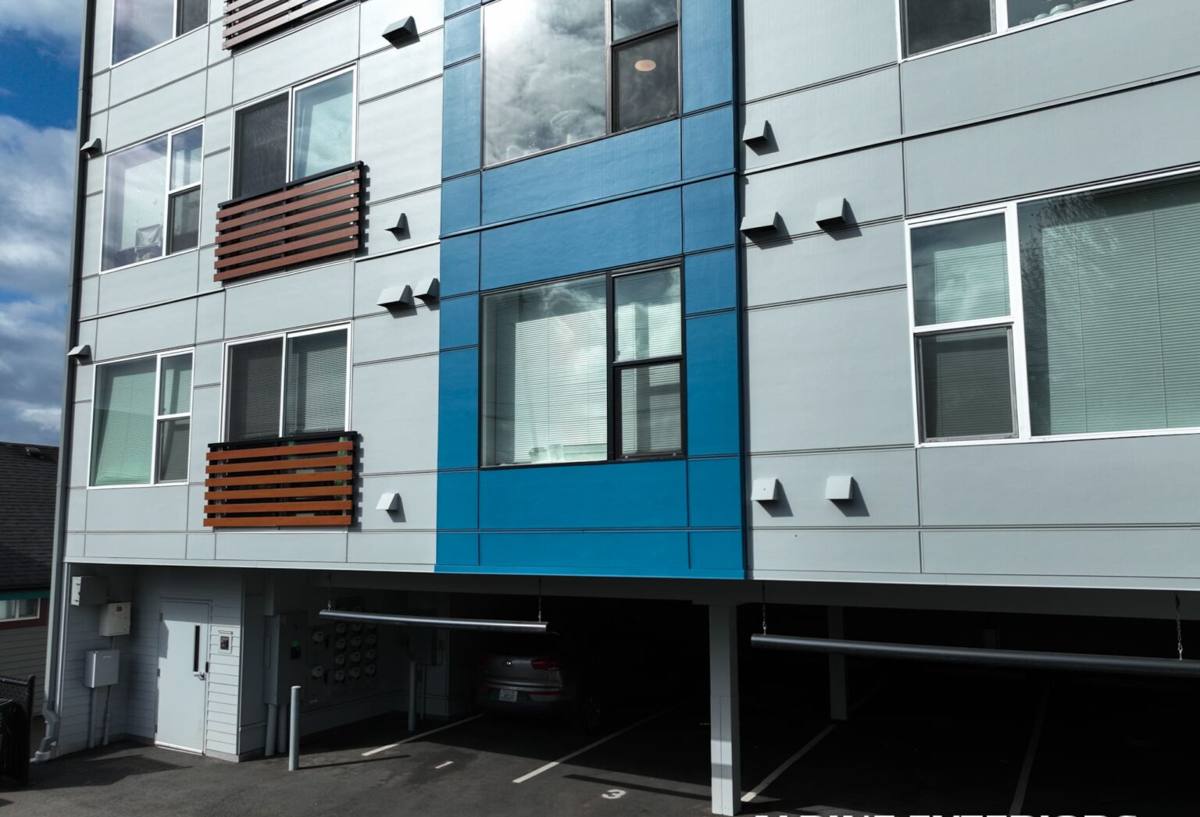
What Samish's Climate Actually Does to Siding
Salt Air
Homes closer to Samish Bay and the surrounding shoreline areas deal with airborne salt that accelerates corrosion on exposed fasteners, staples, and lower-grade trim, and that breaks down cheap paint films faster than inland weather does. Siding material and fastener choice both matter more here than they would twenty miles inland.
Driving Rain
Whatcom County gets sustained wet weather, and wind off the water can drive rain sideways into walls rather than just down them. That means water intrusion risk isn't limited to flat horizontal surfaces — it's a factor at every seam, joint, and penetration on a vertical board and batten wall.
Moss and Organic Growth
Shaded lots, tree cover, and persistent damp conditions create ideal moss and algae growth conditions on siding, trim, and roofing alike. Moss holds moisture against a wall for extended periods, which is exactly the condition that rots wood-based products and delaminates lower-quality composites.
What a Correctly Installed Board & Batten Wall Requires
The visual style of board and batten is simple, but a wall that actually performs in this climate for decades depends on details most homeowners never see once the job is finished:
- A drainage plane behind the siding — a weather-resistant barrier installed continuously and lapped correctly so any water that gets past the cladding drains back out instead of soaking into sheathing.
- A rainscreen gap — a small air space between the back of the siding and the water-resistive barrier that lets the wall dry out after wet weather instead of staying saturated.
- Correct fastener placement and type — fasteners driven per the manufacturer's specified pattern, at the right depth, using corrosion-resistant fasteners appropriate for a coastal-influenced climate.
- Proper flashing at every penetration — windows, doors, hose bibs, light fixtures, and vents all need flashing detailed so water sheds outward, not into the wall assembly.
- Correct batten spacing and board expansion gaps — following the manufacturer's engineering, not a generic rule of thumb, so the material can move with temperature and moisture without cracking joints or paint.
- Factory-finished material where possible — a factory-applied finish resists moisture and UV far more consistently than field-applied paint, which matters when the wall spends much of the year wet.
Skip any one of these and the siding might look right for a season or two before problems show up — usually as paint failure, staining, soft spots, or moss taking hold at seams.
Why We Only Install James Hardie for Board & Batten
We install James Hardie fiber cement exclusively — we don't offer LP SmartSide, vinyl, Cemplank, Allura, primed spruce, or cedar board and batten, and that's a deliberate standard, not a limitation of what we know how to install. For a coastal-influenced climate like Samish's, the reasoning comes down to a few points:
- Non-combustible material. Fiber cement doesn't burn, rot, or feed insects, which matters for long-term durability regardless of moisture exposure.
- Climate-engineered product lines. Hardie's HZ10 formulation is engineered for wetter, colder climate zones like the Pacific Northwest, with moisture and freeze-thaw performance built into the product rather than added on.
- ColorPlus factory finish. A baked-on, factory-applied finish holds color and resists moisture intrusion far more consistently than field-painted wood or primed composite siding, and it's specifically what stands up to the fading and streaking that salt air and constant damp weather cause on lesser finishes.
- Dimensional stability. Fiber cement doesn't swell, cup, or split the way wood-based and some engineered wood products can when they take on moisture repeatedly over years of wet Whatcom County winters.
- A strong transferable warranty that reflects confidence in long-term performance, not just a first-few-years guarantee.
We're not going to tell you cedar looks bad, or that primed wood board and batten can't be made to work — with enough maintenance, it can. What we will say is that we've standardized on one product system because it lets us guarantee the work we do, and because we've seen what constant wet weather and salt air do to lower-maintenance-marketed alternatives over a decade of real exposure, not a showroom sample.
Board & Batten Siding Options: A Comparison
| Material | Moisture Behavior | Finish Durability | Maintenance | Our Position |
|---|---|---|---|---|
| James Hardie Fiber Cement | Dimensionally stable, engineered for wet climates (HZ10) | Factory-baked ColorPlus finish | Low; occasional wash | What we install |
| Cedar | Absorbs and releases moisture; prone to cupping/splitting over time | Field-applied stain/paint, needs reapplication | High; regular resealing | Not installed by us |
| Vinyl | Doesn't rot, but can warp/crack in temperature swings | Color molded in, can fade/chalk | Low, but limited repairability | Not installed by us |
| LP SmartSide / Primed Wood Composite | Engineered wood core; vulnerable if finish fails and moisture reaches edges | Field or factory primer, needs field topcoat | Moderate; edge sealing critical | Not installed by us |
Our Process for a Samish Board & Batten Project
1. On-Site Assessment
We walk the exterior, check existing siding and sheathing condition where accessible, note moss and moisture patterns specific to the lot's exposure and shading, and talk through where board and batten fits the home's style — full exterior, accent wall, gable, or shop building.
2. Detailed Estimate
You get a written scope covering material, prep work, flashing and drainage plane details, color, and timeline — no vague line items.
3. Tear-Off and Prep
Old siding comes off, sheathing gets inspected for hidden rot or moisture damage (common on older homes with failed siding in this climate), and any needed repairs are addressed before anything new goes up.
4. Water Management Layer
Weather-resistive barrier and rainscreen furring go on first, installed continuously and lapped correctly — this layer is what actually keeps a Samish home dry long after the visible siding is installed.
5. Hardie Board & Batten Installation
Panels and battens go up per James Hardie's fastening and spacing specifications, with flashing detailed at every window, door, and penetration.
6. Final Walkthrough
We walk the finished exterior with you, cover care and warranty details, and make sure you know what to expect from the finish over the coming years.
What Board & Batten Costs Depend On
| Factor | Why It Matters |
|---|---|
| Wall square footage and home shape | More corners, gables, and cutouts mean more labor and material waste |
| Sheathing condition underneath old siding | Rot repair found during tear-off adds cost but is essential to a lasting job |
| Trim and flashing detail complexity | Windows, dormers, and roof intersections all require careful flashing work |
| Accent vs. full exterior application | A single gable or accent wall costs far less than a whole-house install |
| Color and finish selection | Standard ColorPlus colors vs. custom field-painted options affect price and timeline |
We don't quote a project without seeing it — a rough number over the phone isn't useful once your home's actual sheathing condition, shape, and trim detail come into play.
Living With Board & Batten Siding in This Climate
Once it's installed correctly, a James Hardie board and batten exterior is genuinely low-maintenance, but "low-maintenance" doesn't mean "no attention." A yearly rinse-down helps prevent moss and algae from getting a foothold, especially on shaded or north-facing walls. Keep an eye on caulking at trim joints and penetrations over the years, since even good sealant eventually needs refreshing. And keep gutters and downspouts clear — most of the siding damage we see on older homes in this area traces back to water overflow or splash-back at the base of a wall, not a flaw in the siding itself.
- Rinse siding annually, more often on shaded or moss-prone walls
- Inspect caulk joints at trim and penetrations every year or two
- Keep gutters clear and downspouts directed away from the foundation
- Trim back vegetation that keeps walls shaded and damp
- Address any paint or caulk failure early rather than waiting
Why Hiring a Crew That Already Works Samish Matters
Board and batten installation isn't complicated in concept, but getting the water management right for this specific climate takes experience with how this area's weather actually behaves — not generic installation knowledge from a drier region. A crew that's worked on homes around Samish and the broader Whatcom County area already understands which walls take the worst of the driving rain, where moss tends to establish first, and how salt-influenced air affects fastener and finish choices over time. That's the difference between siding that looks good at handoff and siding that still looks good in year fifteen.
If you're considering board and batten siding for a home in Samish, we're happy to take a look and talk through what a correctly built wall would involve for your specific property — no pressure, no generic phone quote. Reach out for a free estimate using the form below.