 Whatcom County
 Why Samish Homes Need a Different Approach to Siding
Samish sits close enough to the water that salt air is a daily fact of life for anything on the outside of a house. Add Whatcom County's long stretch of wet months, driving rain that comes in sideways off the water, and a moss and algae season that can run eight or nine months out of the year, and you've got an exterior environment that punishes cheap materials and sloppy installation fast. Siding here doesn't fail because it's old. It fails because it was the wrong product, installed the wrong way, for this specific stretch of coastline.
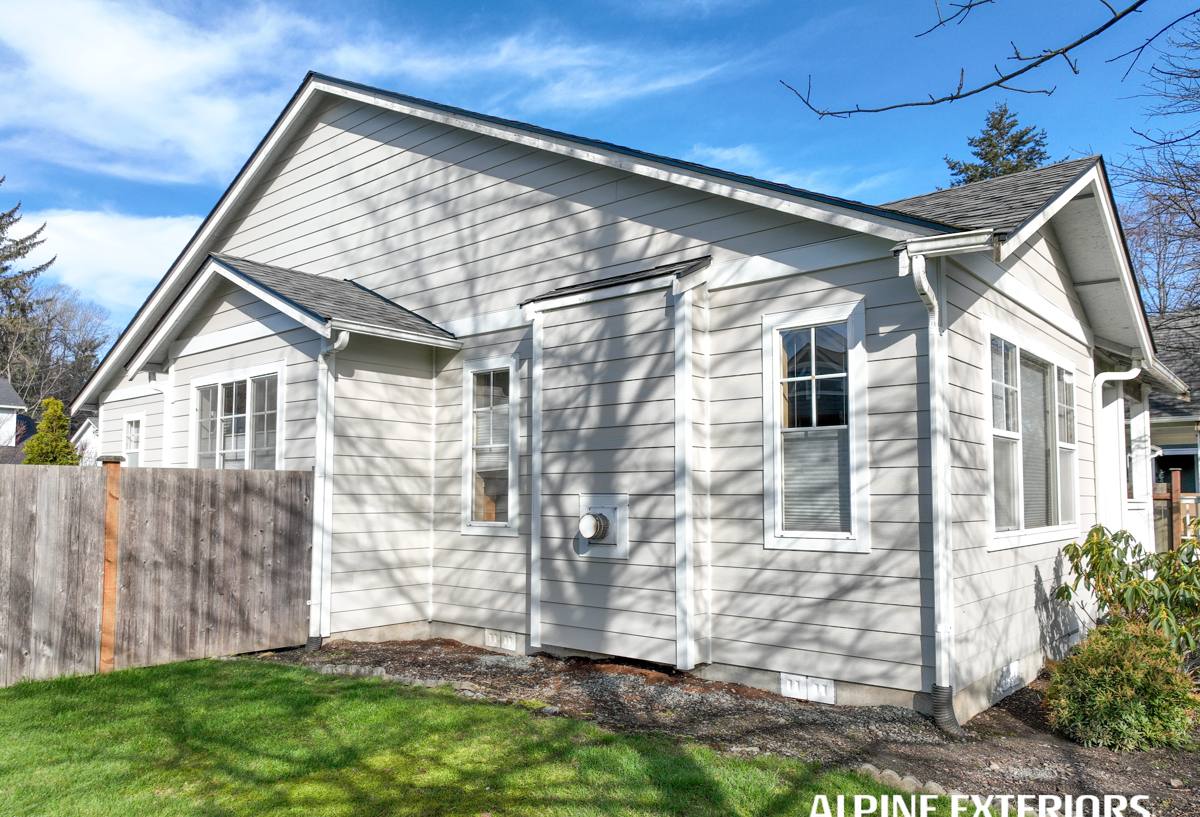
We install James Hardie fiber cement siding exclusively, and Samish is one of the areas where that decision matters most. This page walks through what local homes actually need, what a correct Hardie installation looks like here, and why hiring a crew that already understands Samish's exposure beats hiring whoever's cheapest.
What Salt Air, Rain, and Moss Actually Do to Siding
Salt air
Airborne salt doesn't just sit on the surface — it works into seams, fastener heads, and any place where two materials meet. On wood-based products, that moisture-salt combination accelerates rot at the joints long before the field of the siding shows any problem. On metal fasteners and trim, it accelerates corrosion. Fiber cement doesn't absorb moisture the way wood or wood-composite products do, which is one of the reasons it holds up better in a salt-air environment, but the installation details — flashing, fastener choice, caulking at penetrations — still have to be right, or the same failure points show up anyway.
Driving rain
Samish gets weather that comes in at an angle, not just straight down. That means water finds its way behind siding through laps, corners, and around windows and doors far more often than in a calm, dry climate. A siding system is only as good as its drainage plane and flashing details behind it — the visible siding is the last line of defense, not the only one.
Moss and algae season
Whatcom County's damp, shaded, mild-temperature stretch is close to ideal for moss and algae growth on north-facing and shaded walls. Unfinished or poorly sealed siding surfaces give moss something to grip onto and hold moisture against. A factory-applied, baked-on finish resists that far better than field-applied paint, which is one of the practical reasons we standardized on a factory-finished product rather than something that gets painted after installation.
Why We Only Install James Hardie
We don't install LP SmartSide, vinyl, Cemplank, Allura, primed spruce, or cedar. That's not a marketing position — it's a standard we hold because of what we've seen happen to each of those products in exactly this kind of coastal, wet, moss-prone climate over the years.
- Vinyl can warp and become brittle with UV and temperature cycling, and its seams are a common entry point for wind-driven rain over time.
- Wood-based composite sidings (like LP SmartSide) perform fine in drier climates, but any breach in the factory coating exposes an engineered wood substrate that swells and deteriorates once moisture gets in — a real risk in an area that stays wet as long as Whatcom County does.
- Primed spruce and cedar are natural wood products that need ongoing maintenance — repainting, caulking, moisture checks — to hold up, and that maintenance burden is higher in salt air and long wet seasons than almost anywhere else.
- Other fiber cement brands (Cemplank, Allura) are chemically similar to Hardie, but we've standardized on Hardie specifically for its ColorPlus factory finish, its HZ5 climate-engineered product line, and the depth of its installation network and warranty support in this region.
James Hardie fiber cement is non-combustible, dimensionally stable in wet-dry cycling, and available in the HZ5 formulation engineered for wetter, harsher climates — which fits Samish's exposure directly. The ColorPlus factory finish is baked on under controlled conditions, giving it far better resistance to fading, chipping, and moss adhesion than a coating applied on-site, and it carries a real, transferable finish warranty behind it.
What a Correct Hardie Installation Requires in This Climate
Fiber cement siding is only as good as the installation behind it. A rushed or generic install can undercut even the best material. In a high-moisture, salt-exposed area like Samish, these details are non-negotiable:
Water management first
A proper weather-resistive barrier and correctly lapped, integrated flashing at every window, door, and horizontal transition has to go on before a single piece of siding does. This is the layer that actually keeps driving rain out of the wall assembly — the siding itself is the second line of defense, not the first.
Clearances and gaps
Hardie's own installation specifications call for minimum clearances from grade, roof lines, decks, and other flatwork, plus gaps at butt joints and trim for expansion. Skipping these is one of the most common ways installers void the manufacturer's warranty without the homeowner ever knowing.
Fastener choice and placement
In a salt-air environment, fastener corrosion resistance matters more than it does inland. Correct fastener type, spacing, and embedment depth affect both how the siding performs in wind and how long the fastening system lasts before it becomes a visible problem.
Caulking and sealant at penetrations
Every hose bib, vent, light fixture, and utility penetration is a potential entry point for wind-driven rain. These need to be sealed with the right materials and inspected as part of the job, not treated as an afterthought.
Painted field cuts
Any factory edge that gets cut on site exposes raw fiber cement. Those cut edges need to be sealed or painted before installation, particularly at inside corners and butt joints, to keep moisture from wicking in at the one place the factory finish doesn't reach.
Comparing Siding Options for a Samish Home
| Factor | James Hardie Fiber Cement | Vinyl | Wood / Wood Composite |
|---|---|---|---|
| Performance in salt air | Strong — doesn't absorb moisture like wood-based products | Moderate — seams and fasteners are the weak point | Weaker — moisture and salt accelerate rot at joints |
| Moss/algae resistance | Strong with factory ColorPlus finish | Moderate — smooth surface but can still stain | Weaker — porous surfaces hold moisture and organic growth |
| Finish longevity | Factory-baked finish, long warranty | Color molded in, but can fade/chalk over time | Field-applied paint, needs repainting on a cycle |
| Fire resistance | Non-combustible | Combustible | Combustible |
| Ongoing maintenance | Low — periodic wash, occasional caulk check | Low, but limited repair options if damaged | Higher — recoating, sealing, moisture monitoring |
Our Process for a Samish Siding Job
- On-site assessment. We walk the exterior, check current siding and trim condition, look at moisture exposure by elevation (north/shaded walls versus wind-facing walls), and check existing flashing at windows and doors.
- Scope and product selection. We recommend the specific Hardie product line and HZ climate zone rating appropriate for the home's exposure, along with a ColorPlus color that suits the home and neighborhood.
- Written estimate. A clear scope covering removal, water management upgrades if needed, siding, trim, and caulking — no vague allowances.
- Prep and water management. Old siding removal, sheathing inspection and repair as needed, and correct installation of the weather-resistive barrier and flashing before any new siding goes up.
- Installation to manufacturer spec. Correct clearances, fastening, gapping, and sealed field cuts, following Hardie's published installation guidelines.
- Final walkthrough. We review the completed job with you, point out anything future maintenance should watch for, and go over warranty documentation.
Maintenance: What Owning Hardie Siding in Samish Actually Looks Like
One of the practical advantages of fiber cement with a factory finish is how little upkeep it needs compared to painted wood, but "low maintenance" isn't "no maintenance," especially in this climate.
- Rinse the exterior periodically to keep salt residue and organic buildup from accumulating, especially on shaded and north-facing walls.
- Check caulking at windows, doors, and penetrations every year or two — sealant is the first thing to age, well before the siding itself.
- Keep gutters and downspouts clear so water isn't sheeting down the wall or overflowing near the siding's bottom edge.
- Trim back vegetation that holds moisture against the wall or blocks airflow and sun exposure on shaded sides.
- Have a professional look at any impact damage, cracking, or visible gaps promptly — small issues at seams are far cheaper to fix than water damage behind the wall.
Why Hiring a Crew That Already Works Samish Matters
Siding crews that mostly work inland or in drier parts of the state don't always build in the water-management margin this area needs — they're used to a climate that's more forgiving of shortcuts. A crew that regularly works Samish and the surrounding Whatcom County coastline already knows which elevations take the worst of the driving rain, where moss shows up first, and which flashing details actually matter here versus which ones are just extra steps somewhere drier. That local pattern recognition is the difference between a siding job that looks right at handoff and one that actually holds up through a decade of Samish winters.
Get a Straight Answer for Your Home
If you're dealing with aging siding, visible moss staining, or you're just planning ahead for a home in Samish, we're happy to take a look and give you an honest assessment — including whether replacement makes sense yet or a repair buys you more time. Reach out for a free, no-pressure estimate; there's a form below to get started.