 Whatcom County
 Why Sehome Roofs Wear Differently Than Roofs Inland
Sehome sits close enough to the water and to Bellingham Bay's weather patterns that its roofs take a specific kind of abuse: salt-laden air that accelerates corrosion on metal fasteners and flashing, driving rain that comes in sideways during fall and winter storms, and a moss season that can run from October well into spring. None of these factors are dramatic on their own, but stacked together over years, they're exactly why roofs in this part of Whatcom County fail in different spots and at different rates than roofs in drier climates.
Salt air doesn't just affect homes right on the waterfront. Airborne moisture carries inland, and over time it works on exposed metal — nail heads, drip edge, flashing seams, gutter hangers — softening the protective coatings that keep rust at bay. Combine that with near-constant dampness and you get corrosion showing up years earlier than a manufacturer's warranty timeline would suggest.
The Moss Problem Specifically
Moss is the most visible sign of the local climate's effect on a roof, and it's often misunderstood. Moss itself isn't just cosmetic — its root structure lifts shingle edges and granules, and the moisture it traps against the roof deck keeps that area wet far longer than the rest of the roof after a storm passes. On a roof that already deals with long rainy stretches, that extended wet time is what eventually leads to soft decking and interior leaks, usually starting small and staying hidden until they aren't.
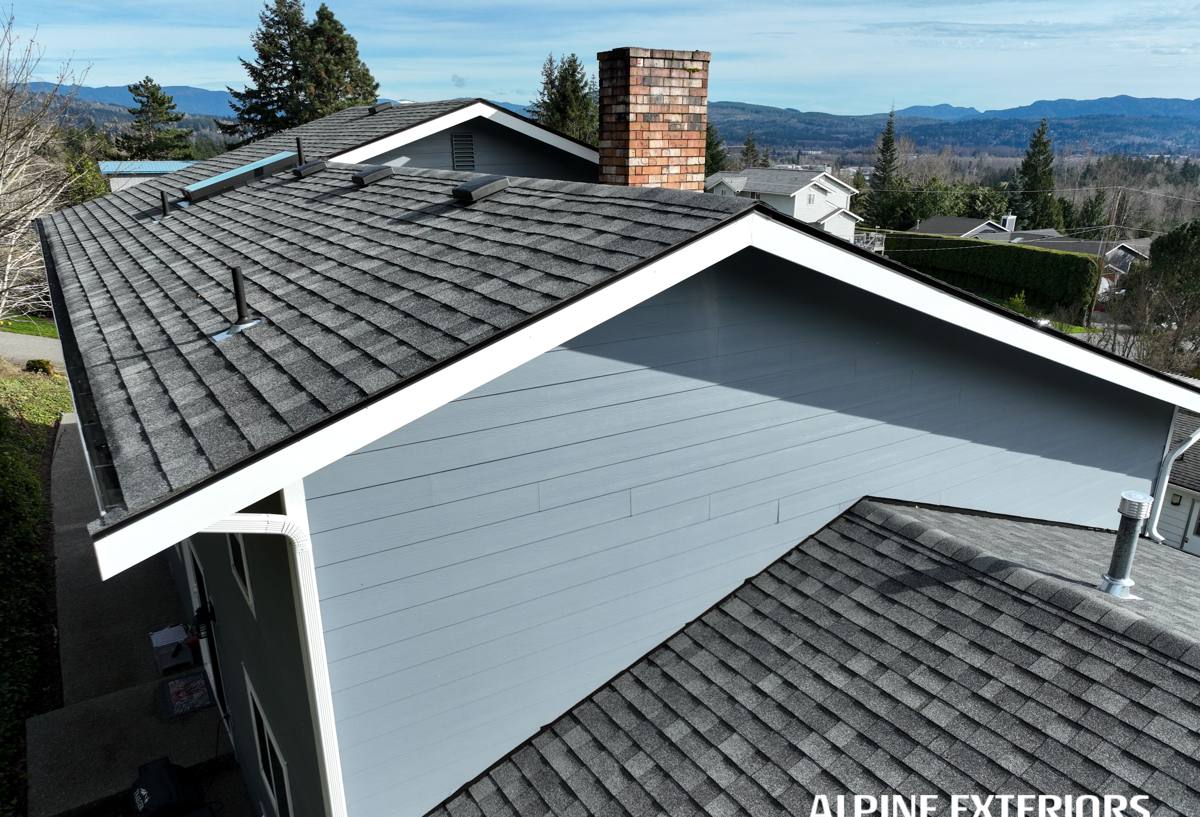
Signs a Sehome Roof Needs Repair, Not Just a Look
Most roof problems we get called out for didn't start as emergencies. They started as small, ignorable things that had months to get worse under repeated rain. Homeowners in this area should treat the following as reasons to have a roof looked at, not necessarily reasons to panic:
- Granules collecting in gutters or at downspout outlets — a sign shingles are wearing faster than they should
- Dark streaking or thick moss growth on north-facing slopes or shaded sections
- Soft or spongy feeling decking noticed from the attic side, especially near valleys or chimneys
- Rust staining below metal flashing, vents, or fastener heads
- Daylight visible through the roof deck in the attic
- Curling, cracked, or missing shingles after a windstorm
- Water stains on interior ceilings that appear only during or after heavy rain
- Gutters pulling away from the fascia or visibly sagging under moss and debris weight
Any one of these on its own might not mean much. Two or three together, especially combined with the roof's age, usually means it's worth a professional look before the next storm cycle.
What a Correct Roof Repair Actually Involves
A roof repair done right isn't just patching the spot where water is coming through. Water travels along the roof deck and underlayment before it shows up as a stain inside, so the visible leak point and the actual failure point are often several feet apart. A repair that only addresses the ceiling stain without tracing the water's actual path tends to come back within a season or two.
Our approach to diagnosing a repair
We start from the attic when access allows, looking for the actual entry point, staining patterns, and deck condition before touching anything on the exterior. Then we inspect the corresponding roof section from outside — flashing, shingles, underlayment where exposed, and any penetrations like vents or chimneys nearby. Only after we understand the actual failure do we scope the repair, so the homeowner knows exactly what's being fixed and why, not just that "a leak was patched."
What a proper repair includes
- Removing and replacing damaged shingles or roofing material back to sound decking
- Replacing — not just resealing — compromised flashing around chimneys, vents, and valleys
- Checking and repairing underlayment in the affected area, since surface shingles can look fine while the layer beneath has failed
- Addressing the decking itself if it's gone soft, rather than fastening new material over compromised wood
- Matching materials as closely as possible so the repair doesn't stand out or create a mismatched wear pattern down the road
Common Repair Situations We See in Sehome
| Issue | Typical Cause Locally | What Drives Repair Cost |
|---|---|---|
| Flashing failure at chimney or vent | Corrosion from salt air and repeated wet/dry cycling | Accessibility, extent of surrounding shingle damage |
| Moss-related shingle lift | Extended moss season, shaded north slopes | Size of affected area, whether decking underneath is affected |
| Valley leaks | Heavy rain volume concentrating in valleys | Whether valley metal needs full replacement vs. resealing |
| Wind-lifted or missing shingles | Exposure to storm systems off the water | Number of courses affected, matching existing material |
| Soft decking | Prolonged moisture retention under moss or debris | Amount of decking to replace, framing condition underneath |
This table reflects patterns, not prices — every roof is different, and the only way to know what a specific repair will run is a direct inspection.
Repair or Replace: How We Make That Call Honest
Not every roof problem in Sehome needs a full replacement, and not every roof is worth continuing to patch. We look at a few honest factors before recommending either direction:
- Age relative to material lifespan — a 10-year-old roof with an isolated flashing failure is a repair; a 22-year-old roof with the same issue plus widespread granule loss is a different conversation
- How much of the roof is affected — one bad valley is a repair; multiple slopes showing decking damage points toward replacement
- Underlying deck condition — extensive soft decking changes the math, since repairs on failing wood don't hold
- How many repairs the roof has already had — a roof that's been patched three times in five years is telling you something
We'll always give you the repair option when it's the honest answer, even if replacement would be the bigger job for us. A roof that's genuinely repairable doesn't need to be sold as a replacement.
Why Local Experience in Sehome and Whatcom County Matters
Roofing crews who mainly work drier climates sometimes underestimate how much moisture management matters here. Flashing details, ventilation, and underlayment choices that are optional elsewhere aren't optional in a climate with this much sustained rain and salt exposure. A crew that regularly works Sehome and the surrounding Whatcom County area has already seen how local roofs age — which flashing details fail first, which slopes hold moss longest, and which repairs actually hold up through a full Pacific Northwest wet season rather than just looking fixed when the truck pulls away.
That experience also means a faster, more accurate diagnosis. We're not guessing at how this climate affects a roof — we're working from what we've already seen on similar homes nearby.
Materials and Repair Compatibility
Most Sehome homes we work on have asphalt composition shingles, though we also see cedar shake and some metal roofing, particularly on additions or outbuildings. Repair approach differs by material:
Asphalt shingle roofs
The most common repair type. Matching shingle color and profile matters for appearance, and we account for the fact that older shingles have faded, so a patch with brand-new material may be visibly different for a season or two.
Cedar shake
Requires more careful moisture assessment, since shake roofs are more sensitive to trapped moisture and moss than asphalt. Repairs often involve checking the condition of shakes well beyond the visibly damaged section.
Metal roofing and metal flashing components
Given the salt air factor, we pay close attention to fastener and flashing material compatibility — mixing incompatible metals accelerates corrosion, which is a mistake worth avoiding rather than fixing twice.
Maintenance That Extends a Repair's Life
A good repair should last, but the same climate conditions that caused the original problem are still at work afterward. A few habits make a real difference:
- Keep gutters and downspouts clear, especially heading into fall storm season
- Have moss treated or removed before it establishes heavily rather than after
- Trim back overhanging branches that keep roof sections shaded and slow to dry
- Have the roof looked at after any significant windstorm, even if nothing looks obviously wrong from the ground
Get a Straight Answer on Your Sehome Roof
If you're seeing signs of a problem, or just want an honest read on where your roof stands before the next wet season sets in, we're happy to take a look. We'll give you a clear explanation of what we find, what it means, and what your real options are — no pressure, no upselling a repair into a replacement it doesn't need. Reach out for a free estimate using the form below.