 Whatcom County
 Edgemoor's Climate Is Harder on Siding Than Most Homeowners Realize
Edgemoor sits close enough to the water that homes here deal with a different combination of stresses than siding a few miles inland in Whatcom County. Salt-laden air off the bay accelerates corrosion on fasteners and trim, wind-driven rain finds its way into seams and laps that would stay dry in a calmer setting, and the tree cover and damp shade that make the neighborhood attractive also feed a long moss and algae season that runs from fall through spring. None of these things ruin siding overnight. What they do is expose every shortcut in a lower-grade product or a rushed install, usually within the first five to ten years, long before a homeowner expects to be dealing with siding problems again.
That's the lens we use on every Edgemoor project: not "what siding looks good going up," but "what siding and what installation will still be doing its job in twenty years, sitting a short distance from saltwater, under a canopy that keeps things damp." It changes some of the decisions that get made on a job.
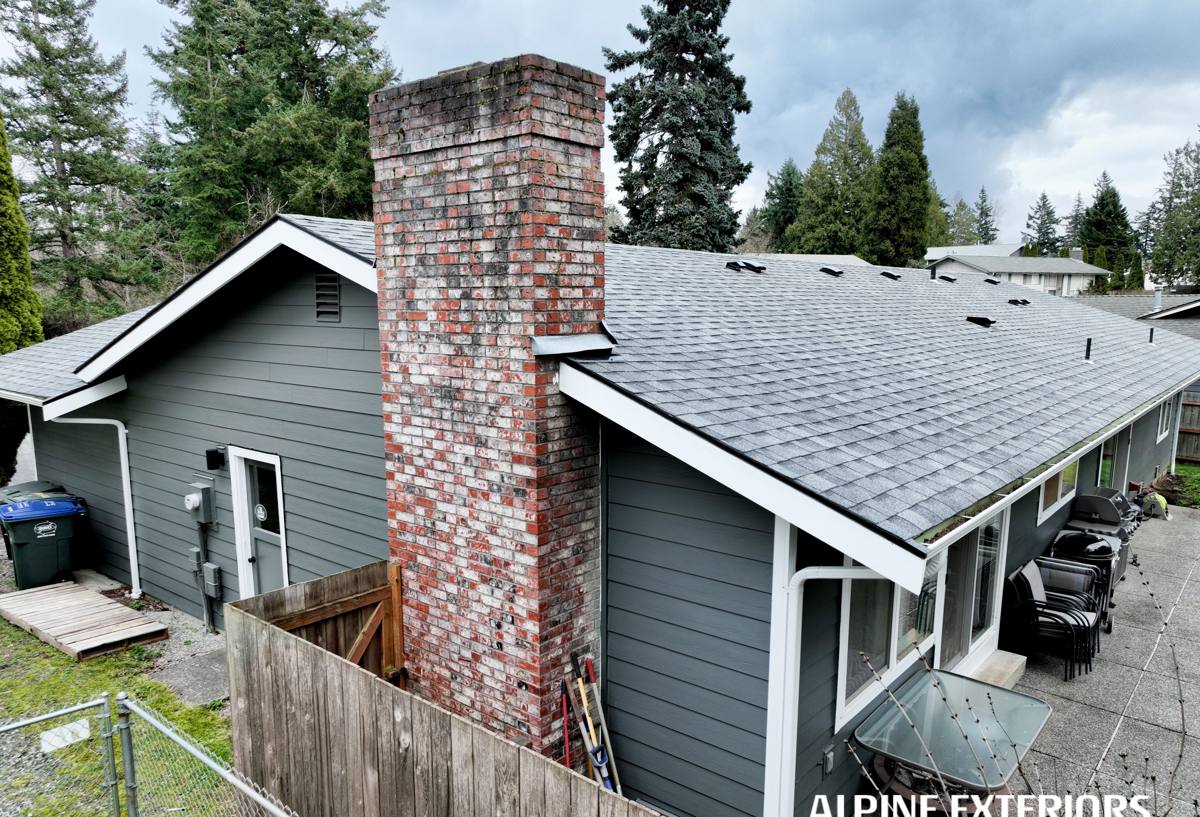
What a Correct Siding Installation Actually Involves
Siding is a system, not a single product. The board or panel gets most of the attention, but on a coastal, high-moisture site like Edgemoor, the details around it usually determine whether the job holds up.
The Weather-Resistive Barrier and Flashing
Behind every board there should be a continuous weather-resistive barrier, properly lapped shingle-style so water sheds down and out rather than behind the assembly. Every window, door, and penetration needs flashing installed in the correct sequence — not caulk substituting for flashing, which is one of the most common shortcuts we see on older homes in this area. Driving rain off the bay will find any gap in that sequence eventually.
Fastening and Clearances
Fastener choice and spacing matter more in salt air than most homeowners assume. Undersized, wrong-gauge, or improperly coated fasteners corrode faster near the water, and corroding fasteners eventually loosen panels, stain the face of the siding, and create entry points for moisture. Correct clearance off grade, off roof lines, and off hardscape also matters — siding installed too close to the ground or a deck surface stays wet longer and is one of the first places we see failure on inspection.
Caulking and Sealant Joints
Sealant joints at trim, corners, and penetrations need the right product, the right joint width, and the right prep — and they need to be treated as a maintenance item, not a permanent seal. A correct install minimizes how many joints exist in the first place and uses trim details that shed water instead of relying on caulk to hold it back.
Why We Install Only James Hardie Fiber Cement
We standardized on James Hardie fiber cement siding and don't install vinyl, LP SmartSide, Cemplank, Allura, or primed wood siding of any kind. That's not a marketing position — it's a decision built around what actually survives a climate like Whatcom County's over decades rather than years.
Fiber cement is non-combustible, which matters increasingly to insurers and to homeowners thinking about wildfire exposure regionally. It doesn't absorb moisture and swell the way engineered wood products can when a seam fails, and it doesn't expand and contract with temperature the way vinyl does, which over time can stress fastener points and cause visible waviness. James Hardie's ColorPlus factory finish is baked on under controlled conditions rather than field-applied, which gives it better adhesion and color retention in UV and salt exposure than a job-site paint job, and it carries a real transferable warranty that backs that finish.
James Hardie also builds region-specific product lines — HZ5 and HZ10 — engineered for different climate exposures, which lets us match the product to what Edgemoor's marine environment actually demands rather than installing a one-size-fits-all board. We're not going to tell a homeowner another product is worthless; vinyl and engineered wood both have a place in the market. We just won't put our name on an install using a product we don't think holds up here, and we'd rather explain that plainly than sell around it.
Our Installation Process
- Site and substrate assessment. We check for rot, water damage, and sheathing condition before anything goes up — covering a wet wall with new siding just hides the problem.
- Tear-off and prep. Old siding, trim, and any compromised building paper or house wrap come off so we're not building on a hidden moisture problem.
- Weather-resistive barrier installation. A continuous, correctly lapped barrier goes on with attention to every seam, corner, and penetration.
- Flashing at every opening. Windows, doors, and any wall penetration get properly sequenced flashing before trim or siding covers them.
- Hardie installation to manufacturer spec. Correct fastener type, spacing, clearance, and joint treatment, following James Hardie's published installation requirements — this is also what keeps the manufacturer's warranty intact.
- Trim, caulking, and finish detail. Final joints and transitions are sealed and finished so water sheds away from the wall assembly.
- Walkthrough. We go over the finished work with the homeowner before calling the job done.
Signs an Edgemoor Home May Need New Siding
- Soft or spongy spots when you press on the siding, especially near the bottom courses or under windows
- Persistent moss, algae, or dark streaking that comes back within a season of cleaning
- Visible cupping, warping, or gaps opening up between boards or panels
- Paint that's failing faster than a normal repaint cycle, or bubbling and peeling in patches
- Rust streaks running down from fastener heads or trim
- Rising heating bills with no other obvious cause, which can point to moisture-compromised insulation behind failing siding
Any one of these on its own might just need a repair. Several at once, especially on a home that's fifteen-plus years old, usually means the siding system itself has reached the end of what it can protect against.
Cost Factors for Siding Installation in Edgemoor
Every Edgemoor home is different, so we don't quote off square footage alone. These are the variables that actually move an estimate:
| Factor | Why It Affects the Estimate |
|---|---|
| Tear-off vs. install over existing structure | Removing old siding, disposing of it, and inspecting/repairing sheathing underneath adds labor but is often necessary given moisture history in the area |
| Home height and access | Multi-story homes and sites with limited access or steep grades near the bluff require more staging and time |
| Trim and architectural detail | Homes with more corners, gables, dormers, and window trim take more flashing and cutting time than a simple rectangular elevation |
| Siding profile and finish | Lap width, shingle-style profiles, and panel systems vary in material and labor cost; ColorPlus finish avoids a separate field-paint step |
| Extent of moisture or rot repair | Sheathing, framing, or window flashing repairs found during tear-off are priced separately from the siding itself |
| Weather barrier and flashing scope | A full rain-screen or drainage plane upgrade behind the siding adds cost but pays off directly in a wet, coastal microclimate |
We walk through each of these on-site before giving a number — not a phone estimate — because the difference between a home that needs simple re-siding and one that needs structural repair underneath isn't something you can judge from photos.
Choosing a Siding Contractor in Whatcom County
Edgemoor's exposure means the contractor matters as much as the product. A crew that mostly works drier, inland jobs may not think twice about details that are non-negotiable here.
- Ask whether they're a factory-certified James Hardie installer, and what that certification actually required
- Ask how they detail flashing at windows and doors — a vague answer is a red flag
- Ask what weather-resistive barrier and clearance standards they follow, and why
- Ask for references or completed work in Whatcom County specifically, not just a general service area
- Ask what's covered by workmanship warranty versus manufacturer warranty, and get it in writing
- Confirm they carry proper licensing and insurance for exterior work in Washington
Maintenance Through Whatcom County's Moss Season
Even correctly installed fiber cement siding benefits from basic seasonal upkeep in a climate like this. A soft wash (not high-pressure) once or twice a year keeps moss and algae from taking hold on shaded elevations, particularly on north-facing walls and anything under tree cover. Keeping gutters clear and directing downspouts away from the wall assembly reduces the amount of water siding has to shed in the first place. Trimming back vegetation that holds moisture against the wall goes a long way too. None of this is heavy maintenance — it's the difference between siding that looks the same in year fifteen as it did in year two, and siding that needs attention it shouldn't.
Why Hiring a Crew That Already Works Edgemoor Matters
A lot of siding problems in coastal Whatcom County neighborhoods trace back to an install that was done correctly for a drier climate but not for this one — flashing sequenced for a lighter rain load, fastener specs that don't account for salt air, or clearances that were fine on paper but too tight once the site's actual drainage and shade patterns are accounted for. Working this area regularly means those variables aren't guesswork; they're the baseline every job starts from.
If you're weighing a siding project on an Edgemoor home, we're happy to take a look and give you a straightforward, no-pressure estimate — what we'd recommend, why, and what it would involve. There's a form below to get that started.