 Whatcom County
 Why Lynden Siding Takes a Different Kind of Beating
Lynden sits in a part of Whatcom County where the weather doesn't do anything in half measures. Moist, salt-tinged marine air moves in off the Sound and settles over the whole county, driving rain comes sideways for months at a stretch, and the shoulder seasons stay damp long enough for moss to get a real foothold on anything that holds moisture. Siding here isn't decorative — it's the one layer standing between that weather and your framing, insulation, and drywall.
Homes in and around Lynden see a specific pattern of damage: moisture that never fully dries out between rain events, moss and algae staining that traps dampness against the wall, and paint or caulking that fails years before it would in a drier climate. None of that is unusual for the area. What matters is whether the siding on your house was built and installed to handle it, and whether repairs are done in a way that actually solves the problem instead of patching over it.
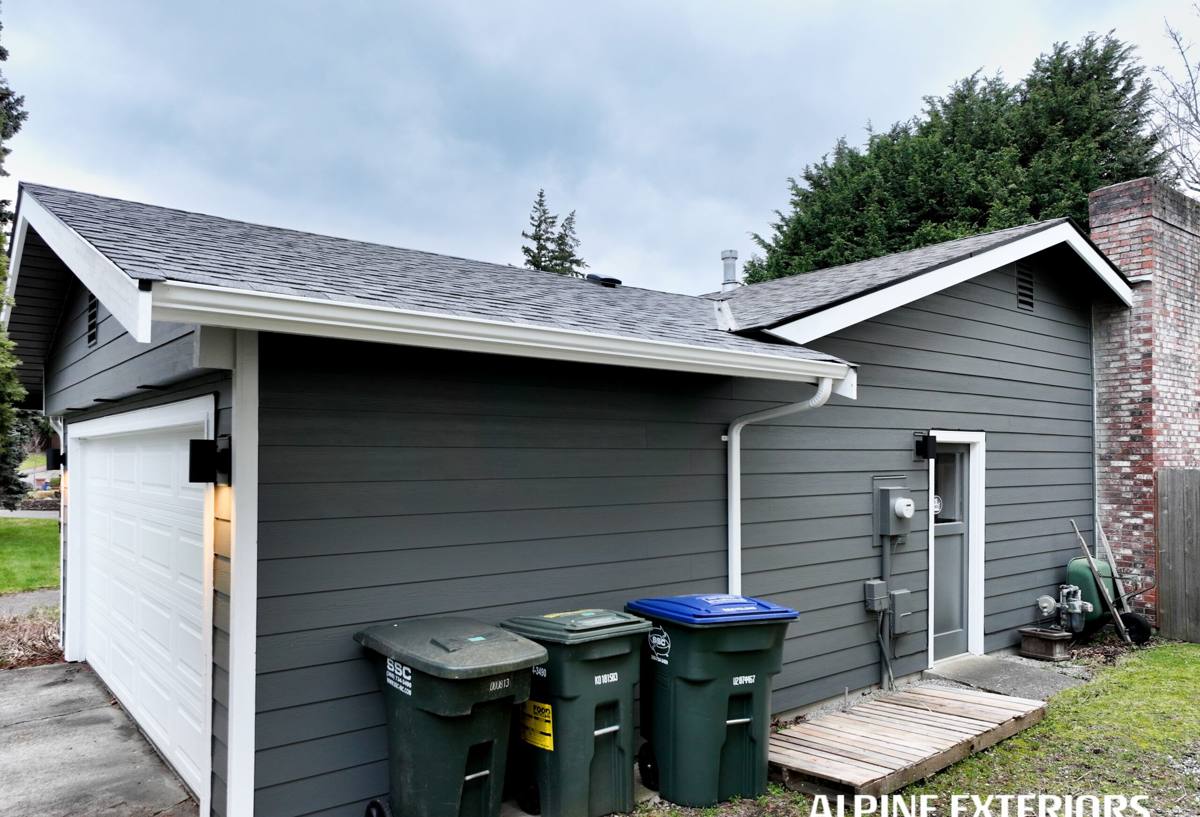
Signs Your Siding Needs Repair — Not Just Cleaning
A lot of Lynden homeowners call us after a pressure-washing or moss-treatment job doesn't fix what's actually wrong. Cleaning removes surface growth; it doesn't tell you what's happening behind the board. Here's what actually signals a repair need:
- Soft or spongy spots when you press on siding, especially near the bottom courses and around windows
- Paint that's bubbling, peeling, or flaking in patches rather than evenly across a wall
- Visible gaps, warping, or boards pulling away from the wall at seams
- Persistent moss or dark staining that comes back within a season of cleaning
- Soft trim or corner boards, which is often the first place rot shows up
- Musty smell or visible staining on interior walls that share a wall with damaged siding
Any one of these on its own might be minor. Several together, or damage that keeps recurring in the same spot, usually means water is getting behind the siding and the fix needs to address the water path, not just the surface.
What a Correct Siding Repair Actually Involves
Diagnosis Before Demolition
The first step isn't pulling boards — it's figuring out why that section failed. Was it a caulking gap that let water in, a flashing detail that was never installed correctly, a drainage plane that's missing behind the siding, or just age and sun/rain cycling wearing the material out? Repairing the visible damage without answering that question means the same spot fails again in a few years.
Checking What's Behind the Siding
Once boards are removed, we look at the sheathing, house wrap or weather-resistive barrier, and any flashing around windows, doors, and penetrations. In a climate this wet, it's common to find water staining or soft sheathing that extends further than the visible siding damage suggested. Repairs that skip this step and just replace boards over compromised sheathing don't hold.
Matching Material and Finish
Repair work should blend in, not stand out as an obvious patch. That means matching board profile, exposure, and — critically — color. This is one of the areas where the siding brand matters more than most homeowners expect, which we get into below.
Reinstalling to Spec
Proper fastening, correct clearance from grade and rooflines, sealed and flashed penetrations, and butt joints that shed water instead of collecting it — these details are what separate a repair that lasts from one you'll be calling about again in a couple of years.
How Different Siding Materials Hold Up to Lynden's Climate
The material already on your house — and what it gets repaired or replaced with — makes a real difference in how often you're dealing with this again. Here's an honest comparison for a climate with this much sustained moisture:
| Material | Moisture Behavior | Repair Considerations |
|---|---|---|
| Vinyl siding | Doesn't rot, but warps and cracks with temperature swings; seams and J-channels can trap water behind the panel | Hard to source exact color/profile matches after a few years due to fading and discontinued runs |
| Cedar | Attractive but absorbs moisture readily; a long damp season accelerates rot, cupping, and moss growth | Requires ongoing refinishing; repaired sections weather differently than aged boards |
| Primed spruce / engineered wood (LP-type) | Wood-based core is vulnerable at cut edges and fastener points if the factory coating is breached | Edge and seam maintenance is critical; deferred caulking failures are a common repair trigger |
| James Hardie fiber cement | Non-combustible, dimensionally stable, and engineered specifically for wet Pacific Northwest exposure (HZ5 line) | Factory ColorPlus finish means new sections can be matched precisely; holds paint/finish far longer than wood-based products |
We don't install every product on that list, and we're upfront about why: we standardized on James Hardie because in a climate that stays wet as long as Whatcom County's does, the products that depend on a perfect, unbroken factory coating or that absorb moisture at the core simply demand more maintenance and fail sooner at the seams and cut edges — exactly where repairs happen.
Why We Only Repair and Install James Hardie Siding
This isn't a brand preference — it's a standard we hold because of what we see in the field around Lynden and the rest of the county. James Hardie's fiber cement is non-combustible, doesn't swell or rot the way wood-based products can, and the HZ5 product line is specifically engineered for climates with heavy, sustained moisture. The ColorPlus factory finish is baked on and warranted, which matters enormously for repair work: when we're matching new boards into an existing wall, a factory finish gives us a real chance at a clean match instead of a visibly different patch.
We're not going to tell you every other product is worthless — vinyl and engineered wood siding have legitimate uses and plenty of homes carry them without major issues. But for the repair and replacement work we do, in this climate, Hardie's moisture performance, finish durability, and transferable warranty are what let us stand behind the work long-term. That's why it's the only siding we install.
Our Repair Process
- On-site assessment — we walk the exterior, check moisture-prone areas (bottom courses, window heads, roof-wall intersections), and probe suspect spots
- Honest scope — you get a clear picture of what's cosmetic, what's structural, and what we'd recommend versus what's optional
- Removal and inspection — damaged siding comes off and we check sheathing, barrier, and flashing before anything goes back up
- Underlying repairs — any compromised sheathing, house wrap, or flashing gets addressed, not covered over
- Matched reinstallation — new Hardie boards installed to manufacturer spec, with correct fastening, clearances, and sealed joints
- Finish and walkthrough — color and profile matched as closely as the existing siding allows, with a final walkthrough so you know what was done and why
Choosing a Contractor for Siding Repair in Lynden
Siding repair is easy to do poorly and hard to verify from the ground once it's painted over. A few things worth checking before you hire anyone:
- Do they inspect behind the siding, or just replace what's visibly damaged?
- Can they explain why the failure happened, not just what they're going to do about it?
- Do they carry manufacturer-specific installation training for the material they're using?
- Will the color and profile actually match your existing siding, or are you getting a visible patch?
- Are they familiar with how the local climate — heavy rain, extended moss season — affects this specific house type?
- Is the warranty on parts and labor spelled out in writing before work starts?
A crew that already works regularly in Lynden and the surrounding parts of Whatcom County has seen how this climate treats different siding materials and installation details over time — that's the kind of judgment that's hard to get from a contractor working the job for the first time in this weather.
What Siding Repair Typically Costs
Repair costs vary a lot depending on scope, so we won't quote a number that doesn't mean anything without seeing the house. What we can tell you is what drives the cost up or down:
| Factor | Effect on Cost |
|---|---|
| Extent of hidden damage (sheathing, framing) | Largest single driver — surface repairs are inexpensive, structural repair is not |
| Size and location of the affected area | Ground-level sections are quicker; second-story or hard-to-access areas add labor |
| Color and profile matching | Factory-finished boards matched to existing siding keep costs predictable versus custom finishing |
| Number of separate repair areas | Consolidating repairs into one visit is more cost-effective than multiple small trips |
A proper in-person assessment is the only honest way to scope a repair — anything else is a guess.
Protecting Repaired Siding Going Forward
Once siding is repaired correctly, a little upkeep goes a long way in this climate. Keep gutters clear so water isn't sheeting down the wall, trim back vegetation that keeps siding shaded and damp, and rinse off moss and algae buildup before it has a chance to hold moisture against the surface for months at a time. None of that replaces a good repair, but it does extend the life of one.
If you're seeing soft spots, recurring moss staining, or siding that just doesn't look right anymore, it's worth having someone take an honest look before it turns into a bigger repair. We offer free, no-pressure estimates for homes in Lynden and the surrounding area — fill out the form below and we'll get you scheduled.