 Whatcom County
 Siding Replacement for Columbia Homes
Columbia sits close enough to the water and the weather patterns that roll through Whatcom County that its homes take a different kind of beating than siding fifty miles inland. Salt-laden air, wind-driven rain that gets pushed sideways under eaves, and a long, damp moss season that can stretch from October into May all work against whatever is on your walls. When we replace siding in this area, we're not just swapping old material for new — we're correcting for a climate that punishes anything that isn't built and installed to handle sustained moisture exposure.
This page covers what a proper siding replacement looks like for a Columbia-area home: what the climate actually does to different siding materials, why we only install James Hardie fiber cement, what correct installation requires, and how our process works from first inspection to final walkthrough.
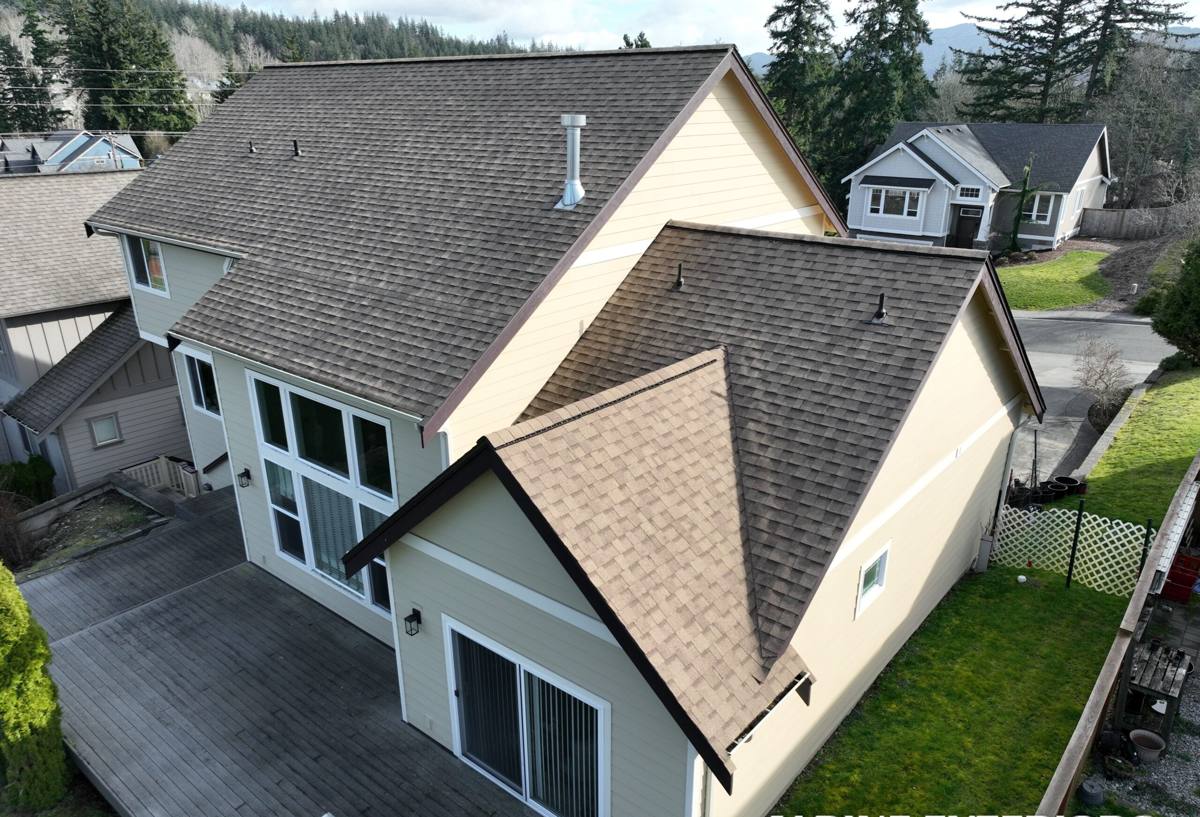
What Whatcom County Weather Does to Siding
Salt Air and Coastal Moisture
Proximity to Puget Sound and Bellingham Bay means salt-bearing air reaches siding, trim, and fasteners more often than homeowners further inland realize. Salt accelerates corrosion in metal fasteners and flashing, and it draws moisture into porous or poorly sealed materials. Over years, that combination shows up as rust streaking, soft spots at panel edges, and premature paint failure.
Driving Rain
Whatcom County doesn't just get a lot of rain — it gets a lot of horizontal rain, pushed by wind off the water. That matters because siding systems are rated and installed differently depending on whether they're expected to shed rain falling straight down or rain being driven sideways into laps, corners, and penetrations. A siding job that looks fine on a calm, dry day can fail during the first real windstorm if the laps, flashing, and caulking weren't detailed for driving rain.
Moss and Sustained Dampness
The long stretch of cool, wet months here keeps exterior surfaces damp for extended periods, which is exactly the condition moss and mildew need to establish. On the wrong material, sustained dampness doesn't just create a cosmetic moss problem — it can wick into seams and fastener holes and start breaking the material down from the inside.
Signs Your Columbia Home's Siding Needs Replacing
- Panels that feel soft, spongy, or crumble slightly when pressed near the bottom edges or seams
- Paint that's peeling, bubbling, or needing repainting far more often than every 8-10 years
- Visible warping, buckling, or gaps opening up at panel joints
- Persistent moss or dark staining that returns within a season of cleaning
- Rising energy bills that track with drafts felt near exterior walls
- Rot or soft wood found at corner boards, window trim, or where siding meets the foundation
- Visible fastener corrosion or streaking below nail heads
Any one of these on its own might just need a repair. Several of them together, especially on a home more than 20-25 years old, usually means the siding system as a whole has reached the end of its useful life.
Why We Only Install James Hardie Fiber Cement
We don't install LP SmartSide, vinyl, Cemplank, Allura, primed spruce, or cedar. That's a deliberate standard, not a lack of options. Each of those products has legitimate uses elsewhere, but for the moisture and salt exposure homes see in this part of Whatcom County, we've concluded they carry trade-offs — ongoing maintenance, moisture sensitivity, or installation tolerances — that don't hold up as well over a 30-plus-year ownership horizon here.
James Hardie fiber cement is non-combustible, dimensionally stable in wet climates, and available in HZ5 product formulations engineered specifically for cold, wet climate zones like ours. The factory-applied ColorPlus finish is baked on under controlled conditions rather than field-painted, which matters directly for the driving-rain and salt-air problems described above — the finish resists the fade, peel, and moisture intrusion that painted wood and some engineered wood products struggle with here. Hardie also backs the product with a strong transferable warranty, provided it's installed to their specification, which is the other half of the equation.
What a Correct Installation Actually Involves
Fiber cement siding performs the way it's supposed to only when it's installed correctly. Rushed or shortcut installations are where most siding failures — Hardie or otherwise — actually originate.
Moisture Management First
Before any siding goes up, the wall needs a properly lapped weather-resistive barrier, correctly integrated flashing at every window, door, and penetration, and a rainscreen or drainage gap where conditions call for it. This is the layer that actually keeps driving rain out of the wall assembly — the siding itself is the second line of defense, not the only one.
Fastening and Clearances
Hardie specifies exact nailing patterns, fastener types, and minimum clearances from grade, roofing, and decks. In a climate with this much sustained dampness, those clearances aren't a formality — they're what keeps the bottom edge of the siding from sitting in standing moisture. Corrosion-resistant fasteners matter more here than in drier regions because of the salt air.
Joints, Caulking, and Butt Seams
Every horizontal and vertical seam is a potential entry point for wind-driven rain. Correct installation means tight, properly backed butt joints, the right sealant used at the right locations (and not over-relied on where flashing should be doing the work instead), and consistent lap dimensions across the whole elevation.
Comparison: What Different Siding Materials Face in This Climate
| Material | Salt Air Exposure | Driving Rain Behavior | Moss-Season Maintenance |
|---|---|---|---|
| James Hardie fiber cement (HZ5) | Engineered for coastal/cold-wet zones | Factory finish resists moisture intrusion at laps | Low — factory finish sheds moss growth better than raw wood |
| Vinyl | Can become brittle and fade over time | Can allow water behind panels if installation is loose | Moderate — surface cleans but seams trap debris |
| Primed wood / cedar | Susceptible to salt-accelerated rot at joints | Requires diligent caulking and repainting to stay sealed | High — repainting and moss treatment on a recurring cycle |
| LP SmartSide / engineered wood | Edge sealing is critical to prevent swelling | Performs well if edges stay sealed; vulnerable if not | Moderate — inspection of cut edges and seams needed |
Our Process for a Columbia Siding Replacement
1. On-Site Inspection
We walk the exterior, check for hidden moisture damage at corners, trim, and penetrations, and assess what's happening underneath the existing siding — not just the surface condition.
2. Scope and Estimate
We give you a clear, written scope: what's being removed, what sheathing or framing repairs (if any) are needed, which Hardie products and colors fit the home, and what the full job costs — no vague allowances.
3. Tear-Off and Wall Prep
Old siding comes off, damaged sheathing or framing gets repaired, and the weather-resistive barrier and flashing get installed or corrected before a single new panel goes up.
4. Installation to Manufacturer Spec
Hardie panels, fasteners, and trim go on following manufacturer nailing patterns, clearances, and joint details — the details that determine whether the warranty holds and whether the siding actually performs through a Whatcom County winter.
5. Final Walkthrough
We review the finished work with you, cover care and cleaning basics for the new siding, and make sure everything matches the agreed scope before we call it done.
Cost Factors for Columbia Siding Replacement
| Factor | How It Affects Cost |
|---|---|
| Home size and elevation complexity | More corners, gables, and dormers mean more cutting, trim, and labor time |
| Condition of underlying sheathing | Rot or moisture damage found during tear-off adds repair scope |
| Siding profile chosen | Lap width, shingle-style panels, and board-and-batten differ in material and install time |
| Trim and accessory scope | Corner boards, window trim, and fascia work add to the total |
| Access and site conditions | Tight lots, slopes, or landscaping near the foundation affect setup and staging |
We don't quote a number without seeing the home first — anyone who does is guessing, and on a job this size, a guess isn't useful to you.
Why a Crew That Already Works Columbia Matters
Siding installation isn't one-size-fits-all across Whatcom County. A crew that's already worked homes in and around Columbia has a working sense of how exposed a given wall typically is to driving rain off the water, where moss tends to establish first on local rooflines and walls, and how salt air behaves on fasteners and trim in this specific pocket of the county. That's not something you get from a general installation manual — it comes from doing the work here, on homes like yours, repeatedly.
It also means faster, more accurate estimates, fewer surprises once tear-off starts, and a crew that isn't learning the local climate at your expense.
Maintaining Hardie Siding After Installation
One of the practical benefits of switching to Hardie is how little ongoing maintenance it demands compared to painted wood or engineered wood siding. A rinse-down once or twice a year to clear pollen, salt residue, and moss spores before they establish is generally enough. Caulking at trim joints should be checked periodically, since caulk — not the siding itself — is usually the first thing to age in a coastal climate. Beyond that, there's no repainting cycle to plan around, which matters a lot given how quickly paint film breaks down under this region's rain and salt exposure.
If your Columbia-area home is showing signs its siding is past its prime, we're happy to take a look and walk you through what we're seeing — no pressure, no obligation. Fill out the form below and we'll set up a free estimate.