 Whatcom County
 Composite Decking on South Hill: What the Climate Actually Demands
South Hill sits up above the flatter parts of Whatcom County, which means afternoon sun on some lots and heavy tree cover on others — often both on the same property depending on which side of the house you're standing on. That mix is exactly what makes decking decisions here different from a generic "pick a composite board and go" job. A deck on a shaded, tree-lined South Hill lot behaves nothing like one facing open sky, and a deck within reach of salt-laden air off Bellingham Bay ages differently than one further inland. Any contractor who treats every Whatcom County deck the same way is going to under-build for at least one of those conditions.
The three factors that matter most for decking here are moisture load, air salinity, and shade duration. Wood decking loses that fight slowly over years — cupping, splintering, and graying unevenly depending on sun exposure. Composite decking, installed correctly, is a better match for this climate because the board itself doesn't absorb water the way wood fibers do. But "installed correctly" is doing a lot of work in that sentence, and it's where most of the problems we get called out to fix actually start.
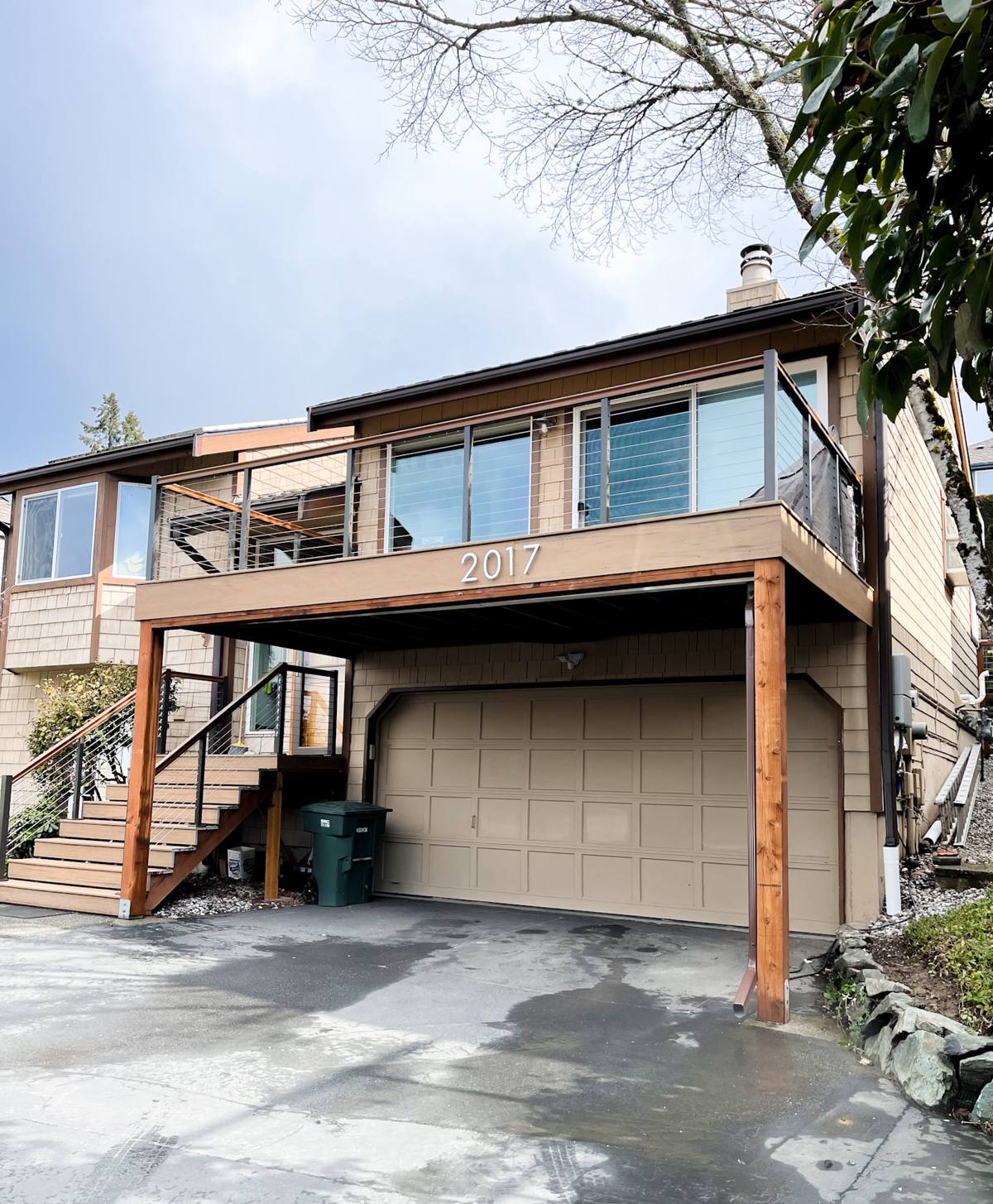
Why Moss Season Is a Structural Issue, Not Just a Cosmetic One
Moisture that doesn't leave
Whatcom County's moss season runs long — shaded, north-facing, or tree-covered sections of a deck can stay damp for weeks at a stretch during fall and winter. On a poorly ventilated deck, that moisture doesn't just grow moss on the board surface; it sits underneath the boards too, against joists, fasteners, and ledger connections. Composite decking resists surface rot, but the framing underneath it is almost always still wood, and that wood needs airflow and drainage detailing to survive damp season after damp season.
What correct ventilation looks like
A deck built for this climate needs consistent gapping between boards for drainage, joist tape or another moisture barrier over the framing lumber, and enough clearance underneath the structure for air to actually move. Skip any of that and you get a deck that looks fine on top while the substructure quietly deteriorates — which is a much more expensive fix than replacing decking boards.
Salt Air, Fasteners, and Why Hardware Choice Matters
Proximity to Bellingham Bay means airborne salt is a real factor for exterior metal on South Hill and throughout much of Whatcom County. Standard fasteners and brackets corrode faster in that environment, and once a fastener starts rusting, it can streak the composite board around it and eventually weaken the connection it's supposed to be holding. This is a case where a small material upgrade — stainless or coated hardware rated for coastal exposure — is worth the modest added cost, because replacing corroded fasteners under an installed composite deck is a labor-heavy job, not a quick fix.
We also pay attention to the metal in ledger board flashing and any structural brackets for the same reason. A deck is only as durable as its weakest connection point, and on a composite deck the boards will usually outlast cheap hardware by a wide margin if that hardware isn't rated for the environment it's sitting in.
Driving Rain and the Ledger Board Connection
Wind-driven rain off the water is common enough in this region that it changes how a deck should attach to the house. The ledger board — where the deck ties into the structure of the home — is the single most common failure point we see on older decks in this area, composite or wood. Water gets behind improperly flashed ledger connections and works into the house's rim joist and sheathing, often for years before it shows up as a visible problem.
On every ledger attachment we install or repair, proper flashing (and ideally a rain screen gap where the ledger meets the siding) isn't optional trim work — it's the difference between a deck that protects your home's structure and one that slowly damages it. This matters more in Whatcom County than in drier parts of the state simply because of how much wind-driven rain the structure has to shed over a typical winter.
Choosing the Right Composite Board for a South Hill Lot
Capped vs. uncapped composite
Capped composite boards have a polymer shell wrapped around the composite core, which resists moisture absorption, staining, and fading far better than older uncapped composite products. For a shaded, damp South Hill lot, that cap matters — it's the layer standing between the board and the moss, mildew, and algae that thrive in low-light, high-moisture conditions. Uncapped composite can still work on sunnier, more exposed sections, but we're honest with clients that it will need more upkeep in shaded areas.
Color and shade exposure
Lighter composite colors show pollen, moss spores, and dirt more visibly in shaded, damp conditions, while darker boards absorb more heat in full sun. On mixed-exposure lots — which describes a lot of South Hill properties — we'll often walk a homeowner through which color families hold up best given exactly which parts of the day and year that specific deck actually sees sun versus shade.
Board profile and grip
Textured, grooved composite boards perform better underfoot when wet, which matters given how many months of the year a Whatcom County deck surface is actually damp. Smooth-face boards look clean but can get slick faster in moss-prone shade.
Our Process for a South Hill Composite Deck
- On-site assessment — we look at sun/shade patterns across the day, existing drainage, ledger condition if it's a rebuild, and any hillside grading that affects footing placement.
- Permitting — Whatcom County and local jurisdictions require permits for most deck construction and significant rebuilds; we handle that paperwork so it isn't left to the homeowner.
- Substructure first — footings, framing, joist spacing rated for composite board span requirements, and moisture barrier tape over every joist.
- Ledger flashing — done properly before a single deck board goes down, not patched around afterward.
- Hidden fastener installation — for a clean surface with no exposed screw heads collecting moisture and grime.
- Final walkthrough — we go over drainage, gapping, and maintenance expectations specific to your lot's sun and shade exposure.
Cost Factors on a Composite Deck Project
| Factor | Why It Changes the Price |
|---|---|
| Board tier (uncapped vs. fully capped composite) | Capped boards cost more upfront but need less maintenance and resist moss staining better in shaded areas |
| Substructure condition | Rebuilding rotted framing or footings on an older deck adds labor before any decking is installed |
| Hillside grading | Sloped South Hill lots sometimes need engineered footings or additional bracing |
| Railing and fascia material | Composite fascia and matching railing systems add cost but keep the whole structure low-maintenance |
| Ledger and flashing work | Proper flashing detail takes more time than a shortcut installation, but it protects the house itself |
| Deck size and layout complexity | Multi-level decks, stairs, and custom shapes increase both material waste and labor hours |
We don't quote composite decking off a square-footage rule of thumb without seeing the site — a flat, sun-exposed deck rebuild and a sloped, shaded, ledger-attached deck can carry very different costs even at the same size.
Maintenance Realities for This Climate
Composite decking is lower-maintenance than wood, not maintenance-free, and we'd rather set that expectation honestly upfront. In Whatcom County, that means periodic washing to keep moss and algae from getting a foothold in shaded sections, especially heading into and out of the wet months. A stiff brush and a composite-safe cleaner handle most of it; pressure washing on too high a setting can damage the cap layer on some boards, so we walk clients through what's safe for the specific product installed.
- Sweep debris off the deck regularly — trapped leaves and needles hold moisture against the board surface
- Clean shaded or north-facing sections more often than sun-exposed areas
- Keep gutters and downspouts near the deck clear so runoff isn't draining directly onto it
- Check railing and stair hardware annually for early signs of corrosion
- Trim back overhanging branches where practical to reduce shade and debris load
- Address any soft spots, movement, or gaps at the ledger connection right away rather than waiting
Why a Crew That Already Works South Hill Matters
A contractor who's worked other South Hill properties already knows which sections of a lot tend to stay damp longest, how the local permitting process typically runs, and what hardware actually holds up against the salt air coming off the bay. That's not something you can fully substitute with a generic decking checklist — it's pattern recognition built from working the same terrain and climate repeatedly. It also means faster, more accurate estimates, because we're not guessing at how a given slope, tree line, or exposure will behave.
We'd rather build a deck once, correctly, than get called back in a few years to fix a ledger connection that was flashed wrong or a substructure that was never given a chance to dry out between rains. That's the standard we hold every composite deck build to, whether it's a small platform off a kitchen or a full multi-level deck built into a hillside lot.
If you're planning a new composite deck or replacing an aging one in South Hill, we're happy to walk the site with you and give you a straight, no-pressure estimate — just fill out the form below and we'll get in touch.