 Whatcom County
 Why Bellingham Siding Wears Differently Than Siding Inland
Houses in Bellingham don't age the same way a house forty miles inland does. Proximity to Bellingham Bay means a steady drift of salt-laden air moving across roofs and walls, and that salt exposure accelerates corrosion on fasteners, trim flashing, and any exposed metal behind or around the siding. Add in the driving rain that comes sideways off the water during fall and winter storms, and siding here has to do more than just look good — it has to shed wind-blown moisture on walls that don't always get a break to dry out between storms.
Then there's moss. Whatcom County's long, damp season gives moss and algae months to establish themselves on north-facing walls, under eaves, and anywhere siding stays shaded and slow to dry. Moss doesn't just look bad — it holds moisture against the siding surface for extended periods, which is exactly the condition that causes rot in wood-based products and finish breakdown in lower-grade fiber cement or vinyl. Repairing siding in Bellingham means understanding all three of these stressors together, not treating them as separate issues.
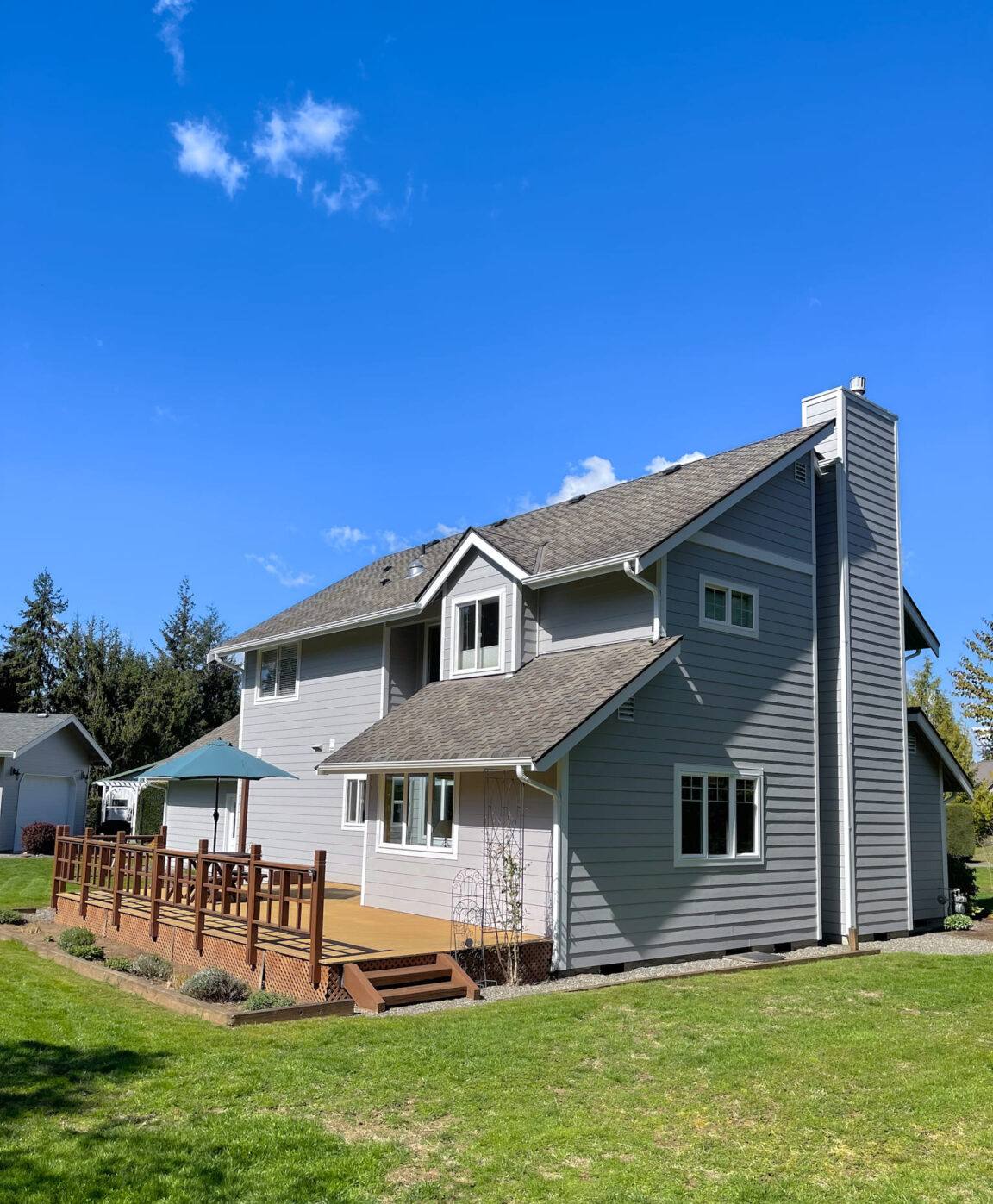
Signs Your Siding Needs Repair — Not a Full Tear-Off
Most siding problems we see in Bellingham don't require replacing an entire wall. They require identifying the actual failure point and fixing it correctly before it spreads. Here's what typically signals a repair job rather than a replacement:
- Isolated soft spots or visible rot at the bottom courses near grade, decks, or downspouts
- Cracked or split boards from impact, settling, or freeze-thaw cycling around fasteners
- Persistent moss or dark staining concentrated on shaded or north-facing sections
- Bubbling, peeling, or chalking paint on a specific run of siding while the rest holds up fine
- Gaps or separation at seams, corners, or trim where caulking has failed
- Fastener corrosion or staining bleeding through the surface, especially near the coast
- Soft or spongy sections around window and door trim where flashing may have failed
If the damage is contained to specific boards, corners, or a single elevation, repair is almost always the right call — and the honest one. We'd rather fix what's actually broken than sell a homeowner a full replacement they don't need yet.
What a Correct Siding Repair Actually Involves
It starts with finding the cause, not just the symptom
A patch that covers a soft spot without addressing why that spot got wet in the first place just buys a year or two before the same failure reappears. Before any board comes off, we look at the flashing, the water-resistive barrier behind the siding, the grading and drainage nearby, and whether the damage is a one-time event (impact, a failed sealant joint) or a sign of an ongoing moisture path (bad flashing, missing kick-out flashing at roof-wall intersections, a clogged gutter dumping water onto the wall).
Matching materials and profiles correctly
Repairs on fiber cement siding need to match not just color but plank width, exposure reveal, and texture — mismatched repairs are one of the most common complaints we hear about other companies' patch jobs. On a home with existing James Hardie siding, that means sourcing the correct HZ5 product line and matching ColorPlus finish where possible, or planning for a repaint of the repaired section if an exact factory match isn't available.
Sealing and flashing details, not just the board
The board itself is rarely the whole story. Correct repair work re-establishes proper water-shedding at every seam, corner, and penetration touched during the repair — new flashing where the old flashing failed, correctly lapped house wrap, and sealant only where sealant belongs (not as a substitute for flashing, which is a shortcut that fails within a few seasons in this climate).
Repair vs. Replace: How We Help You Decide
| Factor | Points Toward Repair | Points Toward Replacement |
|---|---|---|
| Extent of damage | Limited to specific boards or one elevation | Widespread across multiple walls |
| Underlying moisture barrier | Intact, functioning correctly | Compromised, showing signs of chronic water intrusion |
| Siding material | James Hardie or other durable fiber cement | Aging or failing LP SmartSide, vinyl, or untreated wood nearing end of life |
| Age of existing siding | Under 15-20 years, otherwise sound | Original siding is decades old or already patched multiple times |
| Moss/algae pattern | Surface-level, cleanable | Established growth causing visible substrate damage |
We walk every job with this framework in mind and tell homeowners plainly which side of the table their home falls on. If a repair is the right call, that's what we recommend and what we quote — a repair-first approach that only escalates to replacement when the underlying material or moisture barrier genuinely can't be saved.
How Different Siding Materials Fail in This Climate
The repair approach — and how long a repair holds up — depends heavily on what's actually on the wall.
Wood and primed spruce
Wood siding in Bellingham's moss season is fighting an uphill battle. Even well-maintained wood needs regular repainting and caulking to keep water out, and once moisture gets behind a board, rot spreads faster than it does in dryer climates. Repairs often reveal more hidden damage than expected because wood doesn't show distress until it's already advanced.
Vinyl
Vinyl doesn't rot, but it isn't immune to this environment either. Salt air and UV exposure over years can make panels brittle, and wind-driven rain can work its way behind poorly lapped panels at corners and seams. Repairs are usually straightforward panel swaps, but color-matching older, sun-faded vinyl is often impossible, which leaves a visible patch.
LP SmartSide
Engineered wood products like LP SmartSide hold up reasonably well when the finish and caulking are maintained on schedule, but any breach in that finish gives moisture a path into the wood strand core, and once that core swells or delaminates, a patch repair doesn't really solve the underlying problem — the affected section typically needs full replacement, not a repair.
James Hardie fiber cement
This is why we standardized on it. Hardie's fiber cement doesn't rot, doesn't feed moss the way wood fiber does, and isn't vulnerable to the brittleness that UV and salt exposure cause in vinyl over time. When Hardie siding does need repair, it's typically due to impact damage, a failed caulk joint, or flashing issues nearby — not the board itself breaking down. That makes repairs on Hardie siding more predictable and longer-lasting than repairs on most other materials.
Our Repair Process
- Inspection and diagnosis — we identify the actual cause of damage, not just the visible symptom, including a check of flashing, drainage, and moisture barrier condition nearby.
- Honest scope recommendation — repair, partial replacement, or full replacement, explained in plain terms with the reasoning behind it.
- Material sourcing and matching — correct Hardie product line, profile, and finish match where existing siding is Hardie; clear options where an exact match isn't possible.
- Removal and moisture barrier repair — damaged boards come off carefully, flashing and house wrap are corrected underneath, not just covered back up.
- Installation to manufacturer spec — correct fastening, clearances, and sealant placement, because most premature siding failures trace back to installation shortcuts, not the material itself.
- Final check — we walk the repair with the homeowner and point out exactly what was done and why.
Why a Local Whatcom County Crew Matters for Repair Work
Siding repair is diagnostic work as much as it's construction work, and diagnosis depends on pattern recognition built from seeing the same climate stressors over and over. A crew that works Bellingham and the surrounding Whatcom County area regularly knows which elevations take the worst of the driving rain, where moss tends to establish first on local rooflines, and how salt exposure near the water shows up differently than it does even a few miles inland. That familiarity means fewer surprises once boards come off the wall, and repair recommendations grounded in what actually happens to siding here — not generic guidance written for a different climate.
Being local also means being reachable if a repair needs a follow-up visit, and it means standing behind the workmanship warranty on the repair without a homeowner having to track down an out-of-area contractor months later.
What We Don't Do — and Why It Matters for Repairs
We only install and repair with James Hardie fiber cement siding. We don't install vinyl, LP SmartSide, Cemplank, Allura, primed spruce, or cedar, and when a repair job involves one of those materials on an existing home, we'll say so honestly and explain what a repair on that material can and can't accomplish long-term. Where a homeowner is weighing whether to keep patching an aging non-Hardie product or move toward something more durable, we're glad to walk through that decision without pressure — our recommendation is Hardie, but the choice and the timeline are yours.
If your siding in Bellingham is showing damage — soft spots, moss buildup, cracked boards, or failed seams — we're happy to take a look and give you a straight answer on what it needs. Reach out for a free, no-pressure estimate using the form below.