 Whatcom County
 Why Bellingham Homes Wear Out Their Siding Faster Than the Sales Brochure Says
Bellingham sits in a spot that's tough on exterior building materials in ways that aren't always obvious until you're twenty years into ownership. You've got marine air rolling in off Bellingham Bay carrying salt that slowly attacks fasteners, trim, and any siding surface that isn't built to shed it. You've got long stretches of driving rain from fall through spring that push water sideways into seams and laps most siding wasn't designed to handle at that volume. And you've got a moss and algae season that runs most of the year on north-facing walls and anywhere shaded by mature trees or hillside. None of that is exotic — it's just the Pacific Northwest doing what it does — but it means siding that performs fine in a drier, calmer climate can start failing here on a noticeably shorter timeline.
When a homeowner in Whatcom County calls us about siding replacement, the first question isn't "what color do you want" — it's "what's actually happening on the wall right now, and why." Replacement done right corrects the conditions that caused the failure in the first place. Replacement done wrong just puts a new surface over the same problems and buys you a few more years before you're back here.
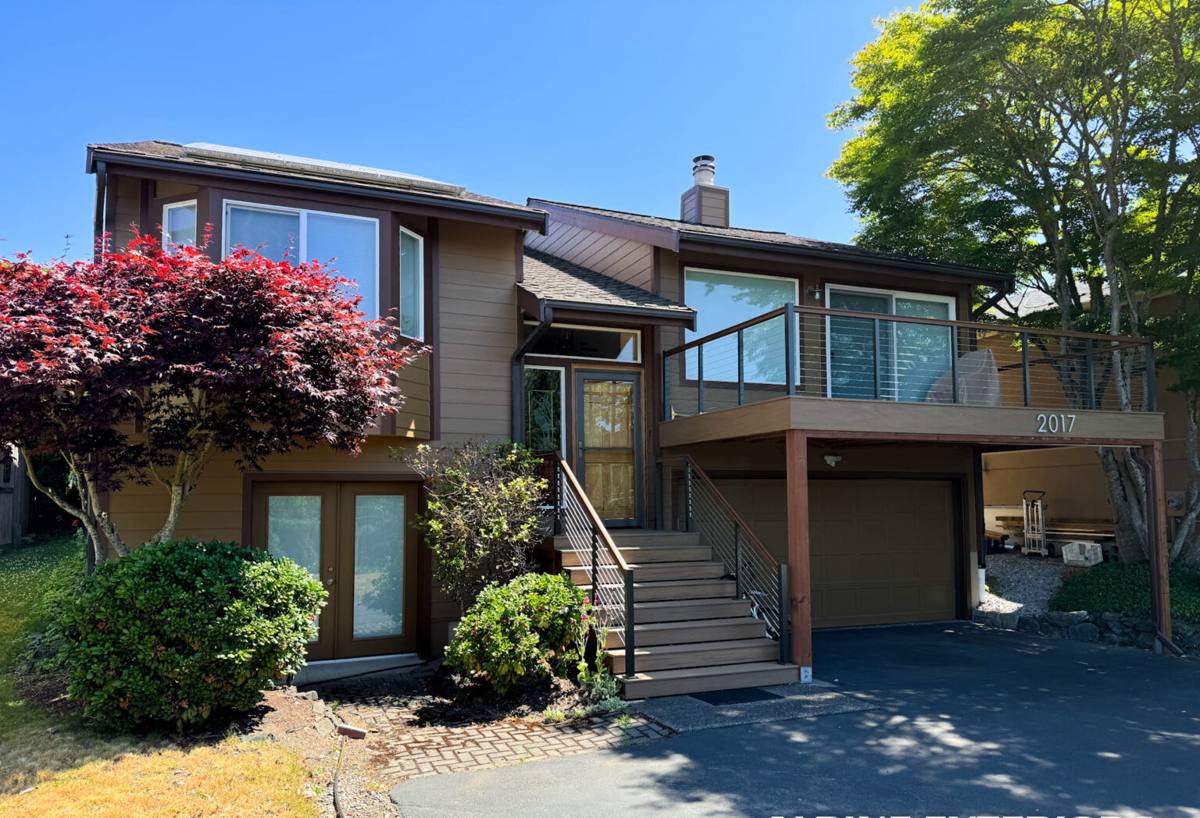
What "Needs Replacement" Actually Looks Like Here
Every siding job we look at in Bellingham falls into one of a few patterns. Recognizing which one you have helps set expectations for the scope of the work.
Moisture Damage Behind the Surface
This is the big one locally. Driving rain finds its way behind lap siding through failed caulking, gapped seams, or house wrap that was never properly lapped and taped during the original build. Once water gets behind the cladding, it doesn't dry out quickly in our humidity — it sits against sheathing and framing. By the time you see staining, soft spots, or paint that won't hold, the damage is often already into the wood behind it.
Moss, Algae, and Chronic Green Growth
Shaded walls, especially those facing north or tucked under overhangs and tree canopy, stay damp for days at a stretch. On porous or textured siding surfaces, that moisture never fully leaves, and you get persistent moss and black algae streaking that comes back within a season or two of cleaning, no matter how carefully it's pressure washed.
Fastener and Trim Corrosion from Salt Air
Closer to the water, salt-laden air accelerates corrosion on nails, trim fasteners, and any exposed metal flashing. You'll see rust bleed staining down the face of siding boards, or trim that's begun to separate because the fasteners holding it have weakened.
Simple Age-Out
Sometimes there's no dramatic failure — the siding is just at the end of its realistic service life, the finish is chalking and fading unevenly, and it no longer makes sense to keep repainting a surface that will need it again in three or four years.
What a Correct Replacement Job Actually Involves
Siding replacement is not a one-day swap of old boards for new ones. Done properly, it's a sequence, and skipping steps is exactly how a house ends up back in the same condition a decade later.
- Full tear-off and inspection. Old siding comes off so the sheathing and framing underneath can actually be seen and assessed — not guessed at.
- Repair or replace damaged sheathing and framing. Any wood that's soft, delaminated, or rotted gets cut out and replaced before anything new goes back on. Covering damaged sheathing is the single most common shortcut that causes early failure.
- Correct the water management system. This means properly lapped and sealed weather-resistant barrier, correctly integrated flashing at windows, doors, and roof intersections, and drainage planes that actually let incidental moisture escape instead of trapping it.
- Install siding to the manufacturer's specified fastening, clearance, and gapping requirements. Bellingham's rain load means these details matter more here than in drier regions — proper clearance from grade, decks, and roof lines keeps water from wicking up into the material.
- Finish and seal trim, corners, and penetrations. This is where salt air and driving rain find their way in if it's rushed.
Every one of those steps is invisible once the job is finished — which is exactly why it matters who's doing the work and not just what material ends up on the wall.
Why We Only Install James Hardie Fiber Cement
We get asked why we don't offer vinyl, LP SmartSide, or other engineered wood options, and the honest answer is climate fit. In a marine environment with this much sustained moisture exposure, we've standardized on James Hardie fiber cement because it's non-combustible, dimensionally stable in wet-dry cycling, and doesn't rely on a wood substrate that can absorb and hold water the way engineered wood products can. That matters directly for the moisture and moss issues we see constantly in Whatcom County.
The HZ5 Climate Engineering
Hardie engineers its products in different formulations for different climate zones, and the HZ5 line is built for exactly the wet, freeze-thaw-adjacent conditions found here in the Pacific Northwest. It's manufactured to resist moisture-related deterioration better than a general-purpose formulation would.
ColorPlus Factory Finish
Rather than site-applied paint, ColorPlus is baked on at the factory, which gives it a more consistent, UV- and moisture-resistant finish than field painting can reliably achieve — relevant here because repainting siding on a house exposed to constant damp and salt air is a recurring cost most homeowners would rather not keep paying.
A Product That Doesn't Feed Moss
Fiber cement's dense, non-porous composition doesn't hold moisture at the surface the way some wood-based sidings do, which means algae and moss have less to grip onto and less consistent dampness to thrive in.
We'll say plainly: other products have real strengths, and if you're evaluating options broadly, that's worth doing carefully. But for the specific combination of salt air, rain volume, and moss pressure that Whatcom County homes deal with, we've chosen to install only the product line we believe holds up best, backed by a strong transferable warranty, rather than offer something we'd have reservations recommending in this climate.
Comparing Approaches: What Actually Changes Long-Term Outcomes
| Factor | Why It Matters in Bellingham |
|---|---|
| Moisture barrier detailing | Determines whether driving rain stays out or slowly saturates sheathing over years |
| Siding material porosity | Affects how much moss and algae growth develops on shaded, damp walls |
| Fastener and flashing materials | Salt air accelerates corrosion on lower-grade metal, leading to staining and loosened trim |
| Factory vs. site-applied finish | Factory finishes hold up more consistently against sustained damp and UV exposure |
| Clearance from grade and roof lines | Insufficient clearance lets rainwater wick into siding from below |
Our Process for Bellingham Siding Replacement Projects
Our approach doesn't change based on the neighborhood, but it's shaped by what we consistently find in this climate.
- On-site assessment that includes checking for hidden moisture damage, not just surface condition
- Honest scoping — telling you upfront if sheathing repair is likely needed, not discovering it mid-project as a surprise change order
- Written estimate that separates material, labor, and any structural repair costs so you know what you're paying for
- Full tear-off rather than covering existing siding, so the water management layer underneath is actually corrected
- James Hardie HZ5 fiber cement installed to manufacturer fastening and clearance specifications
- Final walkthrough covering care basics for the new siding, including how to handle the moss and algae exposure specific to your lot's sun and shade pattern
What to Check Before Hiring Anyone for This Job in Whatcom County
- Do they inspect and photograph the sheathing condition before quoting, or just measure the exterior walls?
- Will they put in writing whether they're doing a full tear-off or installing over existing siding?
- Do they carry manufacturer-specific installation training for the product they're proposing?
- Are they local to Whatcom County, with a track record of jobs that have to withstand this specific climate rather than a generic install approach?
- Does their warranty cover workmanship separately from the manufacturer's material warranty, and for how long?
A crew that works Bellingham regularly has already seen what happens to different siding choices and different installation shortcuts after five, ten, and twenty years in this exact climate. That's not something a contractor coming in from a drier region necessarily has a feel for, and it shows up in the details — how flashing is integrated, how much clearance is left at grade, how seams are handled going into a wet fall.
How Long Should a Replacement Actually Last
Longevity depends heavily on correct installation more than on the product alone. A well-installed fiber cement system, properly flashed and maintained, is built to hold up for decades under normal conditions. But "properly installed" is doing a lot of work in that sentence — the same material installed with rushed flashing or insufficient clearance from grade will underperform regardless of the warranty printed on the box. That's why we spend more time on the water management details than on anything else during a replacement.
What This Costs and What Drives the Range
Costs vary by home size, existing damage, and how much sheathing or framing repair is needed once the old siding comes off — which is exactly why we don't quote a number before seeing the house. What we can tell you is the general factors that move the price:
- Square footage and number of stories
- Extent of hidden moisture or rot damage discovered during tear-off
- Amount of trim, corner, and window/door detail work involved
- Accessibility of the site
If you're seeing moss that keeps coming back, staining you can't explain, or siding that's simply reached the end of its useful life, we're glad to come take a look and give you a straightforward, no-pressure estimate — no obligation, just an honest read on what your home actually needs.