 Whatcom County
 James Hardie Siding Built for Birchwood's Climate
Birchwood sits in a part of Whatcom County where the exterior of a house works harder than it looks like it should. Salt-tinged marine air drifts in and quietly speeds up corrosion on fasteners, trim, and any coating that isn't built to handle it. Rain rarely just falls straight down here — for long stretches of the year it comes in sideways, driven by wind, and finds its way into lap joints and seams that a drier climate would never test. And on shaded lots and north-facing walls, a long moss and mildew season settles in and holds on for months, feeding on any siding surface that stays damp. None of that means siding is a losing battle in Birchwood. It means the material and the installation both have to be chosen with those specific stresses in mind, not treated like a generic exterior going on a generic house.
This page is about one thing: what it actually takes to do James Hardie fiber cement siding right on a Birchwood home. Not a general overview of fiber cement, and not a sales pitch — a straight walk-through of what the climate demands, what a correct installation looks like, and how we run the job from first estimate to final walk-through.
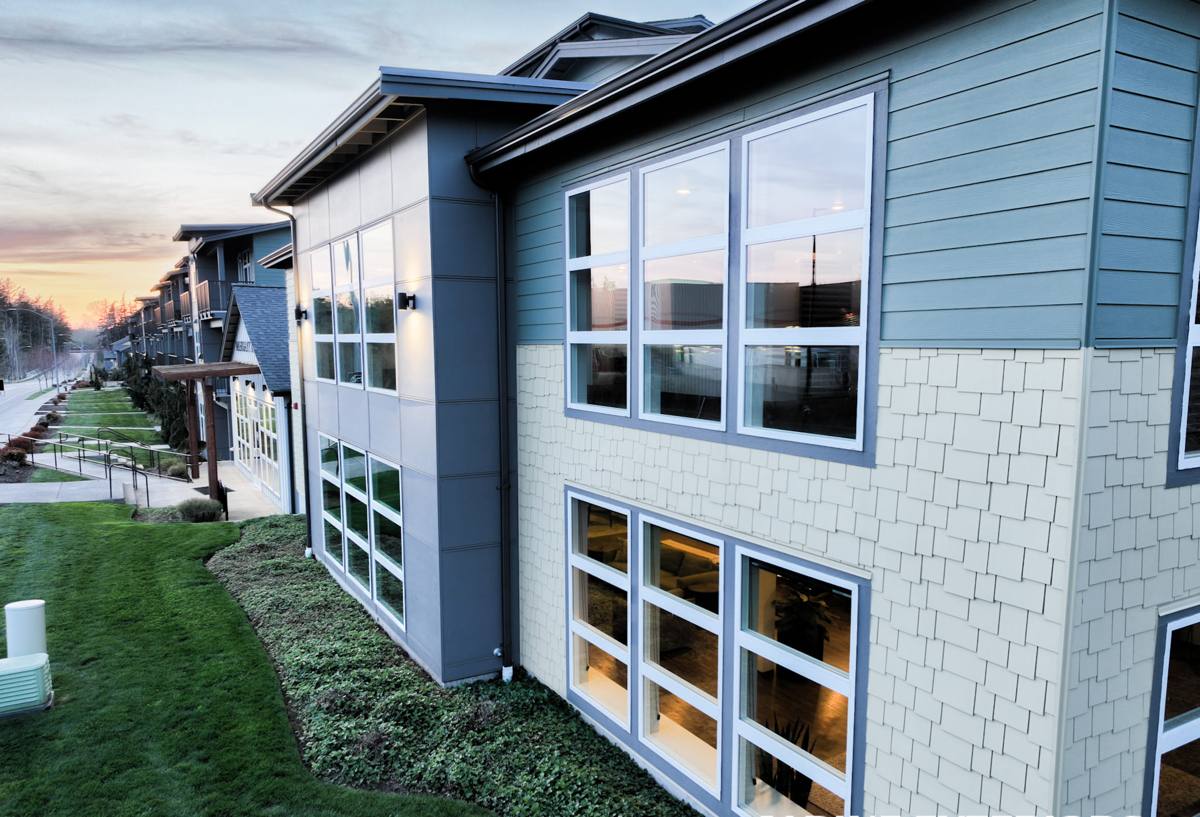
What Birchwood Homes Need From Their Siding
A siding system in this part of Whatcom County is doing three jobs at once, year-round, whether anyone's thinking about it or not: shedding wind-driven rain, resisting salt-accelerated corrosion, and staying inhospitable to moss and mildew on shaded exposures. Skip any one of those and the failure shows up eventually, usually years after the install, which is exactly why cutting corners on siding is so easy to get away with in the short term and so costly to live with later.
Salt Air Off the Water
Salt-laden air accelerates corrosion on lower-grade fasteners and trim hardware, and it breaks down factory finishes faster than the same products would wear in a drier inland market. A coating rated for a generic national climate doesn't necessarily hold up the same way on a property with regular salt exposure.
Wind-Driven Rain
Rain pushed sideways by wind gets forced into lap joints, under trim, and into any seam where the water management detail isn't right. That's a much tougher test on caulked joints and butt seams than a simple annual rainfall total would suggest, and it's where a lot of long-term siding problems actually start.
A Long Moss Season
Mild temperatures and steady moisture add up to active moss and mildew growth for most of the year on shaded, tree-lined properties — common in Birchwood. Organic growth on a siding surface holds moisture against the wall behind it, and that trapped moisture is often the real driver behind siding problems that get blamed on the material itself.
- Corrosion-resistant fasteners and flashing: standard-grade metal shortens the life of trim and flashing details in salt-exposed air.
- A finish that holds color and seals without field maintenance: site-applied paint has to be recoated on a schedule; a factory finish shouldn't.
- Tight, correctly lapped joints: the difference between rain running off and rain getting pushed in.
- A surface and installation that don't trap moisture against the wall: the real defense against moss, mildew, and the rot that can follow.
Why James Hardie Is the Product We Install Here
We install James Hardie fiber cement exclusively — not vinyl, not LP SmartSide or another engineered wood product, not cedar or primed spruce, and not other fiber cement brands like Cemplank or Allura. That's a narrower list than most siding contractors offer, and it's on purpose. Fiber cement as a category is inorganic: a cured blend of Portland cement, sand, and cellulose fiber that doesn't have a wood-based or foam core to absorb water, swell, or feed rot and insects. It's also non-combustible. Within that category, James Hardie is what we standardized on specifically, for reasons that matter directly in this climate rather than in general.
HZ5 Climate Engineering
James Hardie engineers its siding by climate zone, and the HZ5 line is built for regions with sustained moisture exposure and freeze-thaw cycling — a closer match to Whatcom County's winters than a product engineered primarily for hot, dry regions. That's an engineering decision, not a marketing label, and it's a concrete reason this manufacturer fits Birchwood better than fiber cement treated as an interchangeable commodity.
ColorPlus Factory Finish
Rather than relying on field-applied paint, Hardie's ColorPlus finish is baked on in a controlled factory setting in multiple coats before the boards reach the job site. It's backed by its own finish warranty, separate from the substrate warranty, and it's built to resist fading and color shift better than a site-painted surface exposed to UV and salt air over years.
What a Correct Install Involves
Fiber cement's reputation rides heavily on installation quality. The material resists moisture and combustion in its core, but a rushed or out-of-spec install can undercut all of that. This is the level of detail we hold every Birchwood job to.
| Installation Detail | Why It Matters in Birchwood |
|---|---|
| Manufacturer-specified clearances at grade, roofline, and decks | Keeps splash-back and standing moisture off the board edge during heavy rain |
| Correct fastener type, spacing, and depth | Prevents cracking and preserves the water-resistive barrier behind the siding |
| Rainscreen or drainage plane behind the siding | Lets moisture that gets past the surface drain and dry instead of sitting against the sheathing |
| Flashing integrated at windows, doors, and penetrations | Directs wind-driven rain away from seams rather than trapping it behind trim |
| Factory-cut edges used wherever possible; field cuts sealed per spec | Keeps the factory finish's protection intact at every cut edge, not just the visible face |
| Proper joint lap and caulk-free butt seams where specified | Reduces the seams that driven rain can exploit over time |
None of this is exotic. It's the manufacturer's own installation spec, followed completely rather than partially. The gap between a Hardie install that lasts decades and one that causes problems within a few years almost never comes down to the boards themselves — it comes down to whether these details were done right the first time.
Product Lines That Fit Birchwood Homes
James Hardie makes several siding profiles, and the right one depends on the home's style and existing trim more than on the climate — the climate-engineering (HZ5) applies across the product line. We walk through these options during the estimate rather than defaulting to one look for every house.
| Product | Look | Typical Fit |
|---|---|---|
| HardiePlank Lap Siding | Traditional horizontal lap, multiple textures and exposures | The most common choice; fits traditional and craftsman-style homes |
| HardiePanel Vertical Siding | Vertical panel, often paired with board-and-batten trim | Modern or mixed-material exteriors, accent walls, gables |
| HardieTrim | Trim boards for corners, fascia, and window/door surrounds | Paired with either plank or panel siding for a finished, sealed edge |
| HardieSoffit | Pre-finished soffit panels | Used where ventilation and moisture control at the roofline matter most |
How We Run a Birchwood Siding Project
- Walk-through and assessment: we look at the existing siding, trim, water management, and any moisture damage already present before quoting anything.
- Product and profile selection: plank, panel, or a mix, plus trim and color, matched to the home and to what's actually going to perform on this lot.
- Written estimate with the installation spec included: clearances, fastening, drainage plane, and flashing approach spelled out, not left as assumptions.
- Tear-off and sheathing inspection: old siding comes off down to the sheathing so any hidden rot or moisture damage gets addressed before new siding goes up, not sealed underneath it.
- Weather barrier and drainage plane installation: the layer that does the real work of keeping wind-driven rain away from the wall assembly.
- Siding, trim, and flashing installation to manufacturer spec: the stage where most of the long-term performance is decided.
- Final walk-through and warranty registration: we confirm the install with you directly and register the product warranty rather than leaving that step undone.
Why a Crew That Already Works Birchwood Matters
Siding installation quality depends on judgment calls that a spec sheet can't fully cover — how much clearance a specific lot's drainage patterns actually call for, where a shaded wall needs extra attention against moss, how a particular roofline's flashing has to be built to handle rain coming off it. A crew that's already worked Birchwood and the surrounding parts of Whatcom County has seen how these details play out on homes with the same salt exposure, the same wind-driven rain, and the same moss pressure — not as an abstract climate zone on a map, but as the specific conditions this area delivers every year.
That local repetition also matters for practical reasons: familiarity with local permitting, an established relationship with Hardie's distribution for this region, and a track record you can ask about directly rather than take on faith. A contractor who mainly works elsewhere and treats Birchwood as an occasional stop doesn't build that same pattern recognition, and pattern recognition is a lot of what separates a siding job that holds up for decades from one that doesn't.
Cost Factors Worth Understanding
Siding cost varies by house size, existing condition, product mix, and trim complexity, so we're not going to put a number on this page that isn't specific to your home. What's worth understanding going in:
- Tear-off and sheathing repair, if needed, adds cost but is not optional — sealing a compromised wall behind new siding just delays the problem.
- A drainage plane or rainscreen adds a modest cost and is one of the highest-value line items in this climate specifically.
- Trim complexity (corners, window and door surrounds, multiple profiles) affects labor more than it affects material cost.
- Color and finish choice within the ColorPlus line doesn't change the substrate warranty, but it's worth discussing which colors hold up best under regular sun and salt exposure.
Questions Worth Asking Before You Commit
- Is the drainage plane or rainscreen included, or treated as an upgrade?
- What's the fastening and clearance spec, and is it in writing?
- Will field cuts be sealed per manufacturer spec, and where?
- Is the crew installing James Hardie certified for it, or treating it as an unfamiliar swap-in for another material?
- Is the warranty registered after the job, and by whom?
If you're weighing a siding replacement or repair in Birchwood, we're glad to walk your home, look at what's there now, and put together a straightforward estimate — no pressure, no upsell script, just what your house actually needs. The form below gets that conversation started.