 Whatcom County
 Why Ferndale Decks Age Differently Than Decks Inland
Ferndale sits close enough to Bellingham Bay and the Strait of Georgia that salt-laden air is a real factor in how outdoor structures hold up, not just an inland-Whatcom afterthought. Add in Whatcom County's long wet season, where a deck surface can stay damp for days at a stretch, and you've got two forces working against a deck at the same time: corrosion from airborne salt and moisture intrusion into wood fibers, fasteners, and framing connections. A deck built with specs pulled from a drier climate zone will show it within a few seasons — soft spots at the ledger board, rust bleeding through fastener heads, and a slick green film that shows up every fall and doesn't fully leave until late spring.
None of this means a deck in Ferndale is a losing battle. It means the material choices, hardware, and construction details need to match what this specific stretch of Whatcom County actually does to outdoor wood and metal over a full year, not just what looks good on installation day.
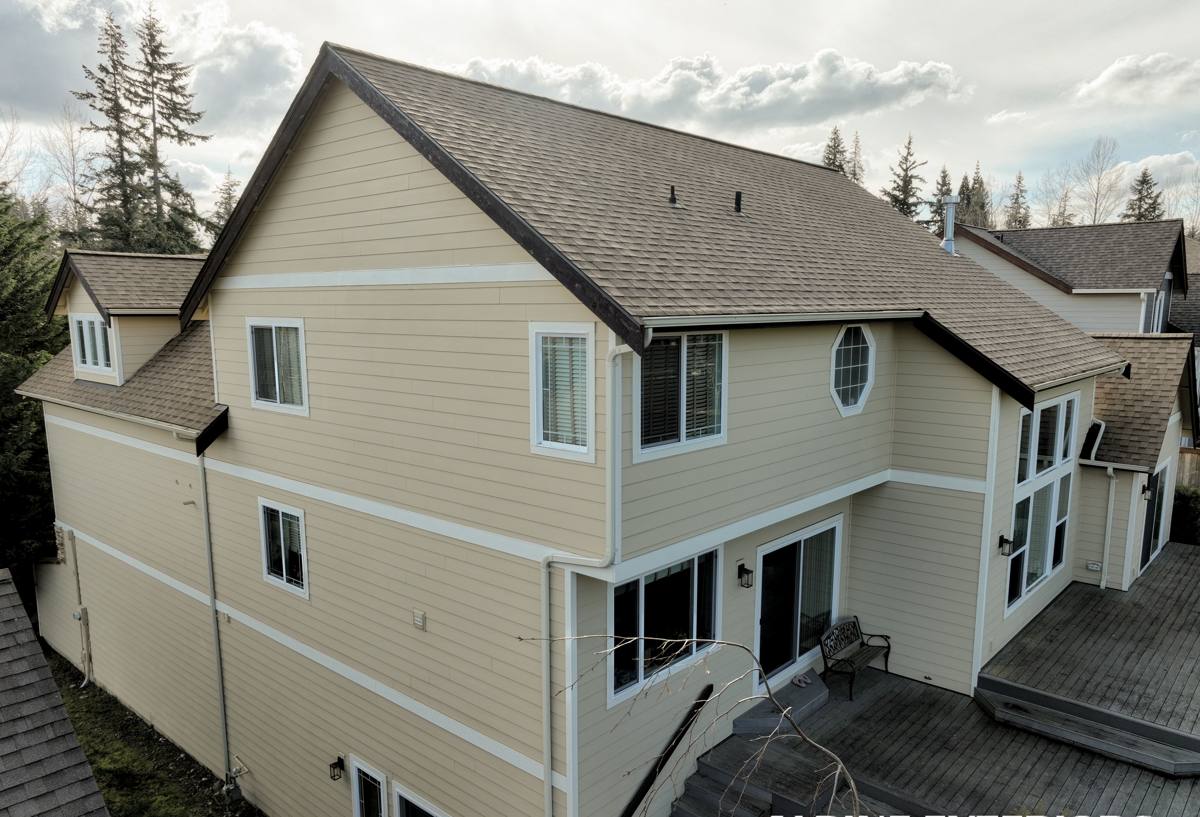
What Local Conditions Actually Do to a Deck
Salt Air and Corrosion
Airborne salt accelerates corrosion on any exposed metal — fastener heads, joist hangers, railing brackets, and structural screws. Once a fastener starts rusting, it weakens at the exact point holding boards or framing together, and rust streaks bleed into the surrounding wood or composite, leaving stains that don't sand or clean out.
Driving Rain and Moisture Intrusion
Wind-driven rain doesn't just fall on a deck surface, it gets pushed sideways into gaps, under railing posts, and behind ledger boards where a house wall meets the deck framing. That's the single most common point of hidden rot on decks in this part of Washington, because it's the hardest area to inspect once the deck is built and the least likely to dry out between storms.
Moss and Algae Season
Whatcom County's extended damp season gives moss and algae months to establish themselves on any horizontal wood or composite surface that doesn't drain and dry efficiently. Beyond looking bad, a mossy deck surface is a slip hazard and, on wood, holds moisture against the board long after the rain has stopped — which is exactly the condition that leads to soft, punky wood a couple years down the road.
Choosing Decking Material for a Ferndale Property
There's no single "correct" decking material for every home — it depends on budget, how much upkeep you're willing to do, and how exposed the deck's location is to wind and salt air. Here's how the common options actually perform under these conditions.
| Material | Salt Air Behavior | Moss/Algae Resistance | Maintenance Load |
|---|---|---|---|
| Pressure-treated fir/hem-fir | Wood itself is fine; fasteners are the weak point | Low — needs regular cleaning and sealing | Highest — annual cleaning, periodic re-staining |
| Cedar | Naturally rot-resistant, holds up well if sealed | Moderate — natural oils slow growth somewhat | High — UV and moisture fade the finish faster near the coast |
| Composite decking | No corrosion in the board itself; fasteners still need to be corrosion-rated | Better — but still needs periodic washing in shaded, damp spots | Low — no staining or sealing, occasional cleaning |
| PVC/capped polymer | Excellent — fully sealed surface | Best of the surface options | Lowest — cleaning only |
Composite and capped polymer decking have become the more common choice for homeowners who want to stop re-staining a deck every couple of years, but wood is still a legitimate option when it's detailed and maintained correctly — and it's usually the lower up-front cost. The honest trade-off is time: composite costs more at installation, wood costs more in ongoing maintenance hours and material.
The Structural Details That Actually Prevent Failure
Decking material gets most of the attention, but the framing and connection points underneath are what actually determine whether a deck lasts 10 years or 25 in this climate.
Ledger Board Flashing
Where the deck attaches to the house, proper flashing — installed in the correct layered order with the house's water-resistive barrier — is what keeps driving rain from working its way behind the ledger and into the rim joist. This is the single most common failure point we see on older or poorly built decks in wet coastal climates, and it's invisible from the outside until the damage is already extensive.
Fastener and Hardware Grade
Standard galvanized fasteners are not enough this close to salt air. Stainless steel or high-grade coated fasteners and connectors cost more up front but are the difference between hardware that's still solid in year fifteen and hardware that's staining and weakening by year five.
Footings and Post Bases
Whatcom County's wet winters mean ground conditions shift with moisture. Footings need to be sized and set to local frost depth and soil conditions, with post bases that keep wood posts elevated off concrete so water doesn't wick up into the post end grain.
Deck Board Spacing and Airflow
Correct board gapping and joist spacing aren't just cosmetic — they control how fast a deck surface dries after rain, which directly affects how much moss and mildew take hold and how long the boards last.
Our Custom Deck Process
- On-site assessment — we look at sun exposure, drainage, wind direction, and how close the build site is to the elements that matter most for a coastal Whatcom County property.
- Design and material selection — sizing, layout, railing style, and a decking material recommendation based on your budget and how much maintenance you actually want to do.
- Permitting — most custom deck builds in Whatcom County require a permit depending on height and size; we handle the paperwork and inspections as part of the build.
- Framing and structural work — footings, ledger flashing, joist layout, and hardware selection done to hold up against local rain and salt air, not just to meet minimum code.
- Decking, railing, and finish work — installed with attention to drainage and airflow underneath, not just a flat, good-looking surface.
- Final walkthrough — we go over maintenance expectations specific to whatever material you chose, so there are no surprises the first wet fall.
Railings and Hardware Worth Getting Right
Railings take more direct weather exposure than almost any other part of a deck — they're vertical, catch driving rain from the side, and get handled constantly. Wood railings need the same fastener and finish considerations as the decking itself. Metal or cable railing systems need components rated for coastal exposure, since standard hardware corrodes visibly within a couple seasons this close to the water. We'll walk through railing options honestly, including which ones hold up with the least fuss in this specific climate versus which ones look great on day one but need more attention later.
Realistic Maintenance by Material
- Pressure-treated or cedar wood: annual wash to clear moss and algae, re-staining or sealing every 2-3 years, periodic fastener inspection.
- Composite decking: seasonal wash with soap and water, occasional check of fastener and flashing points at the ledger.
- PVC/capped polymer: wash as needed, minimal structural upkeep beyond general inspection.
- All materials: keep gutters and downspouts near the deck clear so runoff isn't dumping extra water onto the structure.
- All materials: clear leaves and debris from between boards before they trap moisture through the wet season.
Permits and Local Code Basics
Whatcom County and the City of Ferndale both have permitting requirements for deck construction that depend on the deck's height above grade, size, and whether it's attached to the house. Permitted work also means required inspections at key structural stages — footings, framing, and final — which is a good thing for a deck that's going to be sitting in this climate for decades. We handle the permit application and coordinate inspections as a standard part of any custom deck build, so it's one less thing you have to manage.
Why a Crew That Already Works in Ferndale Matters
Building a deck that holds up here isn't about knowing generic construction standards — it's about knowing what this specific stretch of Whatcom County does to a structure over a full year of salt air, driving rain, and moss season, and building around that from the footings up. A crew that's already doing this work locally knows which fastener grades hold up, which ledger flashing details actually stop water, and which decking materials are worth the extra up-front cost versus which ones are fine for a lower-maintenance budget. That local experience shows up in the details you don't see on installation day but will notice — or won't have to think about — five and ten years later.
If you're planning a new deck or replacing one that's showing its age, we're happy to come take a look and talk through what makes sense for your property, your budget, and how much maintenance you actually want to sign up for. Fill out the form below for a free, no-pressure estimate.