 Whatcom County
 Why Siding Fails Faster in Ferndale
Ferndale sits close enough to Bellingham Bay and the Strait of Georgia that salt-laden air is a constant, low-grade stress on exterior building materials. Add Whatcom County's long stretch of wet months, driving rain that comes in sideways off the water, and a moss season that can run from fall through spring, and you have a climate that punishes any siding product with a weak point in its moisture defense. Salt air accelerates corrosion on fasteners and trim. Driving rain finds gaps in flashing and caulking that would go unnoticed in a drier climate. And moss doesn't just look bad — it holds moisture against the wall assembly for months at a time, which is exactly what wood-based and poorly sealed products can't tolerate long-term.
None of this means siding in Ferndale is doomed to fail early. It means the material and the installation both have to be matched to the conditions. That's the whole premise behind this page: what a Ferndale home actually needs from its siding, what correct replacement work looks like, and why the crew doing the install matters as much as the product itself.
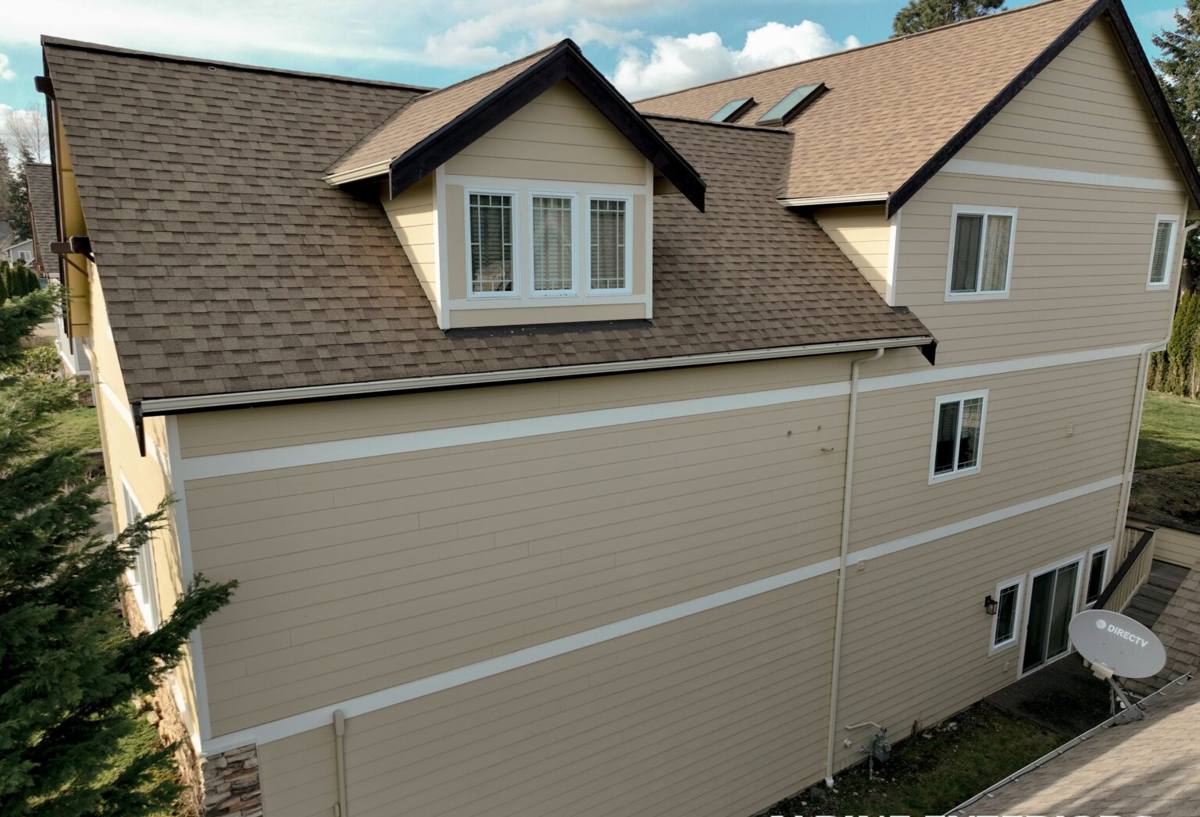
Signs a Ferndale Home Needs Replacement, Not Repair
Not every siding problem calls for a full tear-off. But there are signs that patching is just delaying a bigger bill.
Moisture-related red flags
- Soft or spongy spots when you press on the siding, especially near the bottom courses
- Persistent moss or algae growth that returns within weeks of cleaning
- Paint that bubbles, peels, or won't hold no matter how often it's redone
- Visible warping, cupping, or separation at seams and corners
- Musty smell or staining on interior walls that share an exterior wall with problem siding
Age and material red flags
If the siding is original to a home built more than 20-25 years ago, or if it's a wood-based composite product from the 1990s or early 2000s, replacement is often more cost-effective than continuing to chase repairs. Older products in this category were more vulnerable to moisture intrusion than what's manufactured today, and Whatcom County's climate has had decades to work on them.
What Correct Siding Replacement Involves
A siding replacement is only as good as what happens underneath it. The visible product is the last step, not the first.
Full tear-off and sheathing inspection
Removing the old siding down to the sheathing is the only way to find hidden rot, damaged framing, or existing moisture problems. Any compromised sheathing gets replaced before anything new goes up — covering over a problem just locks it in.
Weather-resistive barrier and flashing
A correctly lapped weather-resistive barrier, properly integrated window and door flashing, and rain screen or drainage gap detailing where called for are what actually keep driving rain out of the wall assembly. This step matters more in Ferndale than in a drier inland climate, because wind-driven rain off the water tests these details harder and more often.
Fastening and clearances
Fiber cement siding has a manufacturer-specified fastening pattern, and getting it wrong — over-driven nails, wrong fastener spacing, missing clearances from grade, decks, and roof lines — is one of the most common causes of early failure on an otherwise good product. Ground clearance and trim gaps also matter for keeping moss and standing moisture away from the bottom edge of the siding.
Why We Only Install James Hardie Fiber Cement
We install James Hardie exclusively, and in a climate like Whatcom County's, that's a deliberate call rather than a brand preference. Fiber cement is non-combustible, doesn't feed moss growth the way wood-based products can, and holds its shape and finish through repeated wet-dry cycles far better than materials that rely on paint film alone for protection.
HZ5 engineering for this climate
James Hardie manufactures its products in climate-specific formulations, and the HZ5 line is engineered for regions with significant moisture exposure — which describes most of western Washington and certainly a bay-adjacent community like Ferndale. That engineering affects how the board resists moisture absorption and how it holds up under the freeze-thaw and wet-cycle stress this area sees.
ColorPlus factory finish
Rather than relying on field-applied paint, ColorPlus finishes are baked on at the factory in multiple coats, which gives a harder, more consistent finish than most site-applied paint jobs. In a salt-air environment, a factory finish holds up longer before it needs attention, which matters directly for maintenance cost over the life of the siding.
Warranty backing
James Hardie backs its products with a transferable warranty, which adds real value if a Ferndale home changes hands — a buyer inheriting a Hardie-sided home inherits a warranty, not a maintenance question mark.
What We Don't Install, and Why
We don't install vinyl, LP SmartSide, cedar, primed spruce, Cemplank, or Allura. Each of those has legitimate uses and each has real trade-offs — vinyl can warp and fade under UV and thermal cycling, wood-based composite products carry more moisture sensitivity than fiber cement, and cedar requires an ongoing maintenance commitment that most homeowners underestimate when they choose it. In a climate that stacks salt air, driving rain, and moss season on top of each other, we've made fiber cement our standard because it holds up to that combination with the least amount of ongoing intervention. That's a professional judgment call on our part, not a claim that other products can't perform in the right setting.
Our Replacement Process
- On-site assessment — we look at the current siding, the wall assembly where accessible, and any moisture history before recommending replacement over repair.
- Tear-off and inspection — old siding comes off, sheathing and framing get inspected, and any damage is documented and addressed before moving forward.
- Weather barrier and flashing installation — the moisture management layer goes in correctly, with attention to window, door, and roofline transitions.
- James Hardie installation — installed to manufacturer fastening specs and clearance requirements, not shortcuts.
- Trim, caulking, and finish detail — the details that keep water out over the long run, not just on install day.
- Final walkthrough and cleanup — job site cleared, work reviewed with the homeowner before we consider it done.
Cost Factors for Ferndale Siding Replacement
| Factor | Why It Matters | Ferndale-Specific Consideration |
|---|---|---|
| Home size and wall complexity | More square footage and more corners, dormers, and trim mean more labor and material | Standard across the region |
| Sheathing condition | Hidden rot found during tear-off adds repair scope | More likely on older homes with a history of moisture exposure near the bay |
| Siding profile and accessories | Lap width, trim style, and corner details affect material cost | Homeowner preference, no climate impact |
| Access and site conditions | Tight lots, landscaping, and multi-story sections affect labor time | Common in established Ferndale neighborhoods |
| Moss and moisture remediation | Existing growth or trapped moisture may need cleanup before install | More common given the area's moss season |
Why a Local Crew Matters
A crew that already works Ferndale and greater Whatcom County knows the permitting process with the local jurisdiction, knows what wind and rain exposure a given lot orientation typically sees, and isn't learning the region's climate behavior on your project. That familiarity shows up in small decisions — where to add extra flashing attention, which sides of a home take the worst weather, how much ground clearance actually holds up here — that a crew unfamiliar with the area might not think to apply. It also means warranty follow-through is realistic: a local company is still local next year if a question comes up.
What to look for when hiring
- Manufacturer training or certification on the specific product being installed
- A clear explanation of tear-off and moisture barrier steps, not just "we'll put up new siding"
- References or examples of work in the same climate zone
- A written scope that specifies fastening method and clearances
- Clarity on who handles warranty claims if an issue comes up down the road
Maintenance After Replacement
Correctly installed James Hardie siding is low-maintenance, not no-maintenance. In Ferndale's climate, that means periodic gentle washing to keep salt residue and moss spores from building up, checking caulking at trim and penetrations every couple of years, and keeping gutters clear so water isn't sheeting down the wall face. None of this is heavy lifting compared to what wood-based or vinyl siding demands here, but a five-minute look during fall gutter cleaning goes a long way toward getting the full life out of the investment.
If your Ferndale home's siding is showing its age or you're just weighing repair against replacement, we're happy to take a look and give you a straight, no-pressure estimate. Use the form below to get started.