 Whatcom County
 Why Sunnyland's Climate Is Hard on Siding
Sunnyland sits close enough to Bellingham Bay that homes here deal with a combination most siding products were never designed for: salt-laden air rolling in off the water, long stretches of driving rain through fall and winter, and a moss season that can run eight months or more under the tree cover common to this part of Whatcom County. Any one of those on its own is manageable. Together, they punish siding that isn't dimensionally stable, doesn't shed water the right way, or can't stand up to constant moisture without swelling, rotting, or feeding mold and algae growth.
Wood-based products absorb moisture at cut edges and fastener holes, which is exactly where Sunnyland's rain finds a way in. Vinyl expands and contracts with temperature swings and can warp or crack over time, and it does nothing to slow moss and algae from taking hold in shaded, damp yards. Fiber cement, installed correctly, resists all three problems at once — it doesn't rot, it holds paint and factory finish far longer in salt air, and its surface doesn't give moss and mildew the organic material they need to spread.
What "Correct" Fiber Cement Installation Actually Means Here
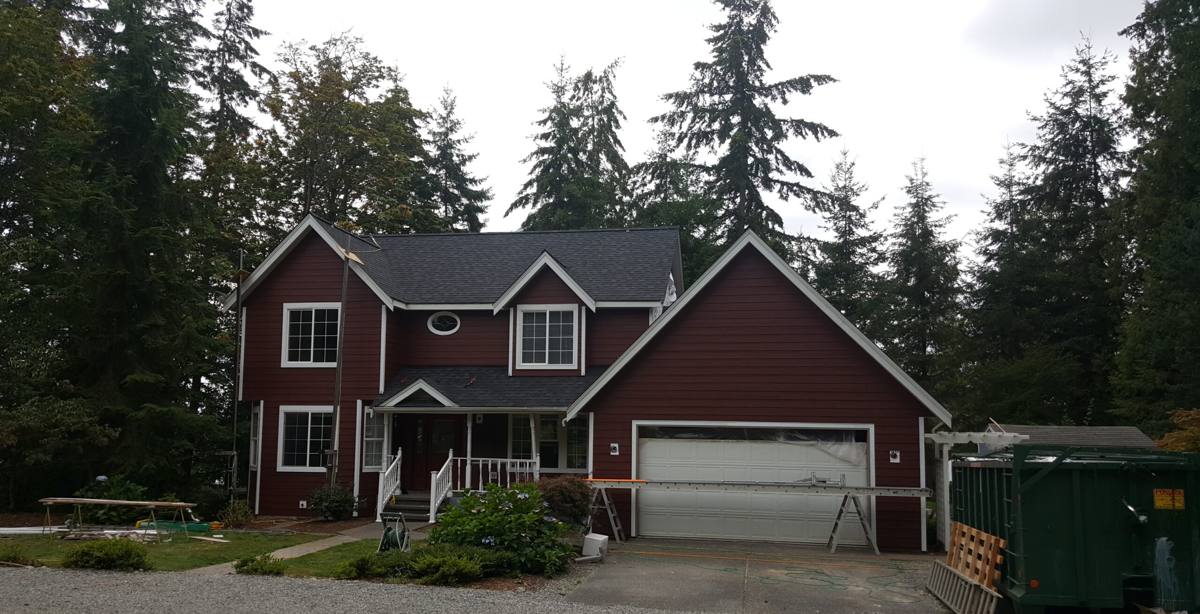
Fiber cement siding is only as good as its installation. The board itself is engineered to handle Pacific Northwest weather, but a rushed or generic install — the kind that ignores local conditions — can undercut all of that. In Sunnyland, a correct install means:
- Proper water-resistive barrier and flashing at every window, door, and penetration, lapped so water is directed out and down, never trapped behind the siding.
- Correct clearances — siding held up from grade, decks, and roof lines per manufacturer spec, so splash-back and standing water don't sit against the bottom edge.
- Factory-cut and sealed edges wherever possible, since a cut edge that isn't primed or caulked is where moisture gets in first.
- Correct fastener pattern and depth — over-driven or under-driven nails crack the board or leave gaps that let water track behind it.
- Rain-screen or drainage gap detailing where the wall assembly calls for it, so any moisture that does get past the siding has somewhere to go instead of sitting against the sheathing.
Skip any one of these and you don't get a "slightly worse" result — you get trapped moisture behind a wall that looks fine from the street for a year or two before the problems show up as stains, soft spots, or paint failure.
Joints, Caulking, and Paint Lines
Butt joints and trim intersections are the most common failure points on any siding job, and they're where driving rain does the most damage over time. We back-caulk joints with a quality sealant rated for exterior movement, and on ColorPlus-finished boards we use touch-up product matched to the factory finish rather than generic paint, so the joint doesn't become a visibly different color or a weak point five years down the road.
James Hardie Products and the HZ5 Climate Zone
We install James Hardie fiber cement exclusively, and the reason is straightforward: it's the product line that's actually engineered for zones like Whatcom County. Hardie's HZ5 formulation is built for regions with sustained damp weather and freeze-thaw cycles, which describes a Sunnyland winter well. That's different from a siding product engineered as a one-size-fits-all national offering.
| Hardie Product | Common Use | Why It Fits Sunnyland |
|---|---|---|
| HardiePlank lap siding | Primary wall cladding | Most common choice; holds ColorPlus finish well in salt air and rain |
| HardieShingle | Accent gables, dormers | Resists moss buildup better than cedar shingle in shaded lots |
| HardiePanel | Modern/vertical siding, porch ceilings | Clean lines, low maintenance in damp coastal air |
| HardieTrim | Corners, window/door trim, fascia | Won't rot or split the way wood trim does under constant moisture |
We also specify factory-applied ColorPlus finish over field-painted siding whenever it fits the project. ColorPlus is baked on and backed by its own finish warranty, which matters in a climate where a field-applied paint job is fighting rain and humidity before it's even fully cured.
Why We Only Install James Hardie
We get asked why we don't also offer LP SmartSide, vinyl, or one of the other fiber cement alternatives on the market. The honest answer is that we standardized on one product so we can be genuinely expert installers of it, and so every warranty, every color match, and every maintenance answer we give a homeowner is consistent. Other products have real strengths — LP SmartSide is lighter and easier to handle on some crews, vinyl is inexpensive up front — but in a climate like this one, the trade-offs (engineered-wood moisture sensitivity, vinyl's limited lifespan and fading) aren't ones we're willing to put on a Sunnyland home and stand behind for the long run. James Hardie's non-combustible composition, factory finish options, and track record in wet coastal climates are why it's the only product line we put our name on.
Our Process on a Sunnyland Project
1. Site Walk and Assessment
We look at more than square footage. Tree cover, exposure to weather off the bay, existing moisture damage, and how the current siding was flashed all shape the plan before we quote anything.
2. Tear-Off and Sheathing Check
Once old siding comes off, we inspect the sheathing underneath. In a climate this wet, it's common to find soft spots or old water staining behind siding that looked fine from the outside — we address that before anything new goes up, not after.
3. Water-Resistive Barrier and Flashing
This step is where most long-term siding failures actually start, and it's also the least visible once the job is done. We treat it as non-negotiable.
4. Installation to Manufacturer Spec
Fastener pattern, clearances, and joint treatment are done to James Hardie's published installation guidelines, not a generalized approach carried over from other products.
5. Final Detailing and Walkthrough
Caulking, touch-up, trim, and a walkthrough so the homeowner understands what was done and what basic upkeep looks like going forward.
What Drives Cost on a Sunnyland Fiber Cement Job
Every home is different, but the same handful of factors move the price up or down on most Sunnyland projects:
| Factor | Why It Matters |
|---|---|
| Existing siding removal | Multiple layers or damaged sheathing add labor and repair time |
| Home shape and trim detail | More corners, gables, and window trim mean more cuts and flashing work |
| Product line and finish | ColorPlus factory finish vs. field-painted changes material and labor cost |
| Access and site conditions | Tight lots, slopes, and mature landscaping near the house affect setup and staging |
| Moisture repair needed | Rot or water damage found during tear-off is addressed before new siding goes on |
We give a firm number after the site walk, not a phone estimate — too many of these factors can't be judged accurately without seeing the house.
Living With Fiber Cement Siding in This Climate
One of the real advantages of switching to James Hardie in a place like Sunnyland is how little upkeep it asks for compared to wood or engineered-wood alternatives. It won't rot, it doesn't need repainting on the schedule wood trim does, and it holds up to the rinse-and-repeat cycle of rain and salt air far longer. That said, "low maintenance" isn't "no maintenance" — a rinse-down once or twice a year keeps moss spores and grime from building up in shaded areas, and it's worth a quick look at caulked joints and trim intersections every year or two, the same way you'd check any exterior finish.
Simple Homeowner Checklist
- Rinse siding with a garden hose (not a pressure washer on high) once or twice a year, especially on shaded, moss-prone walls
- Check caulked joints and trim seams annually for cracking or separation
- Keep gutters clear so overflow isn't running down the siding face
- Trim back vegetation and tree limbs that keep siding damp and shaded longer than necessary
- Touch up any chipped paint or finish promptly rather than letting it sit exposed through a wet season
Why Hiring a Crew That Already Works in Sunnyland Matters
Siding installation standards don't change by neighborhood, but the conditions a crew needs to plan around do. A crew that regularly works Whatcom County homes already knows to check for the moisture patterns that show up under mature tree cover, plans installation around realistic weather windows instead of guessing, and understands how salt air affects fastener choice and finish longevity over years, not just at handoff. That local pattern-recognition is the difference between a siding job that looks right on installation day and one that's still performing correctly in year ten.
It also matters for something less visible: permitting and inspection familiarity. Contractors who work regularly in this area know what local building departments expect to see documented, which keeps a project moving instead of stalling on paperwork.
Get a Straight Answer for Your Home
If your Sunnyland home's siding is showing moss staining, chalky or fading paint, soft spots near the bottom edge, or you're just planning ahead before the next wet season, we're happy to take a look and give you an honest read on what it needs. Reach out for a free, no-pressure estimate — we'll walk the exterior with you and tell you plainly what we'd recommend, and why.