 Whatcom County
 Why Barkley Siding Has to Work Harder Than the Manual Says
Barkley sits close enough to Bellingham Bay that salt-laden air is a daily fact of life on the exterior of a house, not an occasional nuisance. Add the driving rain that rolls in off the Sound most of the year and a moss season that can stretch from late fall well into spring, and you have three separate stressors working on the same wall assembly at once. Most siding products are engineered for one climate condition. Whatcom County routinely delivers all three together, and that combination is exactly what separates a siding job that looks fine for two years from one that still looks right after fifteen.
Salt air accelerates corrosion on anything metal — fasteners, flashing, trim screws — long before it does visible damage to the siding face itself. Driving rain doesn't just wet a wall, it pushes moisture sideways and upward under laps, seams, and trim edges that were never meant to shed water uphill. And moss and algae don't need standing water to take hold; they need shade, moisture, and time, all three of which Barkley's tree cover and marine-layer humidity provide in abundance. A siding system that isn't built for this combination will show it first at the seams, the corners, and anywhere water gets a chance to sit.
What James Hardie Siding Is Built to Handle
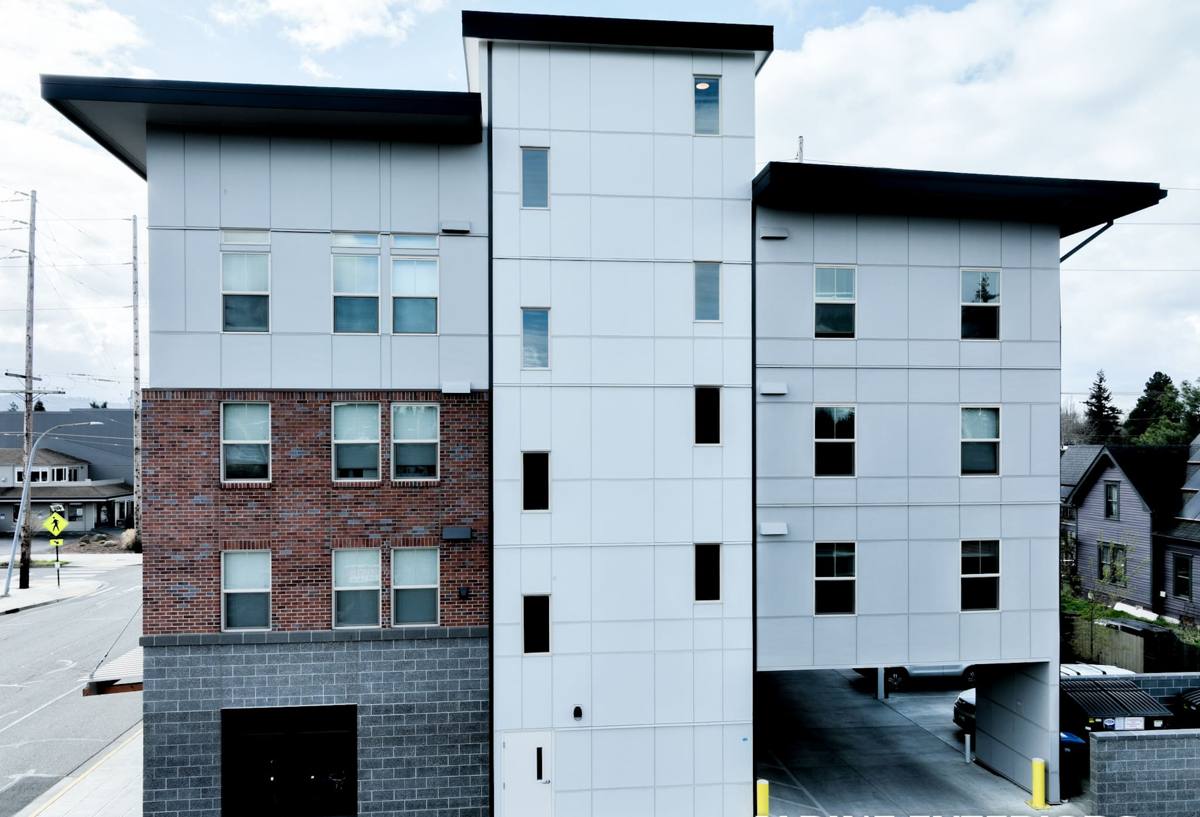
James Hardie fiber cement is engineered in region-specific formulations, and the HZ5 product line used throughout the Pacific Northwest is built around exactly the conditions Barkley deals with: sustained moisture exposure, freeze-thaw cycling, and biological growth. The fiber cement core doesn't absorb and swell the way wood-based siding does, which matters enormously here because swelling is what eventually pops fasteners, cracks paint lines, and opens gaps for moss to colonize.
The factory-applied ColorPlus finish is the other half of the equation. It's baked on under controlled conditions rather than brushed or sprayed on-site, which gives it a harder, more uniform surface that sheds water and resists the kind of chalking and fading that lets moss and mildew get a foothold on a painted surface. It's also non-combustible, which isn't a Whatcom County-specific concern in the way moisture is, but it's part of why we standardized on it across every job we do.
None of that is marketing — it's the reason the product holds up under exactly the kind of weather Barkley sees most months of the year. But the product only performs to that standard if it's installed to spec, which is the part most homeowners never get told about.
Choosing the Right Hardie Product for a Barkley Home
Barkley's housing stock runs from established single-family homes to newer construction with more contemporary lines, and the right Hardie profile depends on the style of the house as much as the climate. Here's how the main product lines compare for this area:
| Product | Best Fit | Climate Notes for Whatcom County |
|---|---|---|
| HardiePlank Lap Siding | Traditional and craftsman-style homes | Overlapping laps shed driving rain well when installed with correct exposure and gapping |
| HardiePanel Vertical Siding | Contemporary homes, accent walls, gable ends | Fewer horizontal seams means fewer places for wind-driven rain to find an entry point |
| HardieShingle | Cottage and craftsman detailing | More surface texture holds moisture briefly longer; benefits most from a properly vented rain screen |
| Board and Batten | Modern farmhouse and transitional styles | Vertical battens need tight, consistent flashing at every seam to perform in sustained rain |
We walk every Barkley property before recommending a profile — the right choice depends on the home's orientation to prevailing rain and wind, how much tree cover shades the walls, and what's already on the house.
What a Correct Installation Actually Involves
James Hardie's own installation manual is specific and detailed for a reason: fiber cement performs exactly as well as it's installed, no better. In a climate like Whatcom County's, the margin for error is smaller than it would be somewhere dry.
The details that matter most here
- A drainage gap (rain screen) behind the siding so any moisture that gets past the cladding has somewhere to go besides the sheathing
- Correct fastener type, spacing, and depth — over-driven or under-driven nails are one of the most common warranty-voiding mistakes we find on older installs
- Proper flashing at every window, door, roofline, and butt joint, not caulk substituted for flashing
- Kickout flashing at roof-to-wall intersections, which is small, easy to skip, and one of the most common sources of hidden rot we find on inspections
- Minimum clearance from grade, decks, and roof lines so the bottom edge of the siding never sits in standing water or snow
- Factory-cut and factory-primed edges wherever possible, with any field cuts sealed per Hardie's spec
Every one of these is boring to explain and easy to skip. Every one of them is also exactly what determines whether a wall stays dry for thirty years or starts showing problems in five.
Where sealant fits — and where it doesn't
Caulk has a real job in a Hardie installation, but it's a secondary line of defense, not the primary one. Flashing should be doing the actual work of directing water away from the wall assembly; caulk is there to close small gaps, not to compensate for missing or undersized flashing. A wall that relies on caulk to stay dry will eventually fail once that bead ages, shrinks, or gets pulled apart by the building's normal seasonal movement — and in a climate this wet, that failure shows up faster than it would somewhere with less rain.
Mistakes We Routinely Fix in Whatcom County
A large share of the calls we get in and around Barkley aren't for new siding — they're for repairing or replacing siding that was installed within the last decade but wasn't installed correctly for this climate. The patterns repeat:
- No rain screen gap, so the siding was fastened directly to the weather barrier with no drainage path
- Missing or undersized kickout flashing where a roofline meets a wall, leading to hidden rot behind the siding at that corner
- Caulk used in place of proper flashing around windows and trim
- Fasteners driven too far or at the wrong spacing, which telegraphs through the finish and creates stress points where moisture collects
- ColorPlus finish painted over after installation, which voids the factory finish warranty and is rarely necessary if the color was chosen correctly to begin with
None of these are exotic problems. They're all things covered plainly in Hardie's own installation guidelines. They just require a crew that follows them on every job, not just the ones someone happens to be watching.
Our Process on a Barkley Job
- On-site assessment. We look at the existing siding, sheathing, and trim, check for hidden moisture damage, and note the home's exposure to prevailing wind and rain.
- Tear-off and sheathing check. Old siding comes off and we inspect the sheathing underneath before anything new goes up — this is where we find problems a homeowner usually can't see from outside.
- Weather-resistive barrier and rain screen. A code-compliant barrier goes on first, followed by a proper drainage gap behind the new siding.
- Flashing. Windows, doors, rooflines, and all penetrations get flashed to spec before siding installation begins.
- Hardie installation. Panels or planks go up per James Hardie's fastening schedule and exposure requirements for our climate zone.
- Trim, caulk, and touch-up. Final trim work and any factory-matched touch-up are completed to Hardie's finish standards.
- Final walkthrough and warranty registration. We walk the job with you and register the installation so the manufacturer warranty is active.
What It Costs — and What Drives the Number
Every Barkley home is different, so we won't put a number on this page that doesn't apply to your house. What we can tell you is what actually moves the price up or down:
| Factor | Why It Matters |
|---|---|
| Home size and wall area | The most direct driver of material and labor cost |
| Condition of existing sheathing | Rot or damage found during tear-off adds repair scope before new siding can go on |
| Home style and trim detail | More corners, gables, and trim transitions mean more cutting, flashing, and labor time |
| Product mix | Combining lap siding with shingle accents or board-and-batten sections adds complexity versus a single profile |
| Story height and access | Two- and three-story walls require more scaffolding or lift time than single-story walls |
We give every Barkley homeowner a written estimate based on an actual walk of the property, not a phone-quote guess.
Why Hiring a Crew That Already Works Barkley Matters
A crew that's worked houses throughout Barkley and the surrounding Whatcom County area already knows what this climate does to a wall assembly over time — where moss tends to build up first, which wall orientations take the worst of the driving rain, and how salt air off the Bay affects fastener choice and flashing longevity. That's not something you can pick up from a manual; it comes from having pulled bad siding off local homes and seen exactly where it failed. It also means straightforward, honest answers on permitting and scheduling instead of a learning curve at your expense.
We install James Hardie fiber cement exclusively — not vinyl, not LP SmartSide, not cedar or primed wood — because it's the product we trust to hold up to what this climate does to a house, and because a single-product focus means our crews install it the same correct way on every job, not a different way depending on what material they're working with that week.
If you're weighing a siding project on your Barkley home, we're happy to walk the property, take a real look at what's there now, and put together a written estimate with no pressure and no obligation.